
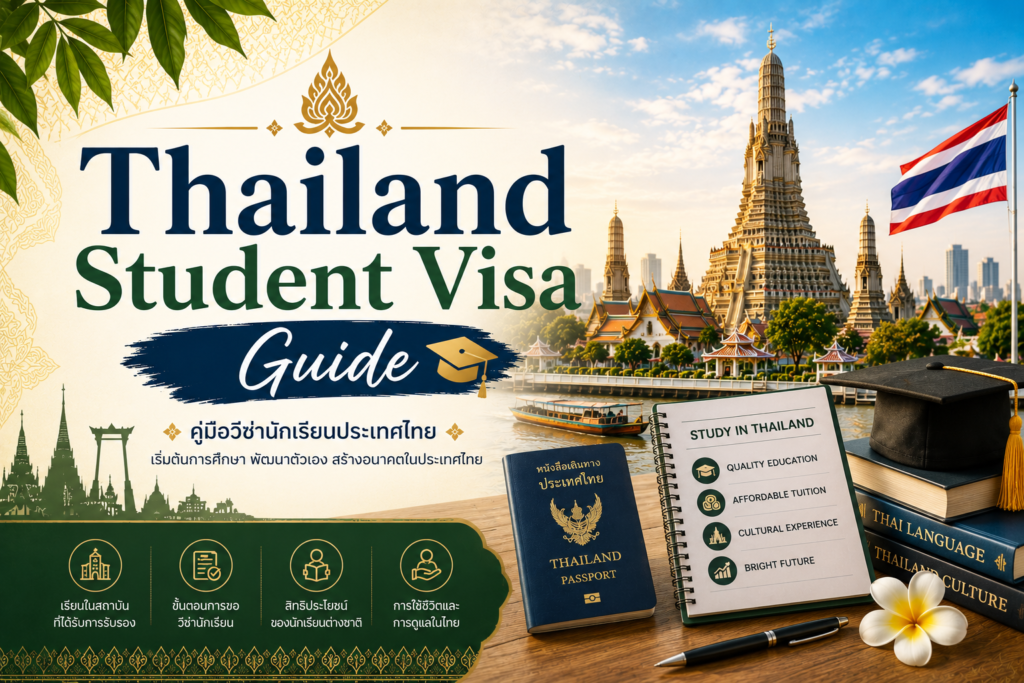
Thailand Student Visa Guide: ED Visa Requirements, Documents, School Support, Extensions, and Common Mistakes
You found a language school in Bangkok, a university program in Chiang Mai, or a Muay Thai course in Phuket — and now you want to stay in Thailand legally while studying. Then the questions begin: Which visa do you need? Can you work while studying? Does attendance matter? How often do you need to extend?
A Thailand Student Visa is commonly issued under the Non-Immigrant ED Visa category for foreigners who want to study, attend training, join seminars, undertake internships, or participate in approved educational activities in Thailand.
From our visa handling experience, many student visa problems do not start with the student’s passport. They start with weak school support, unclear course documents, poor attendance planning, or choosing a program that does not properly support the visa process.
What Is a Thailand Student Visa?
The main route is usually the Non-Immigrant ED Visa
The Thailand Student Visa is commonly connected to the Non-Immigrant ED Visa. It is used for approved education-related purposes such as university study, language courses, internships, seminars, training, Buddhist studies, and certain educational activities.
| Study Purpose | Possible ED Visa Use | Practical Caution |
|---|---|---|
| University study | Degree, exchange, or formal academic program | University documents must match the visa application |
| Language course | Thai or English language study where supported | Attendance and school legitimacy can matter |
| Internship / training | Curricular internship, seminar, workshop, or approved training | Purpose must be educational, not disguised employment |
Official sources to check before applying
Visa rules, school eligibility, document requirements, and extension procedures can change. You can check the latest information from the Ministry of Foreign Affairs of Thailand, the official Thai e-Visa website, and the Royal Thai Embassy or Consulate responsible for your application location.
Thailand Student Visa Requirements
The school matters almost as much as the student
A strong ED Visa application usually depends on both the applicant and the educational institution. The school should be able to issue proper acceptance documents, registration evidence, course details, schedule, and extension support where needed.
From real client cases, students often choose the cheapest school first and ask visa questions later. This can be risky if the school cannot prepare correct Immigration documents or support future extensions.
| Requirement Area | What to Check | Common Mistake |
|---|---|---|
| School eligibility | Can the school support ED Visa documents? | Paying tuition before checking visa support |
| Study purpose | Does the course match an educational purpose? | Using ED Visa mainly as a long-stay solution |
| Student documents | Passport, photo, financial proof, education history | Submitting unclear or mismatched personal documents |
Thailand Student Visa Documents Checklist
Your documents should prove genuine study
A good ED Visa file should clearly answer: who is studying, where they will study, what course they will join, how long the course lasts, how they will support themselves, and whether the school can support the visa process.
| Document | Why It Matters | Practical Tip |
|---|---|---|
| Passport | Confirms identity and travel eligibility | Keep enough validity for visa and extension planning |
| Acceptance letter | Confirms educational purpose | Letter should show course name, dates, student name, and school details |
| School registration documents | Supports institution legitimacy | Request updated copies from the school |
| Course schedule | Shows real study structure | Useful for language, Muay Thai, training, and short courses |
| Financial evidence | Shows ability to support stay | Use clear bank statements, not cropped screenshots |
| Education history | Supports academic background where required | Prepare transcripts or certificates if requested |
How to Apply for a Thailand Student Visa
Step 1: Choose the right school or program
Start by confirming whether the school regularly supports ED Visas, how extensions are handled, what documents the school provides, and whether attendance is monitored.
Step 2: Get school acceptance documents
The school usually prepares the acceptance letter, enrollment confirmation, school registration documents, course details, class schedule, and approval documents where required.
Step 3: Prepare your personal documents
Prepare passport, visa application form, recent photo, financial proof, residence proof, education records, travel plan, and parental documents for minors where relevant.
Step 4: Apply through the correct channel
Depending on your location, the application may be submitted through a Royal Thai Embassy, Royal Thai Consulate-General, or the official Thai e-Visa system.
Step 5: Enter Thailand and check your entry stamp
After arrival, check the admitted-until date immediately. Visa validity and permission to stay are not the same.
Step 6: Coordinate extensions with the school
Many student visa holders need extensions during the study period. The school may need to issue updated enrollment letters, attendance records, payment evidence, or study progress documents.
Step 7: Maintain Immigration compliance
Track extension dates, attendance, school enrollment, re-entry permit needs, address reporting, and 90-day reporting where applicable.
ED Visa vs Tourist Visa vs Work Visa
Choose based on your real purpose
A Thailand Student Visa should match a real educational purpose. If the real purpose is tourism, employment, remote work, or long-term stay without study participation, another visa route may be more appropriate.
| Visa Type | Main Purpose | Work Allowed? | Common Mistake |
|---|---|---|---|
| Non-Immigrant ED | Education and study | Not automatically | Using it as a stay solution without real study |
| Tourist Visa | Tourism and travel | No | Trying to study long-term under tourist status |
| Non-B / Work Visa | Employment or business route | With proper work authorization | Confusing employment with education stay |
| DTV | Remote work, soft power, certain activities | Depends on category and rules | Assuming DTV and ED are the same |
Attendance, Extensions, and School Support
The visa process continues after approval
Many ED Visa holders do not receive one long approval immediately. The process may involve periodic Immigration extensions, updated school documents, attendance confirmation, and ongoing enrollment checks.
From real student cases, the smoothest long-term stays usually happen when the student treats the visa as part of a real educational commitment — not only as a stay solution.
| Ongoing Item | Why It Matters | Practical Tip |
|---|---|---|
| Attendance | May support genuine study and extension | Attend consistently and keep records if possible |
| Enrollment status | Shows the student remains active | Do not disappear from school until extension week |
| Extension documents | Required for longer stay | Ask the school how early documents are prepared |
Approved Case vs Delayed Case: What Made the Difference?
From real client cases, school quality and document timing matter most
| Topic | Delayed or Risky Case | Stronger Case |
|---|---|---|
| School support | School provides unclear or late documents | School regularly supports ED Visa and extensions |
| Study purpose | Course chosen only to stay longer | Study purpose is clear and matches applicant background or plan |
| Attendance | Student rarely attends and cannot support active study | Attendance and enrollment records support genuine study |
| Travel planning | Leaves Thailand during extension period without checking re-entry permit | Re-entry permit is checked before international travel |
Common Thailand Student Visa Mistakes
1. Choosing a school only because it is cheap
Low tuition does not always mean strong visa support. The school’s Immigration experience can be more important than the course price.
2. Assuming attendance does not matter
Attendance and genuine study participation can affect future extension support. Treat the course as a real educational commitment.
3. Waiting too long before extension renewal
School documents, attendance records, holidays, and Immigration schedules can delay the process. Prepare early.
4. Working without proper authorization
A student visa does not automatically allow employment. If you want to work, check the correct work authorization route first.
5. Leaving Thailand without a re-entry permit
If you leave during an extension period without the correct re-entry permission, your stay permission may be affected.
6. Changing schools without checking Immigration impact
An ED Visa is often connected to the institution supporting it. If you withdraw, stop studying, or transfer schools, check the visa impact first.
7. Ignoring 90-day reporting
Long-term student stays may involve 90-day reporting. This is separate from visa extension renewal.
Thailand Student Visa Checklist
| Item | Why It Matters | Practical Tip | Done |
|---|---|---|---|
| Passport | Confirms identity and travel eligibility | Keep long validity | ☐ |
| School acceptance letter | Confirms educational purpose | Verify official signatures and course dates | ☐ |
| School registration documents | Supports institution legitimacy | Request updated copies | ☐ |
| Visa application form | Main visa record | Match passport details carefully | ☐ |
| Financial evidence | Shows ability to support stay | Keep documents clear and recent | ☐ |
| Study plan or course details | Explains educational purpose | Useful for language and specialty programs | ☐ |
| Attendance records | Supports extension renewals | Attend classes consistently | ☐ |
| Re-entry permit | Protects stay during travel | Check before leaving Thailand | ☐ |
| 90-day reporting | Required for long-term stay where applicable | Track separately from extensions | ☐ |
Summary: Thailand Student Visa
Key points to remember:
- Thailand Student Visas are commonly issued under the Non-Immigrant ED category.
- ED Visa can support study, training, seminars, internships, and approved educational activities.
- The school or institution plays a major role in the process.
- School documents, acceptance letters, course details, and registration evidence are important.
- Attendance and active study participation may matter for extensions.
- A student visa does not automatically allow employment in Thailand.
- Changing schools can affect your visa situation.
- Re-entry permits may be needed before leaving Thailand during an extension period.
- Long-term students may need 90-day reporting.
- Always check the latest official requirements before applying or extending.
Let Co Journey Visa help prepare your Thailand Student Visa application
A strong ED Visa case should make your study purpose easy to understand: why you are studying, where you will study, how long the course lasts, whether the school can support the visa, and how you will maintain compliance after arrival.
ทำไมควรให้ Co Journey Visa ช่วยดูแลวีซ่าของคุณ
การขอ Thailand Student Visa อาจมีขั้นตอนที่ซับซ้อนและต้องการความแม่นยำในการเตรียมเอกสาร หากคุณไม่ต้องการให้เกิดความผิดพลาดและต้องการความสะดวกสบายในการดำเนินการ Co Journey Visa พร้อมให้บริการช่วยเหลือคุณในทุกขั้นตอน:
Frequently Asked Questions About Thailand Student Visa
What is a Thailand Student Visa?
A Thailand Student Visa is commonly issued under the Non-Immigrant ED category for foreigners studying or participating in approved educational activities in Thailand, such as university study, language courses, training, seminars, or internships.
Can I work on a Thailand Student Visa?
No, not automatically. A student visa is for education purposes. If you want to work in Thailand, you should check the proper work authorization route before starting any activity.
How long can I stay on a Thailand ED Visa?
The stay period depends on the visa issued, Immigration approval, course length, and extension structure. Many students receive extensions during their study period rather than one long approval immediately.
Does attendance matter for a Thailand Student Visa?
Yes, it can. Schools and Immigration may review whether the student is genuinely participating in the educational program, especially when extensions are requested.
Can I study Thai language on a student visa?
Yes, Thai language schools are commonly associated with ED Visa applications if the institution is properly prepared and supports the visa process.
What happens if I stop studying in Thailand?
If you leave the school, stop the program, or transfer, your visa situation may change. Check with the school and Thai Immigration before withdrawing or changing programs.
Do I need 90-day reporting on a student visa?
Long-term stay in Thailand may involve 90-day reporting depending on your situation and stay period. This is separate from extension renewal.
Can I travel outside Thailand during my studies?
Yes, but check whether you need a re-entry permit before leaving Thailand. Without it, your permission to stay may be affected.
หากคุณต้องการคำแนะนำเพิ่มเติมหรือต้องการให้ Co Journey Visa ดูแลการยื่นวีซ่าของคุณ ติดต่อเราได้เลย 24 ชั่วโมง
บทความที่เกี่ยวข้อง


ติดตามข้อมูลวีซ่าอัปเดตจาก Co Journey Visa
เพิ่มเว็บไซต์นี้เป็นแหล่งข้อมูลที่ต้องการใน Google เพื่อให้ค้นพบบทความจากเราได้สะดวกขึ้น