
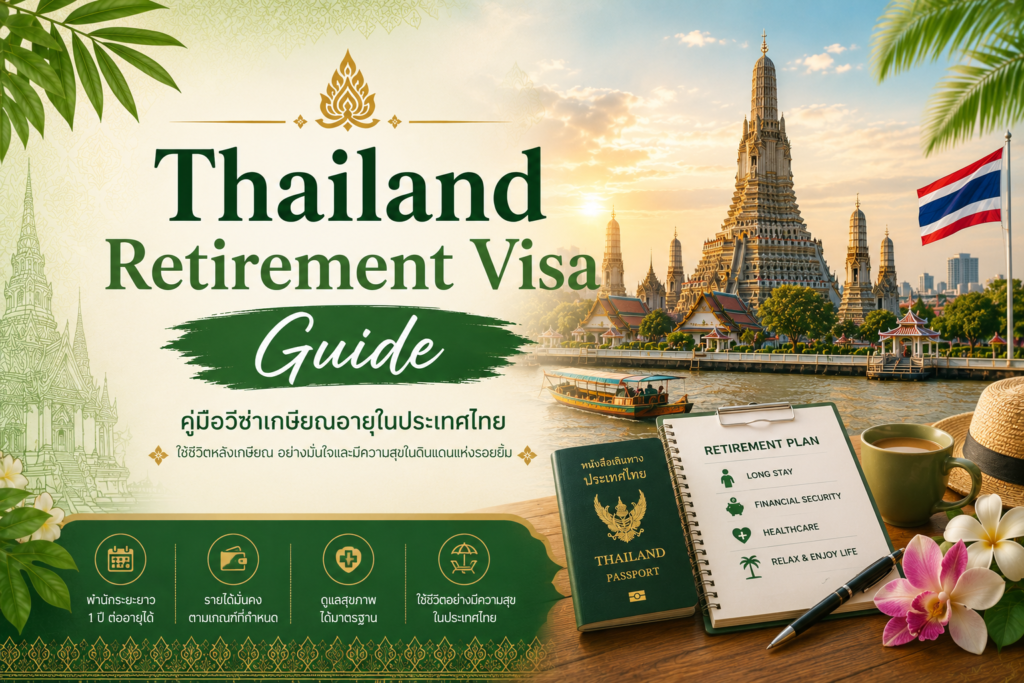
Thailand Retirement Visa Guide: Non-O, Non-OA, 800,000 THB Requirement, 90-Day Reporting, and Renewal Checklist
You love life in Thailand — the slower pace, warm weather, healthcare options, daily routine, and lower living costs — and now you want to stay longer without visa runs or constant flight planning. Then the retirement visa process starts, and suddenly you hear about Non-O, Non-OA, 800,000 THB, income proof, health insurance, 90-day reporting, and re-entry permits.
A Thailand Retirement Visa is commonly used by foreigners aged 50 or older who want to live in Thailand long-term for retirement purposes without working in Thailand. The most common routes involve a Non-Immigrant O or Non-Immigrant OA visa, followed by an extension of stay based on retirement.
From our visa handling experience, retirement visa problems rarely come from age alone. Most delays come from financial timing, bank letter mistakes, old documents, insurance confusion, re-entry permit issues, or misunderstanding the difference between visa validity and permission to stay.
What Is a Thailand Retirement Visa?
A long-stay route for foreigners aged 50 or above
“Thailand Retirement Visa” is a common nickname rather than one single official visa title. In practice, retirees often use a retirement-related Non-Immigrant visa first, then apply for an extension of stay through Thai Immigration.
Thailand’s Ministry of Foreign Affairs states that the Non-Immigrant O-A Long Stay visa may be issued to applicants aged 50 years and over who wish to stay in Thailand for a period not exceeding one year without the intention of working.
| Retirement Term | What It Usually Means | Practical Caution |
|---|---|---|
| Non-Immigrant O Retirement | A retirement-related entry route often used before extension | Often not the same as a full one-year stay from the first step |
| Non-Immigrant OA | Long-stay retirement visa usually applied for from abroad | Insurance and document rules may be more detailed |
| Retirement Extension | Extension of stay based on retirement through Thai Immigration | Financial timing and renewal discipline are critical |
Official sources to check before applying
Retirement visa rules, health insurance rules, financial requirements, and Immigration procedures can change. You can check the latest information from the Ministry of Foreign Affairs of Thailand, the Royal Thai Consulate-General Los Angeles retirement visa page, and the Thai Immigration Bureau 90-day reporting page.
Thailand Retirement Visa Eligibility
Age 50+ is the first filter, but not the only requirement
Thailand retirement-related visa routes are generally for foreigners aged 50 years or older. However, age alone does not complete the case. Retirees also need to show appropriate financial evidence, correct documents, valid stay status, and compliance with local Immigration procedures.
From real client cases, some applicants focus only on being over 50 and forget the financial timeline. Others prepare funds correctly but choose the wrong route for their current location or insurance situation.
| Eligibility Point | Why It Matters | Practical Tip |
|---|---|---|
| Age 50 or above | Basic retirement-route eligibility | Prepare passport biodata page clearly showing date of birth |
| No intention to work | Retirement routes are for retirement, not employment | If you plan to work, review a work authorization route instead |
| Financial evidence | Core proof for long-term stay | Plan bank timing months ahead, not days ahead |
| Insurance where required | Some routes, especially OA-related cases, may involve health insurance | Check the embassy checklist before buying a policy |
Thailand Retirement Visa Financial Requirement
800,000 THB, monthly income, or combination method
Financial proof is one of the most important parts of the retirement extension process. Retirement cases commonly involve one of these approaches: 800,000 THB in a Thai bank account, qualifying monthly income, or a combination method using income and savings.
From practical retirement cases, the biggest problem is not always insufficient money. It is timing. Bank letters, passbook updates, deposit periods, balance maintenance, and statement dates can all matter.
| Financial Method | Typical Structure | Practical Concern |
|---|---|---|
| Bank Deposit | 800,000 THB in a Thai bank account | Timing, account ownership, balance maintenance, bank letter, and passbook update |
| Monthly Income | Pension or qualifying regular income | Document acceptance can depend on current rules and office practice |
| Combination Method | Savings plus annualized income | Calculation and proof must be clear and accepted locally |
Non-O vs Non-OA Retirement Visa
Both can support retirement stay, but the process may differ
Non-O and Non-OA are both commonly discussed in retirement planning, but they are not identical. Non-O is often used as a retirement-based route that can lead to extension in Thailand. Non-OA is commonly associated with long-stay retirement applications from abroad.
| Topic | Non-Immigrant O Retirement | Non-Immigrant OA Long Stay |
|---|---|---|
| Common use | Retirement-based stay and extension route | Long-stay retirement route often applied from abroad |
| Age | Generally 50+ | Generally 50+ |
| Stay concept | Often starts with shorter stay before extension | MFA guidance refers to stay not exceeding 1 year |
| Insurance | Depends on current route and rules | Often more relevant in OA-related applications |
| Common mistake | Assuming first visa equals permanent stay | Underestimating insurance and document rules |
How to Apply for a Thailand Retirement Visa
Step 1: Choose the right retirement route
Start by deciding whether Non-O, Non-OA, or a retirement extension route fits your nationality, current location, insurance situation, and long-term stay plan.
Step 2: Prepare personal documents
Prepare passport, visa application form, recent photo, proof of current address, proof of retirement or pension where relevant, and any embassy-specific documents such as police clearance, medical certificate, or insurance evidence for OA-related applications.
Step 3: Prepare financial evidence early
If using the bank deposit route, prepare your Thai bank account and balance months before renewal. Keep bank statements, bank letters, updated passbook pages, pension records, and transfer records organized.
Step 4: Enter Thailand and check your stamp
After arrival, check your admitted-until date immediately. Visa validity and permitted stay are different. The entry stamp controls your stay period.
Step 5: Apply for extension of stay
Most long-term retirees eventually apply for an extension of stay based on retirement at Thai Immigration. Bring originals, signed copies, updated financial documents, passport pages, current visa pages, arrival stamp copies, residence evidence, and office-specific forms.
Step 6: Manage re-entry permit before travel
If you leave Thailand during your permitted stay, check whether you need a re-entry permit. Without it, your permission to stay may be affected.
Step 7: Track 90-day reporting
Thai Immigration states that notification of staying in the Kingdom over 90 days must be made within 15 days before or 7 days after the 90-day period expires. This is separate from annual extension and re-entry permit planning.
Thailand Retirement Visa Checklist
| Item | Why It Matters | Practical Tip | Done |
|---|---|---|---|
| Passport | Confirms identity and stay status | Copy biodata page, visa page, and entry stamp | ☐ |
| Retirement-eligible visa | Supports retirement purpose | Choose Non-O or Non-OA carefully | ☐ |
| Financial evidence | Core requirement for extension | Prepare months before renewal | ☐ |
| Thai bank account | Needed for many deposit-route cases | Maintain balance timing carefully | ☐ |
| Bank letter | Confirms account and balance | Ask how recent it must be at your office | ☐ |
| Updated passbook | Shows current balance and activity | Update before Immigration visit | ☐ |
| Pension or income proof | Supports income method | Use official and consistent records | ☐ |
| Insurance documents | May apply for some routes | Check before buying or renewing a policy | ☐ |
| Address proof | Supports local residence | Use rental contract, house documents, or office-accepted proof | ☐ |
| Re-entry permit | Protects stay permission during travel | Apply before leaving Thailand if needed | ☐ |
| 90-day reporting | Required for long-term stay | Track separately from annual renewal | ☐ |
90-Day Reporting, Re-Entry Permit, and Renewal Planning
The real retirement strategy is long-term maintenance
Many retirees focus only on the first visa. In reality, long-term retirement stay depends on maintaining requirements year after year. Annual extension, 90-day reporting, re-entry permit, bank timing, insurance, and address records all need separate attention.
| Process | What It Does | Common Mistake |
|---|---|---|
| Annual Extension | Renews retirement-based stay | Preparing financial documents too late |
| 90-Day Reporting | Reports address during long stay | Confusing it with visa renewal |
| Re-Entry Permit | Protects permission to stay when leaving Thailand | Leaving Thailand without checking re-entry needs |
Approved Case vs Delayed Case: What Made the Difference?
From real client cases, timing and organization matter most
| Topic | Delayed or Risky Case | Stronger Case |
|---|---|---|
| Financial timing | 800,000 THB deposited shortly before renewal | Bank balance prepared and maintained according to timing requirements |
| Bank documents | Bank letter date, passbook update, and balance do not match | Bank letter, statement, and passbook are aligned and recent |
| Travel planning | Leaves Thailand without checking re-entry permit | Re-entry permit is planned before international travel |
| Record keeping | Old extensions, TM forms, bank letters, and reports are scattered | Documents are organized year by year for easy review |
Common Thailand Retirement Visa Mistakes
1. Depositing the money too late
If using the bank deposit route, Immigration may check how long the funds have remained in the account. A last-minute deposit can create avoidable problems.
2. Confusing visa validity with stay permission
Visa validity and permitted stay are not the same. The entry stamp or extension date controls how long you may stay.
3. Forgetting the re-entry permit
Leaving Thailand without the correct re-entry permission can affect your permission to stay. Always check before international travel.
4. Using old financial documents
Bank letters, passbook updates, and statements may need to be recent. Ask your Immigration office how recent the documents must be.
5. Assuming all Immigration offices work exactly the same
Core rules are national, but document handling can vary. One office may ask for extra address proof, photos, map, or additional copies.
6. Working informally without checking rules
Retirement permission is not work authorization. If you plan to consult, teach, help a business, or work locally, review the correct work route.
7. Waiting until the final week to renew
Retirement renewals should be prepared early. Last-minute preparation is risky, especially when bank seasoning periods or insurance documents are involved.
Summary: Thailand Retirement Visa
Key points to remember:
- Thailand retirement visa routes are generally for foreigners aged 50 or older.
- Common routes include Non-Immigrant O, Non-Immigrant OA, and retirement-based extension of stay.
- A retirement visa does not automatically allow employment in Thailand.
- Financial proof is central, often involving 800,000 THB, monthly income, or a combination method.
- Financial timing can be as important as the amount itself.
- Some OA-related cases may involve health insurance requirements.
- Visa validity and permitted stay are different.
- Long-stay retirees must track 90-day reporting separately from annual extension.
- Re-entry permit planning is important before leaving Thailand.
- Always check the latest official requirements before applying or renewing.
Let Co Journey Visa help prepare your Thailand Retirement Visa case
A strong retirement visa plan is not only about entering Thailand. It is about maintaining your stay year after year with correct financial timing, organized documents, 90-day reporting, re-entry planning, and renewal discipline.
ทำไมควรให้ Co Journey Visa ช่วยดูแลวีซ่าของคุณ
การขอ Thailand Retirement Visa อาจมีขั้นตอนที่ซับซ้อนและต้องการความแม่นยำในการเตรียมเอกสาร หากคุณไม่ต้องการให้เกิดความผิดพลาดและต้องการความสะดวกสบายในการดำเนินการ Co Journey Visa พร้อมให้บริการช่วยเหลือคุณในทุกขั้นตอน:
Frequently Asked Questions About Thailand Retirement Visa
What age do you need to be for a Thailand retirement visa?
Thailand retirement-related visa routes are generally for foreigners aged 50 years or older who wish to stay in Thailand for retirement purposes.
How much money is required for a Thailand retirement visa?
Retirement extensions commonly involve one of three financial approaches: 800,000 THB in a Thai bank account, qualifying monthly income, or a combination method using savings and income. Exact application depends on current Immigration rules and office practice.
Can I work in Thailand with a retirement visa?
No. Retirement stay is for retirement purposes and does not automatically authorize employment. If you want to work, consult the correct work authorization route before starting any activity.
What is the difference between Non-O and Non-OA retirement visa?
Non-O is often used as a retirement-based extension route inside Thailand, while OA is commonly associated with long-stay retirement applications from abroad. Insurance considerations, documents, and procedures can differ.
Do I need Thai health insurance for a retirement visa?
Some retirement visa categories or extension routes may involve insurance requirements depending on current policy, especially OA-related cases. Check the latest official guidance before applying or renewing.
What is 90-day reporting for retirement visa holders?
Long-term foreign residents in Thailand may need to report their address to Immigration every 90 days. This is separate from annual visa renewal and separate from re-entry permits.
What happens if I leave Thailand without a re-entry permit?
Your permission to stay may be affected if you leave Thailand without the correct re-entry permission. Always check your travel plans before departure.
Can married couples apply for Thailand retirement visas together?
Yes, but the structure depends on nationality, visa route, and whether one spouse is the main retirement applicant while the other applies as a dependent. Supporting relationship documents may be required.
หากคุณต้องการคำแนะนำเพิ่มเติมหรือต้องการให้ Co Journey Visa ดูแลการยื่นวีซ่าของคุณ ติดต่อเราได้เลย 24 ชั่วโมง
บทความที่เกี่ยวข้อง


ติดตามข้อมูลวีซ่าอัปเดตจาก Co Journey Visa
เพิ่มเว็บไซต์นี้เป็นแหล่งข้อมูลที่ต้องการใน Google เพื่อให้ค้นพบบทความจากเราได้สะดวกขึ้น