
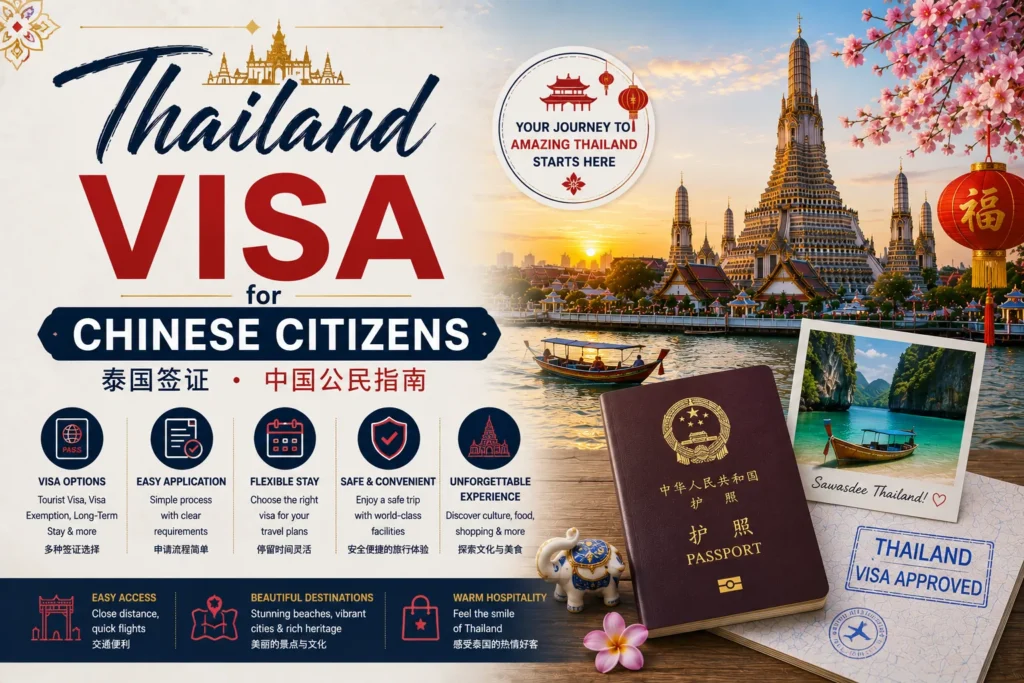
Thailand Visa for Chinese Citizens: 30-Day Visa-Free Entry, 90 Days in 180 Days, e-Visa, DTV, Tourist Visa, Work, Study, Family, Medical, and Long-Stay Checklist
You are planning a trip from China to Bangkok, Phuket, Chiang Mai, Pattaya, or Koh Samui, and the first question is simple: do Chinese citizens still need a visa for Thailand? For short visits, the answer is usually no — but that answer is not enough if you plan to stay longer, work, study, join family, or apply for a long-stay visa.
Chinese citizens holding valid ordinary passports or passports for public affairs can enter Thailand without a visa for up to 30 days per stay under the Thailand–China mutual visa exemption agreement. The agreement also limits cumulative stays to not more than 90 days within any 180-day period.
From our visa handling experience, the biggest mistake Chinese travelers make is assuming visa-free entry means unlimited entry or permission for every purpose. It does not cover residence, employment, study, media activities, or other activities requiring prior approval.
Do Chinese Citizens Need a Visa for Thailand?
Short visits may be visa-free, but purpose and stay limits still matter
Under the Thailand–China mutual visa exemption agreement, holders of valid Chinese ordinary passports and passports for public affairs may enter, exit, or transit through Thailand without a visa for a period of stay not exceeding 30 days, with cumulative stays not exceeding 90 days in any 180-day period.
The agreement does not cover residing, employment, study, media activities, or other activities that require prior approval from Thai authorities. You can check the official announcement from the Ministry of Foreign Affairs of Thailand and visa application information from the Royal Thai Embassy Beijing consular services page.
| Purpose | Likely Route | Practical Caution |
|---|---|---|
| Short holiday or transit | Visa-free entry | 30 days per stay and 90 days in 180 days cumulative limit |
| Longer tourism | Tourist Visa | Apply through Thai e-Visa if visa-free stay is not enough |
| Employment in Thailand | Non-B + Work Permit | Visa-free entry does not cover employment |
| Study in Thailand | ED Visa | Visa-free entry does not cover formal study |
| Remote work, family, medical, retirement, long stay | DTV, Non-O, medical, retirement, LTR, or Thailand Privilege | Choose by real purpose, not convenience |
Thailand Visa-Free Entry for Chinese Citizens
Best for short visits that fit the exemption agreement
Visa-free entry is convenient for tourism, short visits, transit, visiting friends or family, and short non-employment activities. However, it should not be used as a long-term residence plan.
From common cases, frequent entries can become risky when the pattern looks like living in Thailand rather than visiting. The 90-day cumulative limit in any 180-day period should be tracked carefully.
| Visa-Free Rule | Meaning | Practical Tip |
|---|---|---|
| 30 days per stay | Each visa-free entry is limited by the permitted stay stamp | Check your passport stamp immediately after arrival |
| 90 days in 180 days | Frequent trips are limited by cumulative stay | Track all Thailand entry and exit dates |
| Short-visit purpose | Tourism, transit, or brief non-employment visit | Carry documents showing temporary visit |
| Excluded purposes | Residence, employment, study, media, or other prior-approval activities | Apply for the correct visa before travel |
Thai e-Visa for Chinese Citizens
The main route when visa-free entry does not fit
If a Chinese citizen needs a Thai visa, the Royal Thai Embassy in Beijing explains that applicants should check required documents, apply online through Thailand’s official e-Visa website, monitor application status, and print the e-Visa approval after approval.
Use the official Thai e-Visa website. The Embassy also notes that visa issuance is subject to consular discretion, fees may change, fees are non-refundable, and officers may request additional information or an interview where necessary.
| e-Visa Step | What to Check | Common Mistake |
|---|---|---|
| Choose visa category | Tourism, business, work, study, medical, family, DTV, or long stay | Choosing tourist visa for work or study purpose |
| Upload documents | Files should be readable, complete, and category-specific | Blurry passport scan or incomplete bank statement |
| Match dates | Flight, hotel, invitation, school, or hospital dates should align | Travel plan does not match supporting documents |
| Print approval | Approval letter should be ready for entry and exit use | Relying only on email access at the airport |
Documents Chinese Citizens Should Carry Even When Visa-Free
Visa-free does not mean document-free
Even when no visa is required, travelers should carry supporting documents. Airlines and Immigration may ask about passport validity, return ticket, accommodation, purpose of visit, sufficient funds, and travel plan.
From real client cases, travelers usually face questions when their trip looks open-ended or inconsistent — for example, no return ticket, no clear hotel booking, repeated entries, or unclear purpose.
| Document | Why It Helps | Practical Tip |
|---|---|---|
| Return or onward ticket | Shows temporary stay intention | Keep digital and printed copy |
| Accommodation proof | Shows where you will stay | Hotel, host address, lease, or invitation should match trip dates |
| Sufficient funds | Shows ability to support trip | Carry clear bank or payment evidence |
| Purpose evidence | Supports tourism, family visit, or short business purpose | Use itinerary, meeting confirmation, or invitation letter |
Work, Study, and Residence Are Not Covered by Visa-Free Entry
Stay permission and activity permission are different
The Thailand–China mutual visa exemption agreement excludes employment, study, residence, media activities, and other activities requiring prior approval. This is important because a 30-day entry stamp does not allow every activity.
From common mistakes we often see, some travelers enter visa-free first and plan to “change later” after accepting a job, starting classes, or beginning local work. This can create timing and compliance problems.
| Activity | Correct Planning Direction | Document Often Needed |
|---|---|---|
| Working for Thai employer | Non-B + Work Permit | Employer documents, job offer, work permit support |
| Studying in Thailand | ED Visa | School admission, course details, school documents |
| Living with Thai family or spouse | Non-O or family route | Marriage, birth, or Thai family documents |
| Medical treatment | Medical visa or relevant route | Hospital appointment, treatment plan, financial proof |
DTV Visa for Chinese Remote Workers and Freelancers
Useful for eligible remote-work and soft power cases
Some Chinese citizens want to stay in Thailand while working remotely for clients or employers outside Thailand. In that case, the Destination Thailand Visa, or DTV, may be worth reviewing.
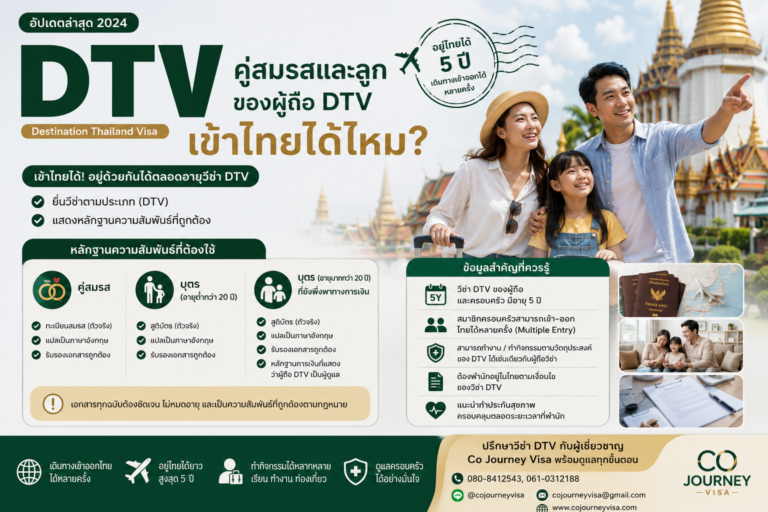
DTV may fit eligible digital nomads, remote workers, freelancers, Thai soft power activity participants, and dependents, depending on current embassy rules. However, DTV is not the same as permission to work for a Thai employer or Thai clients.
| DTV Profile | Useful Evidence | Common Weak Point |
|---|---|---|
| Remote employee | Employment contract, employer letter, remote-work confirmation, salary proof | Employer letter does not confirm remote arrangement |
| Freelancer | Portfolio, invoices, client contracts, payment records | Only saying “I work online” without proof |
| Soft power activity | Course, training, event, medical, or activity confirmation | Activity document is informal or missing dates |
| Dependent | Marriage or birth certificate and main applicant proof | Relationship documents not translated or certified where required |
How Chinese Citizens Should Choose and Apply
Step 1: Define your real purpose
Start with one honest sentence: “I am visiting Thailand for a 10-day holiday,” “I am attending a short business meeting,” “I will work for a Thai employer,” “I will study at a Thai university,” or “I want to stay in Thailand while working remotely for a company in China.”
Step 2: Check whether visa-free entry fits
Visa-free entry may fit if the stay is not more than 30 days per entry, cumulative stay does not exceed 90 days in any 180 days, and the purpose is not residence, employment, study, media activity, or another prior-approval activity.
Step 3: Choose the correct visa if needed
If visa-free entry does not fit, choose by purpose: Tourist Visa, Non-B, ED, Non-O, medical route, DTV, LTR, retirement route, or Thailand Privilege.
Step 4: Apply through Thai e-Visa
Use the official e-Visa system. Check visa category, passport details, travel dates, document format, financial proof, invitation letters, school or employer documents, current-location proof, and photo requirements before submitting.
Step 5: Prepare documents that prove the purpose
A good application should make the purpose obvious. Tourism needs travel plan and hotel booking. Business needs invitation. Work needs employer support. Study needs school documents. Medical treatment needs hospital documents. DTV needs remote-work or activity proof.
Step 6: Check the entry stamp after arrival
Your passport stamp controls your permitted stay. Take a photo of the stamp and set a reminder before expiry.
Step 7: Plan extension or long-stay route early
If you want to stay longer, do not wait until the final week. Late planning can create overstay risk, especially if employer, school, hospital, or family documents are needed.
Thailand Visa Checklist for Chinese Citizens
| Item | Why It Matters | Practical Tip | Done |
|---|---|---|---|
| Passport | Main travel document | Check validity before travel | ☐ |
| Purpose of visit | Determines visa route | Tourism, work, study, DTV, family, medical | ☐ |
| Stay length | Controls whether visa-free is enough | 30 days per stay under mutual exemption | ☐ |
| Cumulative stay | Important for frequent travelers | Not more than 90 days in any 180 days | ☐ |
| Return/onward ticket | Supports temporary stay | Keep booking ready | ☐ |
| Accommodation proof | Shows where you will stay | Hotel, host, lease, or invitation | ☐ |
| Financial proof | May be checked or required | Use clear bank records | ☐ |
| e-Visa documents | Needed for visa applications | Upload readable files | ☐ |
| Invitation letter | Important for business or family cases | Include dates and purpose | ☐ |
| Entry stamp | Shows legal stay deadline | Check after arrival | ☐ |
Approved Case vs Risky Case: What Made the Difference?
From real client cases, the strongest visa plans start with a clear purpose
| Topic | Risky Case | Stronger Case |
|---|---|---|
| Purpose | Traveler says they may travel, study, or work after arrival | Traveler clearly defines tourism, study, work, medical, family, or DTV purpose |
| Visa-free use | Repeated entries look like long-term residence | Traveler tracks 30-day and 90-in-180-day limits |
| Documents | Bank statement, hotel, and itinerary do not match | All documents support one clear travel story |
| Work or study | Traveler enters visa-free and starts local work or study | Correct visa and approval route is prepared before activity begins |
Common Mistakes Chinese Citizens Make
1. Assuming visa-free entry means unlimited entry
Visa-free entry is limited to 30 days per stay and a cumulative 90 days within any 180-day period under the mutual exemption agreement.
2. Using visa-free entry for work or study
The agreement excludes employment and study. If you will work or study, apply for the correct visa route.
3. Not carrying travel documents
Visa-free travelers should still carry return tickets, hotel bookings, funds, and purpose-of-trip evidence.
4. Applying for the wrong visa type
A remote worker applies as a tourist. A student applies without school documents. A business visitor applies without an invitation. The visa category should match the real purpose.
5. Uploading weak e-Visa documents
Common e-Visa issues include blurry passport scans, incomplete bank statements, mismatched travel dates, missing invitation letters, unclear employment proof, and wrong visa category.
6. Confusing visa validity with stay permission
Visa validity and stay permission are different. Your entry stamp tells you how long you can stay after arrival.
7. Waiting too long to extend
If you need more time, start early. A last-minute extension or visa change can become stressful if documents from an employer, school, hospital, or Thai family member are required.
Summary: Thailand Visa for Chinese Citizens
Key points to remember:
- Chinese ordinary passport holders and passport-for-public-affairs holders can enter Thailand visa-free for up to 30 days per stay under the Thailand–China mutual visa exemption agreement.
- The cumulative stay limit is not more than 90 days within any 180-day period.
- Visa-free entry does not cover residence, employment, study, media activities, or other activities requiring prior approval.
- Chinese citizens who need a visa should apply through Thailand’s official e-Visa system.
- The correct visa depends on purpose: tourism, work, study, business, DTV, medical treatment, family, retirement, LTR, or Thailand Privilege.
- Visa-free travelers should still carry return tickets, accommodation proof, funds, and purpose evidence.
- Work and study require proper visa planning.
- DTV may fit eligible remote workers, freelancers, soft power participants, and dependents.
- Check the entry stamp after arrival because it controls the legal stay deadline.
- Always check the latest official requirements before applying or traveling.
Let Co Journey Visa help identify the right Thailand visa route for Chinese citizens
A safe Thailand visa plan should match your real purpose: tourism, short business visit, remote work, Thai employment, study, medical treatment, family visit, retirement, or long stay.
ทำไมควรให้ Co Journey Visa ช่วยดูแลวีซ่าของคุณ
การขอ Thailand Visa for Chinese Citizens อาจมีขั้นตอนที่ซับซ้อนและต้องการความแม่นยำในการเตรียมเอกสาร หากคุณไม่ต้องการให้เกิดความผิดพลาดและต้องการความสะดวกสบายในการดำเนินการ Co Journey Visa พร้อมให้บริการช่วยเหลือคุณในทุกขั้นตอน:
Frequently Asked Questions About Thailand Visa for Chinese Citizens
Do Chinese citizens need a visa for Thailand?
For short visits, many Chinese citizens do not need a visa. Under the Thailand–China mutual visa exemption agreement, holders of valid Chinese ordinary passports and passports for public affairs can enter Thailand without a visa for up to 30 days per stay.
How long can Chinese citizens stay in Thailand visa-free?
Chinese citizens covered by the agreement can stay up to 30 days per stay, with a cumulative stay of not more than 90 days within any 180-day period.
Can Chinese citizens work in Thailand visa-free?
No. The visa exemption agreement does not cover employment. Chinese citizens who will work in Thailand need the correct visa and work authorization.
Can Chinese citizens study in Thailand visa-free?
No. Study is excluded from the visa exemption agreement. Students should apply for the correct education visa through the proper legal process.
How do Chinese citizens apply for a Thailand visa?
The Royal Thai Embassy in Beijing explains that applicants should check the required documents, apply online at Thailand’s e-Visa website, monitor application status, and print the e-Visa approval letter after approval.
Can Chinese citizens apply for Thailand DTV?
Yes, if they meet the DTV purpose and document requirements. DTV may fit eligible digital nomads, remote workers, freelancers, soft power participants, and dependents. The exact checklist should be checked through the relevant Thai Embassy or e-Visa system before applying.
Do Chinese tourists need proof of funds or hotel booking?
A visa-free traveler may still be asked to show supporting documents such as return or onward ticket, accommodation proof, funds, and purpose of travel. It is safer to carry these documents even when no visa is required.
Can Chinese citizens extend their stay in Thailand?
Possibly, depending on the entry type, current rules, and Immigration officer discretion. Apply before the permitted stay expires and check the latest requirements at the responsible Thai Immigration office.
หากคุณต้องการคำแนะนำเพิ่มเติมหรือต้องการให้ Co Journey Visa ดูแลการยื่นวีซ่าของคุณ ติดต่อเราได้เลย 24 ชั่วโมง
บทความที่เกี่ยวข้อง


ติดตามข้อมูลวีซ่าอัปเดตจาก Co Journey Visa
เพิ่มเว็บไซต์นี้เป็นแหล่งข้อมูลที่ต้องการใน Google เพื่อให้ค้นพบบทความจากเราได้สะดวกขึ้น