
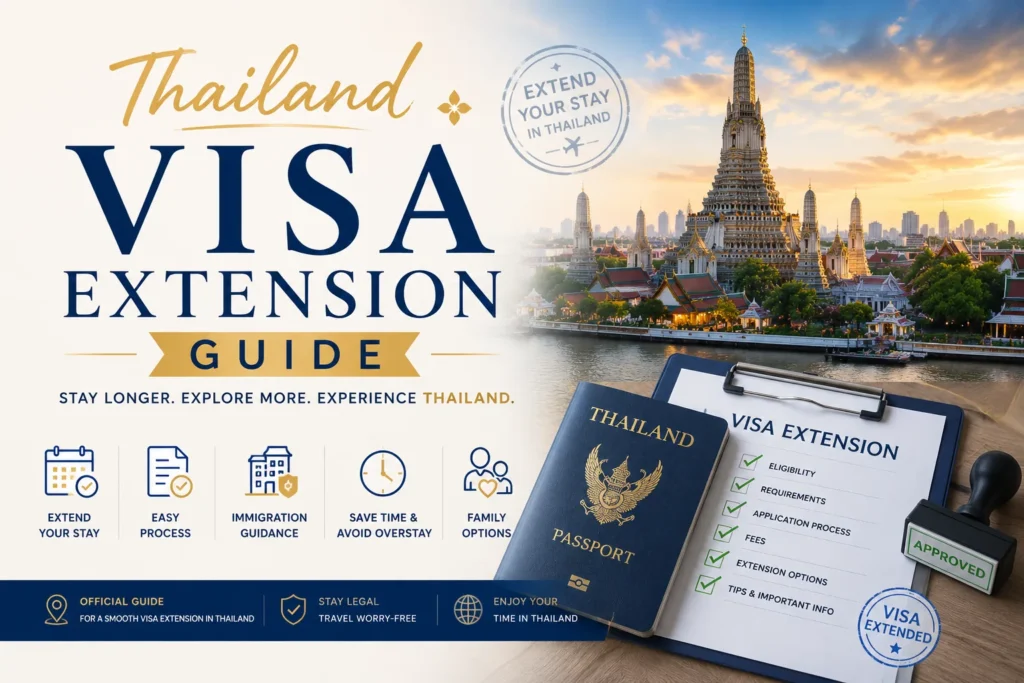
Thailand Visa Extension Guide: TM.7 Form, 1,900 THB Fee, Required Documents, Immigration Process, 90-Day Reporting, and Re-Entry Permit
You are enjoying Thailand, your flight date is getting closer, and suddenly you realize your passport stamp expires sooner than expected. Maybe you entered visa-free, maybe you have a tourist visa, or maybe you are staying on a Non-Immigrant visa. The question becomes urgent: can you extend your stay, and what should you prepare before going to Immigration?
A Thailand visa extension is a request to stay in Thailand beyond the permission date stamped in your passport. It is normally handled by the Thai Immigration Bureau inside Thailand using Form TM.7, and many extension applications carry a standard 1,900 THB fee according to Immigration public service guidance.
From our visa handling experience, many extension problems do not happen because the applicant is ineligible. They happen because the applicant reads the wrong date, prepares tourist documents for a non-tourist case, forgets TM.30 or address proof, or confuses visa extension with 90-day reporting or re-entry permit.
What Is a Thailand Visa Extension?
A request to stay beyond your current permitted-stay date
A Thailand visa extension is an application submitted to Thai Immigration to remain in Thailand longer than your current permission to stay. The key point is not only your visa type, but the date stamped in your passport when you entered Thailand.
Thailand’s Ministry of Foreign Affairs explains that visa validity and period of stay are different. Visa validity means the period during which the visa can be used to enter Thailand, while the period of stay is granted by an Immigration officer upon arrival and shown on the arrival stamp. You can check this explanation on the official Ministry of Foreign Affairs website.
| Extension Situation | Best For | Practical Caution |
|---|---|---|
| Tourist or visa-exempt stay | Travelers who need extra time before leaving Thailand | Check the entry stamp, not only the visa or flight date |
| Medical extension | Patients who cannot travel due to treatment | Hospital confirmation must be clear and current |
| Family-based extension | Foreigners visiting Thai spouse, child, or family | Relationship documents and Thai-side documents are usually required |
| Long-stay extension | Retirement, marriage, education, work, or guardian cases | Financial, school, employer, or family proof must match the reason |
Official sources to check before applying
Thailand visa extension rules, forms, fees, required documents, extension periods, and local Immigration procedures can change. You can check the latest information from the official Thai Immigration Bureau website and the official Ministry of Foreign Affairs website.
Thailand Visa Extension Fee and TM.7 Form
Most extension cases start with TM.7
The standard form for requesting an extension of temporary stay is TM.7. Thai Immigration public service guidance commonly lists TM.7, passport copy, recent photo, and the application fee as core items for many extension applications.
Many Immigration public service manuals list the standard extension fee as 1,900 THB. However, document requirements and accepted supporting evidence can vary by visa type, reason for extension, and local Immigration office.
| Core Item | Why It Matters | Practical Tip |
|---|---|---|
| TM.7 form | Main application form for extension of temporary stay | Fill clearly and sign consistently with your passport signature |
| Passport and copies | Shows identity, visa history, and entry stamp | Copy biodata page, visa page, latest entry stamp, and previous extension if any |
| Recent photo | Required for the application file | Prepare a recent photo before going to Immigration |
| 1,900 THB fee | Common standard extension application fee | Bring cash and keep the receipt carefully |
Thailand Visa Extension Requirements by Case Type
The correct documents depend on your reason for staying longer
A Thailand visa extension is not a one-checklist-fits-all process. Immigration officers review your current stay status, your reason for extension, your supporting documents, your address record, and your previous stay history.
From real client cases, the strongest extension files make the reason obvious. If you need medical treatment, the file should clearly show medical necessity. If you are extending for family reasons, the relationship documents should be easy to verify. If you are extending for work or study, employer or school documents must be current.
| Extension Type | Common Supporting Documents | Common Weak Point |
|---|---|---|
| Tourist / visa-exempt extension | Passport, TM.7, photo, fee, address proof if requested | Applicant waits until the final day or reads the wrong stamp |
| Medical extension | Hospital confirmation letter and physician explanation | Letter does not clearly state why the applicant cannot travel |
| Marriage or Thai family extension | Marriage certificate, birth certificate, Thai ID, house registration, photos, financial proof where required | Relationship proof is incomplete or not updated |
| Education extension | School documents, enrollment proof, attendance records, official letters | School letter is outdated or attendance evidence is weak |
| Work / business extension | Employer documents, company papers, work permit support, tax or social security records where relevant | Company documents are expired, inconsistent, or missing signatures |
| Retirement extension | Financial proof, bank documents, passport, address evidence | Bank timing or account ownership does not match the requirement |
Visa Validity vs Period of Stay: The Stamp Matters Most
Do not use the wrong date when planning your extension
One of the most common extension mistakes is reading the visa expiry date instead of the permitted-stay date. The Ministry of Foreign Affairs explains that visa validity is different from the period of stay granted by Immigration upon arrival.
In practical terms, your extension deadline is usually based on the date shown on your latest entry stamp or latest extension stamp. If your stamp says you are admitted until 10 June, your extension planning should be based on 10 June.
| Date Type | What It Means | Extension Impact |
|---|---|---|
| Visa validity date | Period during which the visa can be used to enter Thailand | Not always your stay deadline |
| Entry stamp date | Permission to stay granted by Immigration on arrival | Usually the most important deadline |
| Extension stamp date | New permission date after Immigration approves an extension | Controls your next stay deadline |
How to Apply for a Thailand Visa Extension
Step 1: Check your current stay status
Start with your passport. Check your nationality, entry date, visa or visa-exempt status, latest entry stamp, latest extension stamp if any, and current permitted-stay expiry date.
Step 2: Identify the correct extension reason
Choose the reason that honestly matches your stay, such as tourism, medical treatment, visiting Thai family, retirement, marriage, education, work, business, guardianship, or official necessity.
Step 3: Prepare core documents
Most applicants should prepare passport, signed passport copies, TM.7 form, recent photo, application fee, latest entry stamp copy, visa or e-Visa copy if applicable, and address evidence if requested.
Step 4: Prepare category-specific evidence
This is where many files become weak. Medical cases need hospital support. Student cases need school letters. Work cases need employer documents. Family cases need relationship evidence. Retirement and marriage cases often require financial proof.
Step 5: Visit the correct Immigration office
Apply at the Immigration office responsible for your area of residence or the office instructed for your visa type. Go early where possible and bring originals plus signed copies.
Step 6: Submit the application and pay the fee
Submit TM.7 and supporting documents. Many extension applications use the standard 1,900 THB fee listed in Immigration public service guidance. Keep the receipt and any appointment or under-consideration slip carefully.
Step 7: Check your new stamp before leaving
Before leaving Immigration, check your new permitted-stay date, passport number, spelling of your name, under-consideration date if any, and whether a re-entry permit is needed before travel.
Thailand Visa Extension Checklist
| Item | Why It Matters | Practical Tip | Done |
|---|---|---|---|
| Passport original | Main identity and stay record | Bring original and signed copies | ☐ |
| Entry stamp copy | Shows your permitted-stay deadline | This date controls urgency | ☐ |
| Visa or e-Visa record | Shows the basis of your entry | Include old visa records if relevant | ☐ |
| TM.7 form | Main extension application | Fill clearly and sign | ☐ |
| Recent photo | Required for the file | Prepare before going to Immigration | ☐ |
| Application fee | Common extension fee is 1,900 THB | Bring cash and keep receipt | ☐ |
| Address evidence / TM.30 | Supports local residence | Ask hotel, landlord, school, or employer early | ☐ |
| Reason-specific documents | Proves why you need extension | Match documents to your case type | ☐ |
| Re-entry plan | Needed if you travel after extension | Apply for re-entry permit if required | ☐ |
| New stamp check | Confirms your next deadline | Check before leaving Immigration | ☐ |
Visa Extension vs 90-Day Reporting vs Re-Entry Permit
These are three different processes
Many long-stay foreigners confuse visa extension, 90-day reporting, and re-entry permit. They are separate processes with different purposes.
Thai Immigration states that foreigners staying in Thailand for more than 90 days must report their residence every 90 days, and the notification should be made within 15 days before or 7 days after the 90-day period expires. A re-entry permit, commonly handled with TM.8, protects an existing permission to stay when leaving and returning to Thailand.
| Process | Purpose | Common Form | Main Warning |
|---|---|---|---|
| Visa extension | Request more time in Thailand | TM.7 | Must apply before stay expires |
| 90-day reporting | Report current address after long continuous stay | TM.47 or official reporting system | Does not extend your stay |
| Re-entry permit | Preserve existing permission to stay when leaving Thailand | TM.8 | Does not add more days |
Approved Case vs Rejected or Delayed Case: What Made the Difference?
From real client cases, timing and document fit are the biggest differences
| Topic | Rejected or Delayed Case | Stronger Case |
|---|---|---|
| Deadline | Applicant applies after the permitted-stay date expires | Applicant checks the stamp and applies before the deadline |
| Reason for extension | Applicant says they need more time but cannot prove the reason | Reason is supported by hospital, family, school, employer, or financial documents |
| Address evidence | TM.30 or residence proof is missing | Address record and residence documents are prepared before visiting Immigration |
| Document quality | Old letters, unsigned copies, unclear photos, or inconsistent passport details | Current documents, signed copies, clear stamp copies, and consistent information |
Common Thailand Visa Extension Mistakes
1. Applying after the stay has expired
Do not wait until after your permission to stay expires. Overstay can create fines, immigration records, travel disruption, and future visa risk.
2. Reading the visa expiry date instead of the entry stamp
Visa validity is not the same as permitted stay. The entry stamp or latest extension stamp controls your immediate deadline.
3. Preparing only tourist documents for a non-tourist case
If you are extending based on marriage, retirement, education, work, medical treatment, or guardianship, passport copies and a photo are usually not enough.
4. Confusing extension with re-entry permit
An extension lets you stay longer. A re-entry permit protects your existing stay permission if you leave and return. They solve different problems.
5. Confusing extension with 90-day reporting
A 90-day report is not a visa extension. Reporting your address does not automatically add more days to your stay.
6. Missing TM.30 or address evidence
Many Immigration offices check address records. If your TM.30 or residence evidence is not ready, your application may be delayed.
7. Forgetting passport validity
If your passport expires soon, the extension period may be affected. Check your passport before applying, especially for long-stay extensions.
Summary: Thailand Visa Extension
Key points to remember:
- A Thailand visa extension is a request to stay beyond your current permitted-stay date.
- The passport stamp matters more than the visa validity date when checking your stay deadline.
- Most extension applications use TM.7.
- Many Thai Immigration public service manuals list the standard extension fee as 1,900 THB.
- The required documents depend on your extension reason.
- Tourist, medical, family, student, work, retirement, marriage, and guardian extensions are not the same.
- 90-day reporting is separate from visa extension.
- A re-entry permit is separate from visa extension and does not add more days.
- Apply before your permitted stay expires.
- Always check the latest official Immigration requirements before submitting your documents.
Let Co Journey Visa help prepare your Thailand visa extension application
A strong Thailand visa extension file should make your case easy to understand: what your current stay status is, when your stamp expires, why you need more time, which documents prove your reason, and what Immigration process applies to your location.
ทำไมควรให้ Co Journey Visa ช่วยดูแลวีซ่าของคุณ
การขอ Thailand Visa Extension อาจมีขั้นตอนที่ซับซ้อนและต้องการความแม่นยำในการเตรียมเอกสาร หากคุณไม่ต้องการให้เกิดความผิดพลาดและต้องการความสะดวกสบายในการดำเนินการ Co Journey Visa พร้อมให้บริการช่วยเหลือคุณในทุกขั้นตอน:
Frequently Asked Questions About Thailand Visa Extension
What is a Thailand visa extension?
A Thailand visa extension is a request to stay in Thailand longer than your current permitted-stay date. It is usually submitted to Thai Immigration using TM.7 with supporting documents based on your reason for staying longer.
How much does a Thailand visa extension cost?
Many Thai Immigration public service manuals list the standard extension application fee as 1,900 THB. Fees and procedures can change, so applicants should check the latest official Immigration guidance before applying.
What form do I need for a Thailand visa extension?
The main form is TM.7, the application for extension of temporary stay in the Kingdom. Additional documents depend on your visa type and extension reason.
Can I extend my tourist visa or visa-exempt stay in Thailand?
In many cases, tourists and visa-exempt travelers may request an extension, but the extension period and requirements depend on current rules, nationality, entry type, and local Immigration procedures. Check your passport stamp before applying.
Is 90-day reporting the same as a visa extension?
No. A visa extension requests more time to stay in Thailand. 90-day reporting is an address notification duty for foreigners staying in Thailand for more than 90 days. Completing a 90-day report does not automatically extend your stay.
Is a re-entry permit the same as a Thailand visa extension?
No. A re-entry permit protects your existing permission to stay when you leave Thailand and return during the approved stay period. It does not add more days to your stay.
When should I apply for a Thailand visa extension?
You should apply before your permitted-stay date expires. Long-stay categories should prepare earlier because financial documents, school letters, employer documents, medical letters, or family documents may take time to arrange.
What happens if I overstay before applying for an extension?
Overstay can lead to fines, immigration records, travel disruption, and future visa risk depending on the length and circumstances. If your stay is close to expiring, check with Immigration or speak with a visa consultant before the deadline.
หากคุณต้องการคำแนะนำเพิ่มเติมหรือต้องการให้ Co Journey Visa ดูแลการยื่นวีซ่าของคุณ ติดต่อเราได้เลย 24 ชั่วโมง
บทความที่เกี่ยวข้อง

ติดตามข้อมูลวีซ่าอัปเดตจาก Co Journey Visa
เพิ่มเว็บไซต์นี้เป็นแหล่งข้อมูลที่ต้องการใน Google เพื่อให้ค้นพบบทความจากเราได้สะดวกขึ้น