
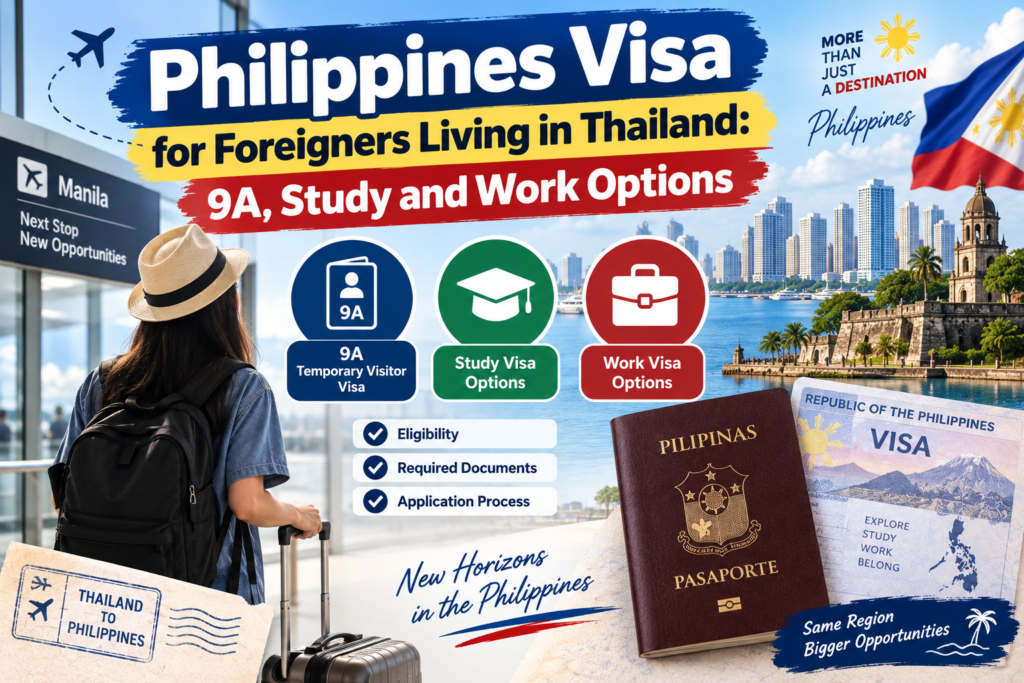
If you are an Indian, Chinese, Pakistani, Bangladeshi, European, African, Middle Eastern or other foreign national legally living in Thailand, the first question is often: “Can I apply for my Philippines visa from Bangkok, or do I need to return to my home country?”
The key rule is that your residence in Thailand and your passport nationality do two different jobs. Philippine Bureau of Immigration guidance states that a foreign national may apply for a Temporary Visitor's Visa at a Philippine Foreign Service Post in the applicant's country of origin or place of legal residence. This means a foreigner legally resident in Thailand may be able to apply through the Philippine Embassy in Bangkok.
However, living in Thailand does not automatically give you the same Philippine entry privileges as a Thai passport holder. Whether you need a visa before travel still depends primarily on the passport you will use, while the correct visa or permit depends on whether your real purpose is visiting, studying or working.
Check whether your passport is visa-exempt. If it is visa-required, the main route is 9(a) Temporary Visitor Visa, and a legal resident of Thailand can generally begin with the Philippine Embassy in Bangkok.
University / degree study:
Foreign nationals age 18+ studying above high-school level generally fall under Student Visa 9(F).
English course / non-degree / qualifying short course:
Usually check Special Study Permit (SSP). SSP is a permit, not a visa.
Employment with a Philippine company:
The normal long-term employment route involves 9(g) Pre-arranged Employment Visa + AEP, with PWP potentially relevant while a 9(g) application is pending.
💬 Not sure whether your nationality requires a visa before flying from Thailand?
Send your passport nationality, current Thai status and purpose of travel to Co Journey Visa. We can help identify the route you should verify before you submit or book.
📋 Contents
- The rule foreigners in Thailand should understand first
- 9A vs 9F vs SSP vs 9G comparison
- 9(a) Temporary Visitor Visa
- Can you apply for 9A in Bangkok?
- Student Visa 9(F) for degree programs
- SSP for English and non-degree courses
- 9(g) Work Visa for Philippine employment
- AEP and PWP: why a 9G is not the whole process
- Can you enter as a visitor and convert status?
- Documents from Thailand to prepare
- Decision table by travel purpose
- Common mistakes
- Official sources
- Frequently asked questions
1) The most important rule: Thai residence is not the same as Thai nationality
A foreigner can legally live in Bangkok for years on a Thai work visa, dependent status, retirement status, education status or another lawful stay and still be subject to the Philippine entry rules of his or her own passport nationality.
| Question | What normally determines the answer? |
|---|---|
| Do I need a Philippine entry visa? | Your passport nationality and current Philippine visa-waiver rules |
| Can I lodge a visitor visa application in Bangkok? | Whether Thailand is your place of legal residence and whether the Embassy accepts the application under current post procedures |
| Can I study? | Your age, level of study, course type and school's BI accreditation |
| Can I work? | Your employer, job structure and appropriate Philippine labor + immigration authorization |
📱 Swipe horizontally on mobile to view the full table.
It may help demonstrate that Thailand is your lawful place of residence, but Philippine admission rules still follow the passport and immigration category used for the trip.
If your Thai immigration status itself is expiring or unclear, resolve your Thailand Visa situation separately. Philippine and Thai immigration status are independent.
2) Philippines visa options for foreigners living in Thailand
| Purpose | Main route to check | Authority | Important point |
|---|---|---|---|
| Tourism / visit family | Visa-free entry or 9(a) | DFA / Philippine Embassy + BI | Depends heavily on passport nationality |
| Temporary business meetings | Visa-free or 9(a) Business | DFA / Embassy + BI | Must remain temporary; not employment |
| Bachelor / Master / Doctorate, age 18+ | Student Visa 9(F) | BI with school involvement | Course must be above high school at an accredited institution |
| English course / non-degree | SSP | BI with accredited school | SSP is a permit, not a visa |
| Long-term employment | AEP + 9(g) | DOLE + BI | Employment and immigration approvals are separate |
| Need to work while 9(g) is pending | Check PWP | BI | Submitting a 9(g) alone is not permission to start work |
📱 Swipe horizontally on mobile to view the full table.
3) What is the Philippines 9(a) Temporary Visitor Visa?
Bureau of Immigration defines the Temporary Visitor's Visa as the visitor category used for common temporary purposes including:
- Pleasure — tourism, holidays and leisure visits
- Business — temporary commercial or professional activity such as conferences, contract negotiations and business meetings
- Health — qualifying temporary medical or health-related visits
The important word is temporary. A 9(a) business visit is not a substitute for a Philippine employment visa or work permit.
BI distinguishes between non-visa-required nationals admitted under Philippine visa-waiver rules and visa-required nationals who need an entry visa. Always check the passport you will actually travel with rather than assuming that residence in Thailand changes the rule.
For readers who prefer a Thai-language country page, our วีซ่าฟิลิปปินส์ page can be used as a related overview, but nationality-specific requirements should still be verified for the individual passport.
4) Can a foreigner legally living in Thailand apply for a 9A visa in Bangkok?
Yes, this is possible in principle when Thailand is your place of legal residence. BI's official FAQ states that a foreign national may apply for a Temporary Visitor's Visa at a Philippine Foreign Service Post in the applicant's country of origin or place of legal residence.
For a Bangkok application, the Philippine Embassy's current non-immigrant visa form asks for information such as citizenship, Thai/home address, occupation, passport details, purpose of entry, financial means, flight information and address in the Philippines.
Be prepared to demonstrate that your stay in Thailand is lawful if the Embassy requests it. The exact document could depend on your status — for example a Thai visa/stay record, work-related status or other residence evidence. Confirm the Embassy's current checklist before submission rather than relying on an old online list.
Useful documents to prepare before checking with the Embassy
- Original passport and passport data-page copy
- Completed non-immigrant visa application form
- Recent photograph in the format requested by the post
- Evidence of lawful stay or residence in Thailand if requested
- Proof of financial capacity
- Flight itinerary / return or onward travel evidence
- Accommodation or address in the Philippines
- Invitation letter if visiting a business, host or organization
- Supporting documents explaining the true purpose of travel
The Philippine Embassy's visa undertaking states that a visa processing fee is non-refundable, additional documents may be required, and final admission remains at the discretion of Philippine immigration authorities at the port of entry.
5) Student Visa 9(F): for degree study and higher education
Bureau of Immigration states that Student Visa 9(F) is for foreign nationals who are:
- At least 18 years old
- Taking a course of study higher than high school
- Studying at a university, seminary, college or school accredited to accept foreign students
- Able to meet the other immigration and documentary requirements
The school is not a passive part of this process. It should confirm that it is properly accredited for foreign students and guide the applicant through the correct 9(F) route.
BI's Student Visa Conversion system currently asks whether the applicant has at least 21 days of valid Tourist Visa stay remaining, is at least 18, has sufficient means and intends to study above high-school level at an accredited institution.
If your plan is to convert from Temporary Visitor status to 9(F), the current online eligibility check includes the 21-day valid-stay condition. Speak with the school before the timeline becomes too short.
6) English course or non-degree study: check the SSP route
Not every student needs Student Visa 9(F). Bureau of Immigration provides the Special Study Permit (SSP) for foreign nationals who do not qualify for a Student Visa but are undertaking qualifying study.
Current BI guidance covers categories including non-degree study and English Language Programs. SSP is especially relevant to foreigners living in Thailand who plan to spend several weeks or months at an English school in Cebu, Manila, Baguio or another Philippine destination.
| Study type | Route to check first | Why |
|---|---|---|
| Bachelor's degree, age 20 | 9(F) | Age 18+ and higher education |
| Master's degree | 9(F) | Higher-than-high-school degree program |
| English Language Program | SSP | BI places English-language study under the SSP framework |
| Qualifying non-degree short course | SSP | Non-degree course rather than 9(F) degree study |
| Minor student | Check SSP | 9(F) has a minimum age of 18 |
📱 Swipe horizontally on mobile to view the full table.
SSP is a study permit issued under Temporary Visitor status. If the student's Authorized Stay expires before the course ends, the immigration stay must be extended separately.
7) Work Visa 9(g): for employment with a Philippine company
If the purpose is genuine employment in the Philippines, the main long-term immigration route to understand is the Pre-arranged Employment Visa 9(g).
BI describes 9(g) as the route for foreign nationals proceeding to the Philippines to engage in a lawful occupation for wages, salary or another form of compensation.
Unlike a 9(a) visitor application, this is generally an employer-driven process. A Philippine employer acts as petitioner and the application involves employment documents, BI review, a hearing, biometrics and ACR I-Card processing.
Visitor status and employment authorization are different legal questions.
8) AEP, 9G and PWP: three documents people commonly mix up
| Document | What it is | Authority |
|---|---|---|
| AEP | Alien Employment Permit — labor-side employment authorization | Department of Labor and Employment |
| 9(g) | Pre-arranged Employment Visa — immigration status for qualifying employment | Bureau of Immigration |
| PWP | Provisional Work Permit during the pendency of a pre-arranged employment visa application | Bureau of Immigration |
| ACR I-Card | Foreign-national registration / identity card | Bureau of Immigration |
📱 Swipe horizontally on mobile to view the full table.
DOLE guidance states that foreign nationals intending to engage in gainful employment must secure the proper employment authorization. In 2026 DOLE also moved AEP processing into a more centralized framework, so employers should use current DOLE procedures rather than old Regional Office instructions.
BI says a Provisional Work Permit is issued to a foreign national during the pendency of a pre-arranged employment visa application. Filing a 9(g) application alone should not be treated as permission to begin work.
9) Can you enter the Philippines as a visitor and convert to study or work status?
In some categories, yes — but only if you meet the formal conversion requirements. This is not the same as saying that visitor status authorizes study or work before conversion is complete.
Visa-free if eligible, or with the appropriate 9(a) visa if your passport requires one.
Do not allow your visitor stay to expire while waiting for a school or employer to prepare documents.
Degree students may check 9(F) Conversion; non-degree or English students may check SSP.
Employer checks AEP and 9(g), and PWP where applicable before actual work begins.
Follow the transaction-specific requirements issued by BI.
The applicant must still satisfy the eligibility rules, maintain valid stay and wait for the appropriate permission before starting restricted activity.
10) Documents from Thailand: what should foreign residents prepare?
The exact checklist depends on nationality and visa category, but foreigners applying from Thailand should organize documents into three groups.
A. Identity and Thai residence
- Passport used for Philippine travel
- Current Thai immigration status or lawful residence evidence if requested
- Thai address and contact details
- Thai employment / business / study documents where relevant to your circumstances
B. Purpose of travel
- Tourism itinerary or host details for a visitor application
- Business invitation for temporary business travel
- School acceptance documents for study
- Employment contract and Philippine employer documents for work
C. Financial and travel evidence
- Bank statements or other proof of financial capacity where requested
- Return/onward itinerary for a temporary visit
- Philippine accommodation or residential address
- Additional nationality-specific documents requested by the Embassy
If supporting evidence is only in Thai, review the receiving authority's current language/authentication requirements. Our guide on เอกสารแปลภาษาอังกฤษ covers common document-translation mistakes to check before submission.
11) Decision table: which route should you check first?
| Your situation in Thailand | Your goal in the Philippines | First route to check | Who needs to be involved? |
|---|---|---|---|
| Legally resident in Thailand | Holiday for 7 days | Visa-free eligibility or 9(a) | Applicant / Embassy if visa required |
| Thai work-visa holder, foreign passport | Business meeting | Visa-free business visit or 9(a) | Applicant + host/company if documents required |
| Foreign student/resident in Thailand | English course in Cebu | Temporary Visitor status + SSP | Applicant + BI-accredited school |
| Foreign resident in Thailand | Bachelor's or Master's degree | 9(F) | Applicant + accredited Philippine school + BI |
| Foreign employee in Thailand | Accept Philippine company job | AEP + 9(g) | Philippine employer + DOLE + BI |
| Foreign consultant based in Thailand | Provide short-term services in Philippines | Do not assume 9(a); check work-permit route | Philippine host/employer + BI/DOLE as applicable |
📱 Swipe horizontally on mobile to view the full table.
⚡ The fastest way to choose correctly is to start with four facts:
Passport nationality → Thai legal status → purpose in the Philippines → length of stay.
12) Common mistakes foreigners living in Thailand make
| Mistake | Why it causes problems | Better approach |
|---|---|---|
| Assuming Thai residence gives Thai passport privileges | Visa-waiver eligibility follows passport nationality | Check your actual passport against Philippine rules |
| Applying in Bangkok without proving legal Thai residence when requested | BI's rule refers to country of origin or place of legal residence | Keep Thai stay/residence evidence ready |
| Using a 9(a) visitor visa to start employment | Temporary business and employment are different activities | Check AEP / 9(g) / PWP before work begins |
| Using 9(F) for an English course automatically | English Language Programs generally fall under SSP | Ask the accredited school which BI route applies |
| Thinking SSP extends the tourist stay | SSP is a study permit, not a visa extension | Maintain Temporary Visitor Authorized Stay separately |
| Waiting until visitor status has almost expired before 9(F) conversion | Current BI eServices checks for at least 21 days of valid tourist stay | Coordinate with the school early |
| Calling every work document a “work visa” | AEP, 9(g), PWP and ACR have different legal functions | Track each document separately |
📱 Swipe horizontally on mobile to view the full table.
13) How Co Journey Visa can help foreigners living in Thailand
Co Journey Visa can help you identify the correct starting point before you submit an application, particularly when your passport nationality, Thai immigration status and Philippine purpose do not fit a simple tourist case.
- Nationality screening — check whether the passport should begin with visa-free rules or a 9(a) application
- Thailand residence review — identify documents that may help establish lawful residence in Thailand
- Study-route review — distinguish 9(F) from SSP
- Work-route review — distinguish 9(g), AEP, PWP and visitor activity
- Document consistency check — compare passport, Thai status, purpose letters, flights and Philippine invitations
- No approval guarantees — final decisions remain with the Embassy, BI, DOLE and other Philippine authorities
If you need a broader visa service, send the passport nationality and exact travel purpose first. That allows the document review to begin from the correct immigration category rather than a generic checklist.
14) Official Philippines visa and immigration sources
-
Philippine Bureau of Immigration — FAQ
Temporary Visitor, Student and Employment Visa FAQ
Confirms that a Temporary Visitor Visa may be applied for at a Philippine Foreign Service Post in the country of origin or place of legal residence. -
Bureau of Immigration — Temporary Visitor 9(a)
Temporary Visitor Visa / Visa Waiver
Use this to check visitor admission and extension rules after arrival. -
Bureau of Immigration — Student Visa 9(F)
Student Visa 9F
Official eligibility and BI processing information for higher education. -
BI eServices — Student Visa Conversion
BI eServices
Current online system includes Student Visa Conversion 9(F) and its eligibility checklist. -
Bureau of Immigration — Special Study Permit
Special Study Permit
Official route for qualifying students who do not fall under Student Visa 9(F). -
Bureau of Immigration — Pre-arranged Employment Visa 9(g)
Pre-arranged Employment Visa 9G
Official requirements and processing route for qualifying employment. -
Bureau of Immigration — Provisional Work Permit
Provisional Work Permit
BI describes PWP as a permit available during the pendency of a pre-arranged employment visa application. -
Philippine Embassy in Bangkok — Non-Immigrant Visa Form
Bangkok Philippine Embassy Visa Application Form
Current Embassy form for non-immigrant visa applicants in Thailand.
This guide was checked against Philippine Bureau of Immigration, BI eServices, DOLE information and Philippine Embassy Bangkok materials available as of 6 September 2026. Nationality-specific visa requirements, Embassy checklists, fees and online procedures can change, so applicants should verify the current requirements before payment or travel.
❓ FAQ: Philippines Visa for Foreigners Living in Thailand
Can a foreigner living in Thailand apply for a Philippine visa in Bangkok?
Does living in Thailand change whether I need a visa for the Philippines?
What is the 9A visa for the Philippines?
Which Philippine visa do I need for university study?
Do I need a Student Visa 9F for an English course in the Philippines?
What do I need to work for a company in the Philippines?
Can I enter the Philippines as a tourist and then start studying or working?
📌 Summary: start with nationality, residence and purpose
- Living legally in Thailand may allow a foreign national to apply through the Philippine Embassy in Bangkok because Thailand can be the applicant's place of legal residence.
- Thai residence does not change the Philippine visa-waiver rule attached to your passport nationality.
- Tourism, family visits and temporary business generally start with visa-free eligibility or 9(a).
- 9(a) does not authorize normal employment.
- Degree study above high school for applicants age 18+ generally falls under 9(F).
- English-language and qualifying non-degree programs generally use SSP.
- SSP is not a visa and does not automatically extend Temporary Visitor stay.
- Long-term employment normally requires both labor-side and immigration-side compliance, commonly AEP + 9(g).
- PWP may be relevant when a 9(g) is pending and work needs to begin lawfully.
- Always confirm the current Bangkok Embassy and BI checklist before paying fees or booking around a processing date.
Your Thai visa tells us where you live. Your passport and purpose tell us which Philippines route to check.
Send your passport nationality, Thai immigration status, purpose in the Philippines and intended length of stay. Co Journey Visa can help identify whether you should start with visa-free entry, 9(a), 9(F), SSP or an employment route.
📱 LINE: @cojourneyvisaCall 080-841-2543 / 061-031-2188 | cojourneyvisa@gmail.com
Disclaimer: This article is intended to help foreign residents of Thailand identify the Philippine immigration route they should verify. Visa-free admission, visa issuance, conversion, SSP, Student Visa 9(F), AEP, PWP, 9(g), ACR I-Card and admission at the Philippine border depend on the applicant's nationality, legal status, school or employer, documents and current government rules. Final decisions are made by the Philippine Department of Foreign Affairs, Philippine Bureau of Immigration, Department of Labor and Employment and other competent authorities.
บทความที่เกี่ยวข้อง
ติดตามข้อมูลวีซ่าอัปเดตจาก Co Journey Visa
เพิ่มเว็บไซต์นี้เป็นแหล่งข้อมูลที่ต้องการใน Google เพื่อให้ค้นพบบทความจากเราได้สะดวกขึ้น