
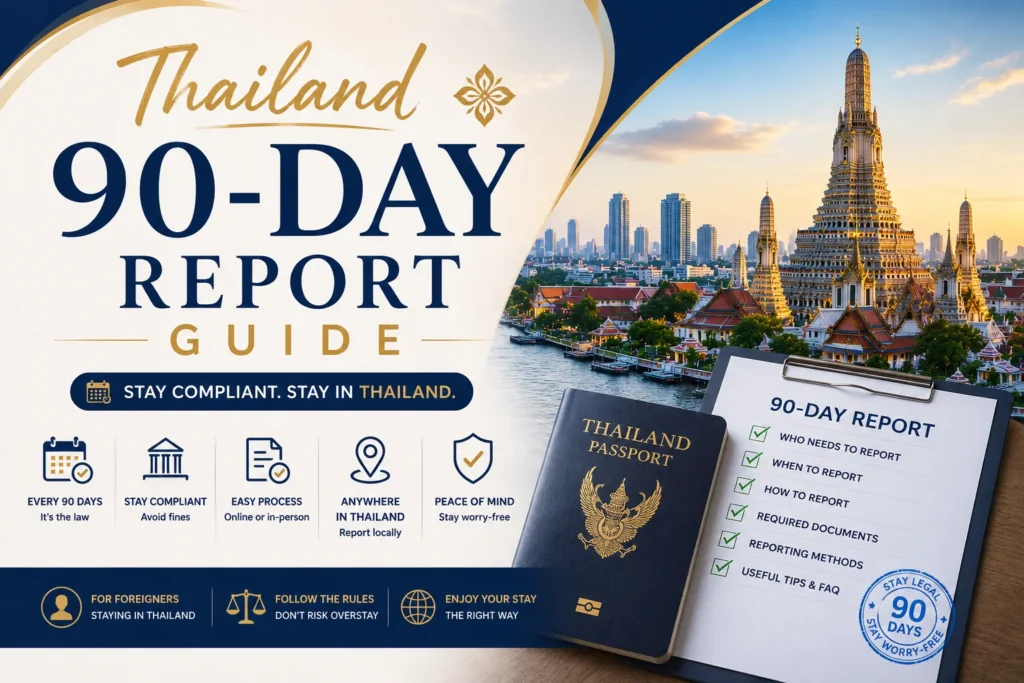
Thailand 90-Day Report Guide: TM.47 Form, Online Reporting, Due Date, Documents, Fines, and Immigration Compliance
You have a valid long-stay visa or extension in Thailand, everything seems fine, and then someone asks, “Did you do your 90-day report?” Many foreigners only hear about it when the deadline is close — or worse, after it has already passed.
A Thailand 90-Day Report is an address notification required for foreigners who stay in Thailand for more than 90 consecutive days. It tells Thai Immigration where you are currently living. It is not a visa extension, not a re-entry permit, and not a new visa.
From our visa handling experience, many 90-day report problems happen because applicants confuse the report with visa extension, miss the online window, move address without checking TM.30, lose the previous receipt, or forget to recalculate the count after international travel.
What Is the Thailand 90-Day Report?
An address notification, not a visa extension
The Thailand 90-Day Report is a residence notification required for foreigners staying in Thailand for more than 90 consecutive days. Thai Immigration states that foreigners staying in the Kingdom over 90 days must notify their residence to Immigration every 90 days.
The key word is address. The 90-day report does not give you more time in Thailand. It only confirms where you are currently staying. This is why long-stay foreigners must track both their permission-to-stay date and their 90-day report due date separately.
| Who Usually Needs It | Why It Matters | Practical Caution |
|---|---|---|
| Retirement visa or extension holders | Often stay in Thailand continuously | Do not confuse annual extension with 90-day reporting |
| Marriage or Thai family extension holders | May remain in Thailand long-term | Track address records carefully after moving home |
| Students, workers, and guardians | Often rely on school, employer, or family documents | Keep passport, visa, and address documents updated |
| LTR or Thailand Privilege members | Long-stay status may still include reporting duties | Check the specific reporting rules for your visa category |
Official sources to check before reporting
90-day reporting rules, online system conditions, forms, timing windows, fines, and local Immigration practices can change. You can check the latest information from the official Thai Immigration 90-day reporting page and the official online TM.47 reporting system.
Thailand 90-Day Report Due Date and Reporting Window
Timing is the most common reason people get into trouble
Thai Immigration guidance states that the 90-day notification can be made within 15 days before or 7 days after the 90-day period expires. For online reporting, the official TM.47 online manual states that the request should be submitted in advance before the next due date within 15 days.
From real client cases, the safest approach is to set a reminder 15 days before the due date and not wait until the last day. Online systems can reject a submission if information does not match Immigration records, and you may need time to visit Immigration in person.
| Reporting Method | Common Timing | Practical Tip |
|---|---|---|
| Online TM.47 reporting | Within 15 days before the due date | Submit early in case the system rejects the report |
| In-person reporting | Within 15 days before or 7 days after the due date | Bring passport, copies, old receipt, and address proof |
| Authorized representative | Depends on office practice | Prepare authorization documents if required |
| Postal reporting | Subject to local office rules | Send early and keep proof of mailing |
TM.47 Form and Thailand 90-Day Report Documents
TM.47 is the main form for 90-day residence notification
TM.47 is the form used for notifying Immigration of staying in Thailand longer than 90 days. Provincial Immigration offices commonly identify this service as “Notification of staying in the Kingdom over 90 days (TM.47).”
From our visa handling experience, the report is usually simple when the applicant’s passport details, latest entry stamp, visa status, previous receipt, and address record are consistent. Problems often happen when the applicant has moved, changed passport, lost the old receipt, or traveled abroad and followed the old due date.
| Document / Information | Why It Matters | Practical Tip |
|---|---|---|
| Passport | Confirms identity and stay history | Bring original for in-person reporting |
| Latest entry stamp | Helps calculate consecutive stay | Recalculate after every international trip |
| Current visa or extension | Shows current stay status | Keep clear signed copies ready |
| Previous 90-day receipt | Shows next due date | Keep paper and digital copies |
| TM.47 form | Main notification form | Use current form from Immigration |
| Current address | Core purpose of the report | Make sure it matches your real residence |
How to Do a Thailand 90-Day Report
Step 1: Check whether you must report
Start by checking whether you have stayed in Thailand for more than 90 consecutive days. Look at your latest entry stamp, previous 90-day receipt, and whether you have left Thailand since your last report.
Step 2: Choose the reporting method
Thailand 90-day reporting can commonly be done online through the official TM.47 system, in person at the responsible Immigration office, by an authorized representative, or by post in some areas depending on local office rules.
Step 3: Prepare your documents
For in-person reporting, prepare your passport, copies of relevant passport pages, current visa or extension, latest entry stamp, previous 90-day receipt, completed TM.47 form, and address details. For online reporting, passport and address information must match Immigration records.
Step 4: Submit within the correct window
For online reporting, submit within the allowed online period before the due date. For in-person reporting, Thai Immigration guidance commonly allows notification within 15 days before or 7 days after the 90-day period expires.
Step 5: Keep the new receipt
After approval, keep the receipt carefully. It usually shows your next reporting date. Take a photo and store it digitally because losing this receipt is one of the most common causes of confusion.
Step 6: Recalculate after leaving Thailand
If you leave Thailand and return, your 90-day count usually restarts from the latest entry date. Do not rely only on the old receipt if you traveled internationally after receiving it.
Online Thailand 90-Day Report
Convenient, but not always accepted by the system
Thai Immigration provides an official online TM.47 reporting system. The online manual states that foreigners must register with an email address and submit the notification within the allowed period before the due date.
From common cases, online reporting may fail if the applicant enters incomplete data, submits outside the allowed period, has information that does not match Immigration records, recently changed passport, moved address, or has a first-time or complex reporting situation.
| Online Reporting Issue | Why It Happens | What to Do |
|---|---|---|
| System rejects the report | Data may not match Immigration records | Check passport, arrival date, address, and visa details |
| Submitted too late | Online window may already be closed | Report in person if required |
| No approval received | Application may still be pending or rejected | Do not ignore it; follow up before the deadline |
| Address mismatch | TM.30 or residence record may not match | Confirm address record with landlord, hotel, or residence owner |
90-Day Report vs Visa Extension vs Re-Entry Permit vs TM.30
These are different immigration duties
Many foreigners mix several immigration processes together. This can create serious problems because each process has a different purpose.
A 90-day report notifies Immigration of your address. A visa extension requests more time to stay. A re-entry permit protects your existing permission to stay when you travel abroad. TM.30 is a residence notification normally connected to the person responsible for the place where the foreigner stays.
| Process | Main Purpose | Common Form | Does It Extend Stay? |
|---|---|---|---|
| 90-Day Report | Notify current address after long consecutive stay | TM.47 | No |
| Visa Extension | Request more time in Thailand | TM.7 | Yes, if approved |
| Re-Entry Permit | Protect current stay permission when leaving Thailand | TM.8 | No |
| TM.30 | Residence notification by house owner, hotel, landlord, or responsible person | TM.30 | No |
Thailand 90-Day Report Checklist
| Item | Why It Matters | Practical Tip | Done |
|---|---|---|---|
| Passport | Confirms identity and stay history | Bring original for in-person reporting | ☐ |
| Latest entry stamp | Helps calculate 90-day count | Recalculate after international travel | ☐ |
| Current visa or extension | Shows current stay status | Keep copies ready | ☐ |
| Previous 90-day receipt | Shows next due date | Keep paper and digital copies | ☐ |
| TM.47 form | Main 90-day report form | Use current form from Immigration | ☐ |
| Current address | Core purpose of the report | Make sure it matches your real residence | ☐ |
| TM.30 or address record | May be checked by Immigration | Confirm with landlord, hotel, or residence owner | ☐ |
| Online login email | Needed for online reporting | Use an email you can access | ☐ |
| Due date reminder | Prevents missed reports | Set reminders 15 days before due date | ☐ |
| Travel history check | Leaving Thailand can reset the count | Use the latest arrival date after each trip | ☐ |
Approved Case vs Late or Rejected Case: What Made the Difference?
From real client cases, good records make reporting much easier
| Topic | Late or Problem Case | Stronger Case |
|---|---|---|
| Due date tracking | Applicant relies on memory and misses the report window | Applicant sets reminders from the previous receipt date |
| Online reporting | Applicant submits late and the online system does not accept the request | Applicant submits early and has time to go in person if needed |
| Address record | Applicant moves condo but address record is not updated | TM.30 and residence details are checked before reporting |
| Travel history | Applicant follows old receipt date after leaving and re-entering Thailand | Applicant recalculates the count from the latest entry date |
Common Thailand 90-Day Report Mistakes
1. Thinking the 90-day report extends your visa
The 90-day report does not add more days to your stay. You still need to track your visa or extension expiry date separately.
2. Thinking visa extension replaces 90-day reporting
A visa extension and 90-day report are different processes. Sometimes timing may overlap, but one does not automatically replace the other in every case.
3. Missing the online reporting window
Online reporting is convenient, but timing matters. If you submit too late, the system may not accept the report and you may need to visit Immigration in person.
4. Not updating address records
If your address record does not match your current stay, your report can become complicated. Keep your TM.30 and residence details organized, especially after moving.
5. Forgetting after leaving Thailand
If you leave Thailand, the 90-day count usually restarts when you re-enter. Always check your latest arrival stamp after international travel.
6. Losing the previous receipt
The receipt is small but important. It usually shows the next report due date. Keep it with your passport and store a photo digitally.
7. Confusing 90-day report with re-entry permit
A re-entry permit protects your permission to stay when leaving Thailand. A 90-day report only notifies Immigration of your address.
Summary: Thailand 90-Day Report
Key points to remember:
- A Thailand 90-Day Report is an address notification for foreigners staying in Thailand for more than 90 consecutive days.
- The main form is TM.47.
- The report does not extend your visa or permission to stay.
- Thai Immigration guidance states that reporting can be made within 15 days before or 7 days after the 90-day period expires.
- Online reporting is available through the official TM.47 system and is commonly submitted within 15 days before the due date.
- If you leave Thailand before reaching 90 consecutive days, the count usually restarts when you re-enter.
- Keep your previous 90-day receipt because it usually shows your next due date.
- TM.47 is different from TM.30, TM.7, and TM.8.
- Address records matter, especially after moving.
- Always check the latest official Thai Immigration guidance before reporting.
Let Co Journey Visa help with your Thailand 90-Day Report
A smooth 90-day reporting file should make three things clear: where you are staying now, when your next report is due, and whether your travel history has changed the count. Good records reduce stress and help prevent missed deadlines.
ทำไมควรให้ Co Journey Visa ช่วยดูแลวีซ่าของคุณ
การขอ Thailand 90-Day Report อาจมีขั้นตอนที่ซับซ้อนและต้องการความแม่นยำในการเตรียมเอกสาร หากคุณไม่ต้องการให้เกิดความผิดพลาดและต้องการความสะดวกสบายในการดำเนินการ Co Journey Visa พร้อมให้บริการช่วยเหลือคุณในทุกขั้นตอน:
Frequently Asked Questions About Thailand 90-Day Report
What is the Thailand 90-Day Report?
The Thailand 90-Day Report is a residence notification for foreigners who stay in Thailand for more than 90 consecutive days. It tells Thai Immigration your current address and does not extend your visa.
Does the 90-day report extend my visa in Thailand?
No. The 90-day report only notifies Immigration of your current address. It does not extend your permission to stay, replace a visa extension, or protect your stay when leaving Thailand.
When should I submit my Thailand 90-day report?
Thai Immigration guidance states that the notification can be made within 15 days before or 7 days after the 90-day period expires. For online reporting, the official TM.47 manual states that the request should be submitted within 15 days before the due date.
Can I do the Thailand 90-day report online?
Yes. Online reporting is available through the official Thai Immigration TM.47 system. However, the system may reject some cases if the information does not match Immigration records or if the report is submitted outside the allowed window.
What is TM.47?
TM.47 is the form used to notify Immigration of staying in Thailand longer than 90 days. It is different from TM.7 for visa extension, TM.8 for re-entry permit, and TM.30 for residence notification by the accommodation owner or responsible person.
What happens if I leave Thailand before 90 days?
If you leave Thailand before reaching 90 consecutive days, you generally do not need to report for that period. When you re-enter Thailand, the 90-day count usually starts again from the latest entry date.
Can someone else do the 90-day report for me?
In many cases, the foreigner may report in person or authorize another person to report on their behalf. Local Immigration offices may request authorization documents, so check the office responsible for your address.
What happens if I miss the Thailand 90-day report deadline?
If you miss the deadline, you may need to report in person and may be fined depending on the situation and local practice. Do not ignore it; contact Immigration or speak with a visa consultant as soon as you realize the deadline has passed.
หากคุณต้องการคำแนะนำเพิ่มเติมหรือต้องการให้ Co Journey Visa ดูแลการยื่นวีซ่าของคุณ ติดต่อเราได้เลย 24 ชั่วโมง
บทความที่เกี่ยวข้อง





ติดตามข้อมูลวีซ่าอัปเดตจาก Co Journey Visa
เพิ่มเว็บไซต์นี้เป็นแหล่งข้อมูลที่ต้องการใน Google เพื่อให้ค้นพบบทความจากเราได้สะดวกขึ้น