
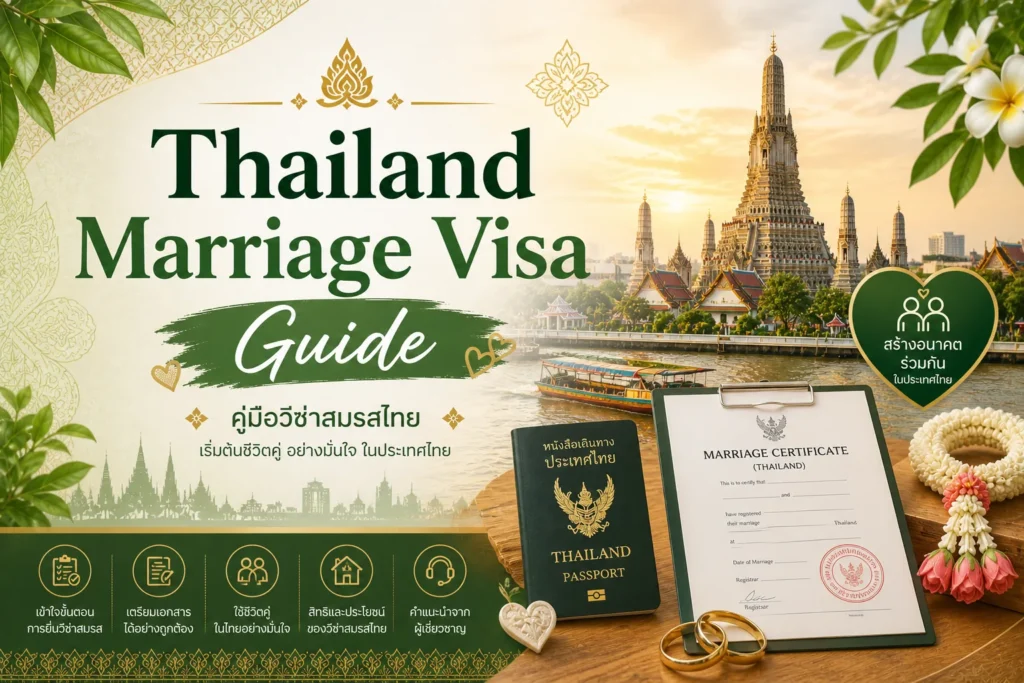
Thailand Marriage Visa Guide: Non-O Visa, Thai Spouse Extension, 400,000 THB Requirement, and Document Checklist
You are married to a Thai citizen and want to live together in Thailand, but the visa information online feels confusing. Some people call it a “marriage visa,” others say “Non-O,” and Immigration may talk about an “extension of stay based on Thai spouse.”
In practice, a Thailand Marriage Visa usually means starting with a Non-Immigrant O Visa based on marriage to a Thai citizen, then applying for a longer stay in Thailand through Thai Immigration. Royal Thai Embassy Singapore states that a Non-Immigrant Visa-O may be granted to applicants lawfully married to a Thai citizen, with single-entry validity of 90 days from the date of issue.
From our visa handling experience, marriage visa cases are rarely about one document only. The strongest applications clearly prove legal marriage, genuine relationship, correct address, spouse involvement, and financial readiness.
What Is a Thailand Marriage Visa?
Usually a Non-Immigrant O Visa plus a marriage-based extension
“Thailand Marriage Visa” is a common name, not always the exact official wording. For a foreign spouse of a Thai citizen, the route is usually connected to a Non-Immigrant O Visa and an extension of stay based on marriage to a Thai national.
| Stage | Where It Is Handled | Practical Caution |
|---|---|---|
| Non-Immigrant O Visa | Royal Thai Embassy, Consulate, or Thai e-Visa where available | This is usually the starting visa, not automatically a one-year stay |
| Extension of Stay Based on Thai Spouse | Thai Immigration office in Thailand | Requires spouse documents, financial proof, and relationship evidence |
| Re-entry Permit | Thai Immigration | Needed before leaving Thailand if you want to preserve your permitted stay |
Official sources to check before applying
Visa rules, forms, financial evidence, and local Immigration practices can change. You can check Non-O spouse visa guidance from the Royal Thai Embassy Singapore, re-entry and extension guidance from Royal Thai Embassy Hanoi, and local document requirements from the Thai Immigration office responsible for your address.
Legal Marriage and Genuine Relationship Requirement
A wedding ceremony alone is not enough
For a Thailand Marriage Visa or marriage-based extension, you need official evidence that you are legally married to a Thai citizen. A wedding party, engagement, religious ceremony, or photos together may support the relationship, but they do not replace legal marriage registration.
From real client cases, applicants often prepare bank documents well but forget the relationship evidence. Immigration may want to understand not only whether the marriage is registered, but also whether the couple genuinely lives as spouses.
| Evidence Type | What It Proves | Common Mistake |
|---|---|---|
| Marriage Certificate | Legal marriage | Only bringing wedding photos or ceremony documents |
| Kor Ror 2 | Current Thai marriage registration record | Using an old record when the office asks for a recent extract |
| Home Photos and Address Evidence | Genuine shared life and residence | Photos do not show couple, house number, or real living space |
Thailand Marriage Visa Financial Requirement
Prepare the financial route early
For a foreign husband married to a Thai woman, Immigration-related guidance commonly refers to either monthly income of at least 40,000 THB or 400,000 THB in a Thai bank account maintained for the required period. Local offices may check the bank letter, passbook, account name, update date, and timing carefully.
| Financial Route | Common Requirement | Practical Warning |
|---|---|---|
| Bank Deposit | 400,000 THB in a Thai bank account for the required period | Last-minute deposits can cause problems |
| Monthly Income | At least 40,000 THB per month for relevant cases | Income proof must be accepted by the local Immigration office |
| Mixed or Special Evidence | Depends on office and case | Do not rely on unofficial advice without checking locally |
Thailand Marriage Visa Documents Checklist
Both spouses’ documents matter
A marriage-based application is not only the foreign spouse’s file. The Thai spouse’s ID card, house registration, signed copies, and attendance may be part of the process. Immigration guidance also indicates that the applicant and Thai spouse or Thai family member may need to appear in person to give evidence.
| Document | Why It Matters | Practical Tip |
|---|---|---|
| Foreign spouse passport | Confirms identity and current stay | Check visa page, entry stamp, and passport validity early |
| Non-O visa | Common starting visa category | Check admitted-until date after entry |
| Marriage certificate | Proves legal marriage | Bring original and signed copies |
| Kor Ror 2 | Confirms current Thai marriage registration | Ask local office how recent it must be |
| Thai spouse ID card | Proves Thai nationality and spouse identity | Use signed copy and bring original where required |
| Thai spouse house registration | Supports spouse identity and address record | Address consistency matters |
| Home photos and map | Supports genuine relationship and residence | Follow local Immigration photo requirements |
How to Apply for a Thailand Marriage Visa
Step 1: Confirm your marriage documents
Start with the marriage record. If married in Thailand, prepare the Thai marriage certificate and updated Kor Ror 2 where required. If married abroad, you may need certified translation, legalization, or Thai registration-related documents.
Step 2: Apply for a Non-Immigrant O Visa
If you are outside Thailand, the common starting point is applying for a Non-Immigrant O Visa based on marriage through a Royal Thai Embassy, Consulate, or Thai e-Visa where available.
Step 3: Enter Thailand and check your stamp
After entering Thailand, check your admitted-until date immediately. Visa validity and permission to stay are not the same.
Step 4: Prepare financial evidence early
If using the bank deposit route, prepare the Thai bank account and required balance early. If using monthly income, check what income proof your local Immigration office accepts.
Step 5: Prepare home and relationship evidence
Prepare home photos, map, rental agreement or house documents, spouse ID, house registration, marriage documents, and children’s birth certificates if relevant.
Step 6: Submit at the Immigration office responsible for your address
Bring originals and signed copies. Both spouses may need to attend. Some offices may take the case under consideration before final approval.
Step 7: Manage re-entry and renewal
If you plan to leave Thailand, check whether you need a re-entry permit before travel. For renewal, prepare early because bank timing, updated marriage records, and fresh photos may be required.
Non-O Visa vs Marriage-Based Extension of Stay
They are connected, but not the same
Many applicants confuse the initial Non-O visa with the long-term marriage-based extension. The Non-O visa is usually the entry route. The extension is handled by Thai Immigration after entering Thailand, if eligible.
| Topic | Non-Immigrant O Visa | Marriage-Based Extension |
|---|---|---|
| Where handled | Embassy, Consulate, or Thai e-Visa | Thai Immigration office |
| Main purpose | Entry based on Thai spouse | Longer stay based on Thai spouse |
| Key proof | Marriage and spouse documents | Marriage, spouse, finances, home, and genuine relationship evidence |
| Common mistake | Thinking it is already a full one-year stay | Preparing financial proof too late |
Can You Work on a Thailand Marriage Visa?
Marriage-based stay is not automatic work permission
A marriage-based stay may allow you to live in Thailand with your Thai spouse, but working in Thailand is a separate legal question. If you want to work for a Thai company, teach, consult locally, run operations, or receive Thai-source employment income, you should review the work permit route.
From real client cases, this misunderstanding creates problems when applicants assume that being married to a Thai citizen automatically allows employment. It does not remove the need to check labour rules.
| Situation | What to Review | Practical Caution |
|---|---|---|
| Living with Thai spouse | Marriage-based stay | Focus on relationship, address, and financial proof |
| Working for Thai company | Work permit process | Marriage visa does not automatically authorize work |
| Changing employer or work role | Work permit update or new application | Do not assume one approval covers all work |
Approved Case vs Delayed Case: What Made the Difference?
From real client cases, consistency matters more than document volume
| Topic | Delayed or Risky Case | Stronger Case |
|---|---|---|
| Marriage proof | Only wedding photos, no legal registration record | Marriage certificate and updated registration evidence are ready |
| Financial proof | 400,000 THB deposited too late or bank letter date does not match | Bank balance, passbook, and bank letter are prepared on time |
| Address evidence | Map, rental contract, photos, and application address do not match | Address story is consistent across documents |
| Spouse involvement | Thai spouse documents missing or spouse cannot attend | Thai spouse’s ID, house registration, signed copies, and attendance are planned |
Common Thailand Marriage Visa Mistakes
1. Thinking a wedding ceremony is enough
A wedding party or religious ceremony does not prove legal marriage. You need official marriage registration documents.
2. Preparing the bank account too late
If using the 400,000 THB bank deposit route, timing matters. Last-minute deposits can create avoidable problems.
3. Missing Thai spouse documents
Thai spouse ID card, house registration, signed copies, and original documents may be required. Do not prepare only the foreign spouse’s documents.
4. Not updating marriage records
Some offices may ask for a recent Kor Ror 2 extract. An old certificate alone may not be enough.
5. Weak home photos
Photos should help confirm the couple’s shared life. Follow local requirements for house number, outside view, inside home, and couple photos.
6. Not appearing together
The Thai spouse may need to appear with the applicant. Plan the appointment around both spouses’ schedules.
7. Forgetting the re-entry permit
If you leave Thailand after receiving an extension without the proper re-entry permit, your permission to stay may be affected.
Summary: Thailand Marriage Visa
Key points to remember:
- A Thailand Marriage Visa usually refers to a Non-Immigrant O route and extension of stay based on marriage to a Thai citizen.
- Legal marriage registration is required.
- The relationship should be genuine in practice, not only on paper.
- For relevant cases, financial evidence may involve 400,000 THB in a Thai bank account or 40,000 THB monthly income.
- The Thai spouse’s documents and attendance often matter.
- Home photos, map, address evidence, and relationship proof can be important.
- A marriage-based stay does not automatically grant work permission.
- Re-entry permit planning is important before leaving Thailand.
- Local Immigration offices may request additional documents.
- Always check the latest official requirements before applying.
Let Co Journey Visa help prepare your Thailand Marriage Visa application
A strong marriage visa file should make your family situation easy to understand: legal marriage, genuine relationship, correct address, spouse involvement, and financial readiness.
ทำไมควรให้ Co Journey Visa ช่วยดูแลวีซ่าของคุณ
การขอ Thailand Marriage Visa อาจมีขั้นตอนที่ซับซ้อนและต้องการความแม่นยำในการเตรียมเอกสาร หากคุณไม่ต้องการให้เกิดความผิดพลาดและต้องการความสะดวกสบายในการดำเนินการ Co Journey Visa พร้อมให้บริการช่วยเหลือคุณในทุกขั้นตอน:
Frequently Asked Questions About Thailand Marriage Visa
What is a Thailand Marriage Visa?
A Thailand Marriage Visa usually refers to a Non-Immigrant O Visa and extension of stay based on marriage to a Thai citizen. The initial visa is commonly handled by a Royal Thai Embassy, Consulate, or Thai e-Visa where available.
How much money do I need for a Thai marriage visa extension?
For a foreign husband married to a Thai woman, Immigration-related guidance commonly refers to either monthly income of at least 40,000 THB or 400,000 THB in a Thai bank account maintained for the required period. Check the latest rule with your local Immigration office before applying.
Does the marriage have to be registered in Thailand?
The marriage must be legally recognized. If you married outside Thailand, you may need translation, legalization, certification, or Thai registration-related documents before applying in Thailand.
Can I work in Thailand on a marriage visa?
Not automatically. A marriage-based stay may allow you to live in Thailand with your Thai spouse, but work permission is separate. If you want to work, you should check the work permit route.
Does my Thai spouse need to go to Immigration with me?
Often, yes. The Thai spouse may need to attend to provide evidence and confirm the relationship. Check the latest requirement with the Immigration office where you will apply.
What documents does the Thai spouse need?
Common documents include Thai ID card, house registration, signed copies, marriage documents, and sometimes additional address or relationship evidence. Local offices may ask for extra documents.
Can I leave Thailand after getting a marriage-based extension?
Yes, but you should check whether you need a re-entry permit before leaving. Without the proper re-entry permit, your permission to stay may be affected when you leave Thailand.
What happens if we divorce?
If the marriage ends, the basis for the marriage-based stay may no longer exist. You should contact Thai Immigration and review another visa route immediately to avoid overstay or status problems.
หากคุณต้องการคำแนะนำเพิ่มเติมหรือต้องการให้ Co Journey Visa ดูแลการยื่นวีซ่าของคุณ ติดต่อเราได้เลย 24 ชั่วโมง
บทความที่เกี่ยวข้อง

ติดตามข้อมูลวีซ่าอัปเดตจาก Co Journey Visa
เพิ่มเว็บไซต์นี้เป็นแหล่งข้อมูลที่ต้องการใน Google เพื่อให้ค้นพบบทความจากเราได้สะดวกขึ้น