
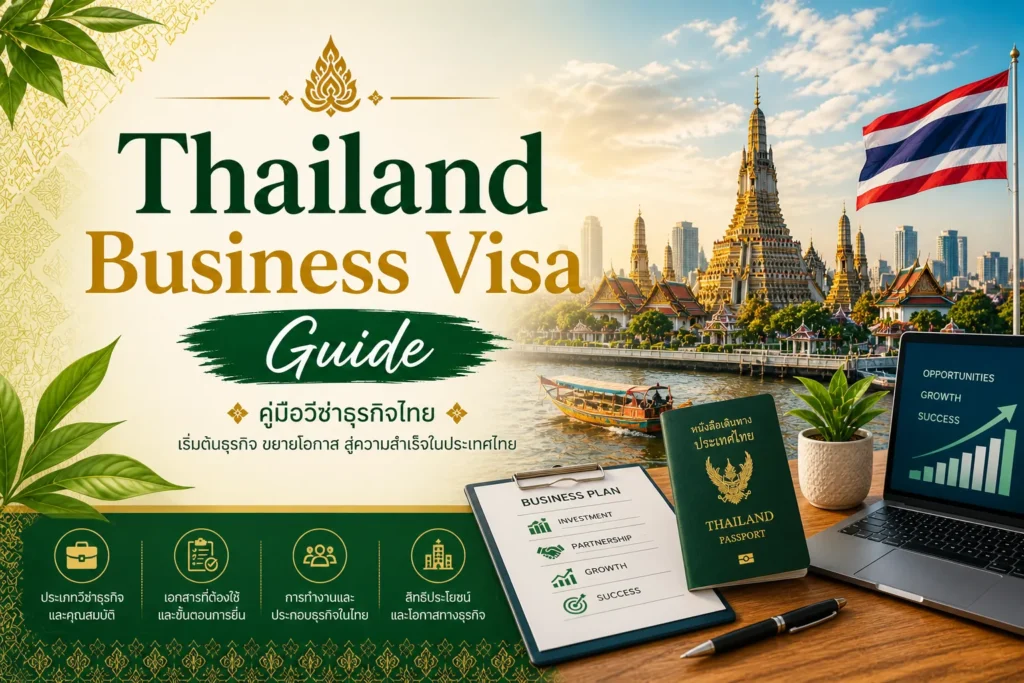
Thailand Business Visa Guide: Non-B Visa, Documents, Invitation Letter, Work Permit Rules, and Application Tips
You have a meeting in Bangkok, a Thai company wants to invite you, or you are exploring an investment opportunity in Thailand. Then the visa question appears: do you need a business visa, a work visa, a tourist visa, or a work permit?
A Thailand Business Visa usually refers to the Non-Immigrant Visa Category “B”, used by foreigners who wish to enter Thailand to conduct business, work, or undertake investment-related activities. It is not automatically a work permit. If the visa holder wants to work in Thailand, official guidance states that they must be granted a work permit before starting work.
From our visa handling experience, the biggest problem is usually not one missing document. It is a purpose mismatch: the applicant says “business meeting,” but the invitation letter sounds like employment, daily operations, or local work.
What Is a Thailand Business Visa?
Usually a Non-Immigrant Visa Category “B”
A Thailand Business Visa is commonly used for business meetings, negotiations, company visits, investment discussions, and business-related travel. The most common category is the Non-Immigrant Visa “B”, often called Non-B.
| Business Purpose | Possible Visa Route | Practical Caution |
|---|---|---|
| Business meetings | Non-B Business | Invitation letter must explain meeting purpose clearly |
| Employment in Thailand | Non-B Employment + Work Permit | Business visa alone is not enough to start work |
| Investment discussion | Non-B / investment-related route | Investment proof may be required depending on case |
Official sources to check before applying
Visa rules, fees, document requirements, and embassy checklists can change. You can check the latest information from the Ministry of Foreign Affairs of Thailand, the official Thai e-Visa website, or the Royal Thai Embassy / Consulate responsible for your location.
Thailand Business Visa vs Work Permit
A Business Visa does not automatically allow work
This is the most important point. A Non-B visa can support a business or work-related purpose, but if you will work in Thailand, you generally need proper work authorization before starting.
From real client cases, many applicants use the word “business” too broadly. Attending a meeting is different from managing operations, serving clients, training staff, or working at a Thai office.
| Activity | Business Visit? | Work Permit Risk |
|---|---|---|
| Attend meetings | Often fits business visit | Lower if genuinely short visit |
| Negotiate partnership | May fit business visit | Documents should show meeting purpose |
| Manage daily operations | May look like work | Work permit route should be reviewed |
| Take a paid position in Thailand | Employment case | Work permit generally required |
Thailand Business Visa Documents Checklist
The invitation letter and Thai company documents are critical
A strong Thailand Business Visa application should show who is inviting you, why you are traveling, how long you will stay, who covers expenses, and whether the activity is only a business visit or actual work.
| Document | Why It Matters | Practical Tip |
|---|---|---|
| Passport | Confirms identity and travel eligibility | Keep at least 6 months validity where required |
| Visa application form | Main application record | Details must match passport and invitation letter |
| Recent photo | Applicant identification | Follow embassy size and format |
| Business invitation letter | Explains purpose of visit | Include dates, meeting purpose, relationship, and signatory |
| Thai company documents | Proves Thai counterpart exists | Use updated registration, shareholder list, VAT, and balance sheet if requested |
| Travel and accommodation proof | Shows visit timeline | Dates should match the invitation letter |
How to Write a Strong Business Invitation Letter
The letter should explain the business purpose clearly
From real client cases, a weak invitation letter is one of the most common reasons for follow-up questions. A strong letter should not be vague. It should show exactly why the applicant needs to visit Thailand.
| Strong Invitation Letter | Weak Invitation Letter |
|---|---|
| States applicant name, passport number, visit dates, and meeting purpose | Only says “please issue visa for business purpose” |
| Explains relationship between companies | Does not explain why the applicant is invited |
| Signed by authorized person and stamped where used | No signatory name, title, or company contact |
| Uses wording consistent with business visit | Uses wording that sounds like employment or daily work |
Single-Entry, Multiple-Entry, and 3-Year Business Visa
Choose based on your real travel pattern
A single-entry Non-B may be enough for one business trip. A multiple-entry visa may be more practical if you need repeated visits. Thailand also has a 3-year Non-Immigrant “B” visa for certain business visitors, but official MFA guidance states that employment of any kind is strictly prohibited for holders of that visa.
| Entry Type | Best For | Important Caution |
|---|---|---|
| Single Entry | One business trip | Leaving Thailand normally uses the entry |
| Multiple Entry | Repeated visits, negotiations, regional business trips | Itinerary should explain multiple entries |
| 3-Year Non-B Business Visa | Frequent business visitors | Employment is strictly prohibited |
How to Apply for a Thailand Business Visa
Step 1: Define your real purpose
Write your purpose in one sentence: “I am visiting Thailand for three days to meet a distributor,” “I am exploring investment,” or “I am entering to begin employment after work permit planning.” This sentence should guide the whole file.
Step 2: Choose the correct Non-B route
Business visit, employment, investment, and frequent business travel are not identical. Choose the route that matches the real activity.
Step 3: Prepare applicant documents
Prepare passport, application form, photo, proof of current location if required, travel itinerary, accommodation, financial evidence, overseas employer letter, or business registration if self-employed.
Step 4: Prepare Thai counterpart documents
Ask the Thai company for invitation letter, company registration, shareholder list, VAT registration, balance sheet, company profile, authorized signatory document, and company stamp where required.
Step 5: Apply through the correct channel
Depending on your current location, you may apply through the official Thai e-Visa system, Royal Thai Embassy, or Royal Thai Consulate-General.
Step 6: Review before submission
Check passport details, travel dates, company names, invitation wording, signatory, stamps, financial documents, and uploaded PDF quality before payment.
Step 7: Check your entry stamp after arrival
Visa validity and permitted stay are not the same. After arrival, check the admitted-until date immediately.
Approved Case vs Delayed Case: What Made the Difference?
From real client cases, the strongest file is clear within the first minute
| Topic | Delayed or Risky Case | Stronger Case |
|---|---|---|
| Purpose | Says business visit but documents suggest employment | Purpose, invitation, and itinerary clearly match business visit |
| Invitation letter | Vague letter with no dates or meeting details | Letter explains who, why, when, and company relationship |
| Thai company documents | Old registration, missing shareholder list, unclear VAT record | Updated company file with clear signatory and stamp |
| Entry type | Single entry selected despite repeated visits | Entry type matches actual business travel pattern |
Common Thailand Business Visa Mistakes
1. Treating a Business Visa as a work permit
A Non-B visa may support business or work-related entry, but it does not automatically authorize employment. Work requires proper authorization.
2. Using a Tourist Visa for business purpose
If the real purpose is business meetings, negotiations, or company visits, a Tourist Visa may not match the case.
3. Submitting a weak invitation letter
A vague letter can make the officer question the purpose. Use clear dates, meeting details, relationship, and company contact.
4. Using outdated company documents
Company registration, balance sheet, VAT documents, and shareholder lists may need recent versions.
5. Confusing visa validity with stay length
Visa validity is not the same as permission to stay. Always check the entry stamp after arrival.
6. Applying for single entry when multiple entries are needed
If your business plan includes repeated Thailand visits, single entry may create unnecessary problems.
7. Not checking local embassy rules
Thai e-Visa and embassy checklists may vary by passport country, current location, visa type, purpose, and entry type.
Summary: Thailand Business Visa
Key points to remember:
- A Thailand Business Visa usually refers to the Non-Immigrant Visa Category “B”.
- It may be used for business visits, meetings, negotiations, investment discussions, and some work-related routes.
- A Business Visa is not automatically a work permit.
- If you will work in Thailand, you must review the work permit route before starting.
- A strong invitation letter is essential.
- Thai company documents are often as important as applicant documents.
- Single entry, multiple entry, and 3-year Non-B serve different purposes.
- The 3-year Business Visa is for business visits, and employment is strictly prohibited.
- Always check the latest official requirements before applying.
Let Co Journey Visa help prepare your Thailand Business Visa application
A strong business visa file should make the purpose obvious: who invited you, why you are visiting, what business activity will happen, how long you will stay, and whether the case is a business visit or employment route.
ทำไมควรให้ Co Journey Visa ช่วยดูแลวีซ่าของคุณ
การขอ Thailand Business Visa อาจมีขั้นตอนที่ซับซ้อนและต้องการความแม่นยำในการเตรียมเอกสาร หากคุณไม่ต้องการให้เกิดความผิดพลาดและต้องการความสะดวกสบายในการดำเนินการ Co Journey Visa พร้อมให้บริการช่วยเหลือคุณในทุกขั้นตอน:
Frequently Asked Questions About Thailand Business Visa
What is a Thailand Business Visa?
A Thailand Business Visa usually means a Non-Immigrant Visa Category “B” for foreigners entering Thailand to conduct business, work, or undertake investment-related activities.
Does a Thailand Business Visa allow me to work?
Not by itself. If you will work in Thailand, you generally need proper work authorization before starting work. A business visa and a work permit are not the same.
How long can I stay with a Thailand Business Visa?
It depends on the visa issued and the entry stamp. Some embassy guidance states that a Non-Immigrant single-entry visa is valid for 3 months from issuance, and the stay may be up to 90 days from entry. Always check your entry stamp after arrival.
What documents are needed for a Thailand Business Visa?
Common documents include passport, application form, photo, business invitation letter, Thai company documents, travel booking, accommodation proof, and financial evidence. The exact checklist depends on the embassy or e-Visa system.
Can I attend meetings in Thailand on a Business Visa?
Yes, a business visa is commonly used for meetings, negotiations, and company visits when the purpose fits the visa category. Your invitation letter should clearly explain the meeting purpose and dates.
Is a Business Visa the same as a Non-B Visa?
In many cases, yes. The common Thailand Business Visa is the Non-Immigrant Visa Category “B”, often called Non-B. However, business visit, employment, and investment purposes may require different supporting documents.
Can I apply for a Thailand Business Visa online?
In many locations, yes. The official Thai e-Visa system lets applicants create an account, complete the form, upload documents, pay the visa fee, wait for processing, and receive the e-Visa confirmation by email.
What is the 3-year Thailand Business Visa?
The 3-year Non-Immigrant “B” visa may be issued to businesspeople for multiple entries. It is valid for 3 years and allows stays not exceeding 90 days per visit. Employment of any kind is strictly prohibited for this visa type.
หากคุณต้องการคำแนะนำเพิ่มเติมหรือต้องการให้ Co Journey Visa ดูแลการยื่นวีซ่าของคุณ ติดต่อเราได้เลย 24 ชั่วโมง
บทความที่เกี่ยวข้อง
ติดตามข้อมูลวีซ่าอัปเดตจาก Co Journey Visa
เพิ่มเว็บไซต์นี้เป็นแหล่งข้อมูลที่ต้องการใน Google เพื่อให้ค้นพบบทความจากเราได้สะดวกขึ้น