
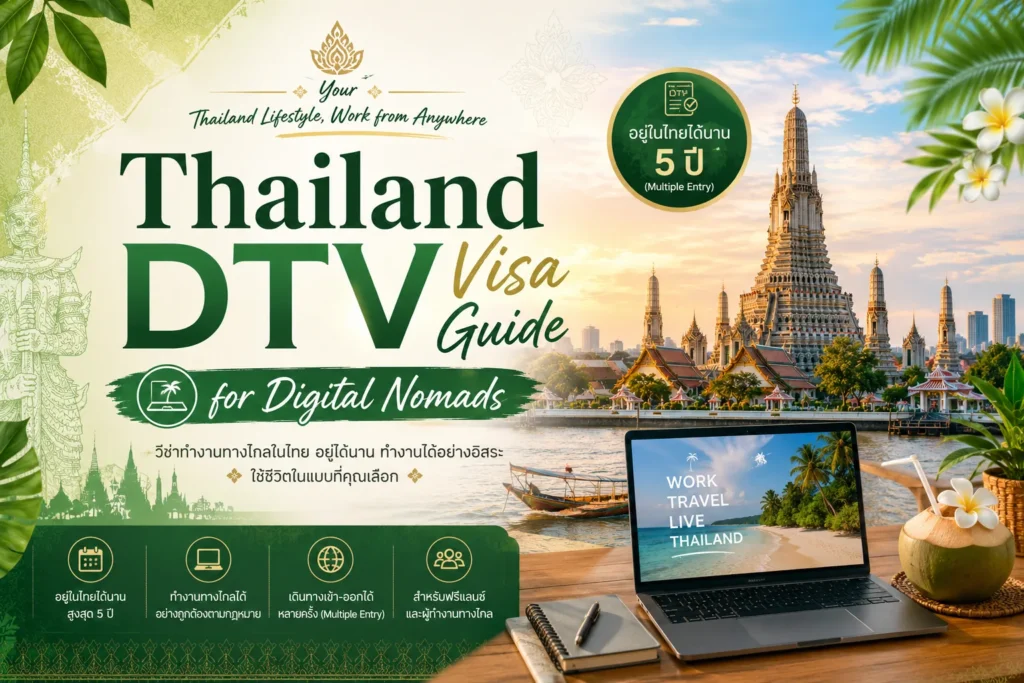
Thailand DTV Visa Guide for Digital Nomads: Requirements, Documents, 500,000 THB Financial Proof, and Application Tips
You want to spend months in Thailand, keep working with overseas clients or your foreign employer, and avoid the stress of border runs or using the wrong visa. Then you hear about the Thailand DTV Visa — but the details can feel scattered: 5 years, 180 days, 500,000 THB, digital nomads, soft power, dependents, and extension rules.
The Thailand DTV Visa, officially called the Destination Thailand Visa, is a long-stay multiple-entry visa for eligible foreign nationals, including digital nomads, remote workers, freelancers, foreign talents, people joining Thai soft power activities, and eligible family members of DTV holders.
From our visa handling experience, many weak DTV applications do not fail because the applicant cannot work online. They fail because the documents do not clearly prove remote work, foreign income, financial readiness, or the correct DTV category.
What Is the Thailand DTV Visa?
A long-stay visa for digital nomads, remote workers, freelancers, soft power participants, and eligible dependents
Thailand DTV Visa is designed for eligible foreigners who want a longer and more flexible stay in Thailand. Official embassy guidance commonly lists three major groups: Workcation, Thai soft power activities, and dependents of DTV holders.
| DTV Category | Best For | Practical Caution |
|---|---|---|
| Workcation | Digital nomads, remote workers, foreign talents, freelancers | You must prove your professional status clearly |
| Thai Soft Power Activities | Muay Thai, Thai cooking, medical treatment, training, approved activities | Activity documents should be official and verifiable |
| Dependents | Spouse and children under 20 of DTV holders | Relationship documents must be easy to verify |
Official sources to check before applying
DTV rules, visa fees, document lists, and extension conditions can change. You can check the latest details from the Royal Thai Embassy London DTV page, the Royal Thai Consulate-General Los Angeles DTV page, or the official Thai e-Visa website.
Thailand DTV Visa Validity and Stay Length
5-year validity does not mean 5 years of continuous stay
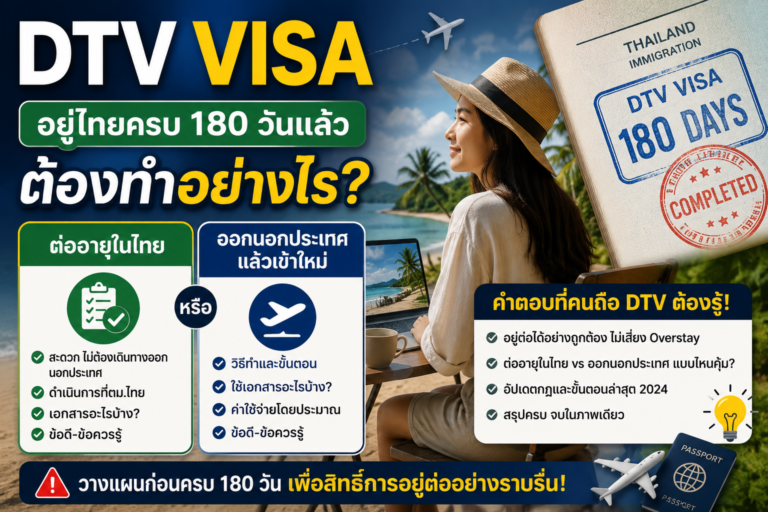
Official embassy guidance commonly lists the Thailand DTV Visa as valid for 5 years with multiple entries and a period of stay of 180 days per entry. Royal Thai Embassy London also states that extension through Thai Immigration may be possible one time for a period not exceeding another 180 days per entry.
From real client cases, this is one of the most misunderstood points. DTV is flexible, but you still need to follow entry, stay, extension, and re-entry rules.
| Item | Common Official Guidance | Practical Tip |
|---|---|---|
| Visa validity | 5 years | This is the visa validity, not continuous stay permission |
| Entry type | Multiple entries | Useful for nomads who travel in and out of Thailand |
| Stay per entry | 180 days per entry | Always check your entry stamp after arrival |
| Extension | Possible one-time extension up to another 180 days per entry, depending on Immigration | Do not assume extension is automatic |
Thailand DTV Visa Financial Requirement: 500,000 THB
Financial evidence must be clear, recent, and easy to verify
Several official Thai embassy and consulate pages list financial evidence of at least 500,000 THB or equivalent for DTV applications. Examples may include bank statements, savings or checking account statements, or sponsorship evidence depending on the embassy and applicant category.
From our visa handling experience, the strongest financial files are not just high-balance files. They are clean files showing account ownership, date, currency, full pages, and a reasonable source of funds.
| Strong Financial Proof | Weak Financial Proof |
|---|---|
| Bank statement shows name, bank, currency, date range, and balance | Screenshot shows only balance with no name or date |
| Funds are stable or supported by income / business records | Large deposit appears right before applying with no explanation |
| If sponsored, sponsor letter and sponsor bank proof are included | Sponsor letter is included but no relationship or financial proof |
DTV Visa Documents for Digital Nomads and Remote Workers
The real challenge is proving your work status
For digital nomads, the most relevant DTV category is usually Workcation. Official guidance describes this group as digital nomads, remote workers, foreign talents, and freelancers.
From real client cases, weak DTV applications often include only a portfolio or self-written explanation. A stronger file uses documents that prove the same story from different angles: work status, income, clients, employer, business activity, and financial ability.
| Applicant Type | Documents That Help | Technique to Strengthen the File |
|---|---|---|
| Remote employee | Employment contract, employment certificate, payslips, employer letter | Ask the employer letter to mention role, company, and remote work arrangement |
| Freelancer | Portfolio, client contracts, invoices, payment records, tax records | Connect client work to income and bank deposits |
| Online business owner | Business registration, website, invoices, payment records, business profile | Show how the business operates outside Thailand |
| Foreign talent / professional | Professional profile, portfolio, media, certificates, contracts | Make the professional identity easy to verify |
How to Apply for Thailand DTV Visa as a Digital Nomad
Step 1: Confirm that DTV fits your real purpose
Ask whether you work remotely for a foreign employer, serve overseas clients, run an online business, or have a professional profile that supports digital nomad or freelance status.
Step 2: Identify your DTV category
For digital nomads, this is usually Workcation. If you are applying for Muay Thai, Thai cooking, medical treatment, training, or dependent status, your documents should match that category instead.
Step 3: Prepare core documents
Prepare passport biodata page, recent photo, proof of current location, financial evidence, and documents proving your DTV category.
Step 4: Build strong remote work evidence
Use employment certificate, remote work letter, freelance contracts, invoices, portfolio, business registration, payment records, and tax records where relevant.
Step 5: Prepare financial proof carefully
Do not treat the 500,000 THB requirement as only a last-minute balance target. Prepare complete statements that show ownership, currency, dates, balance, and stable activity where possible.
Step 6: Check translation and notarization rules
Some embassies have specific language and certification rules. For example, certain embassy guidance requires supporting materials issued outside specific countries to be accompanied by certified English translations and notarization.
Step 7: Submit through the correct embassy or e-Visa channel
Depending on your current location, you may apply through the Thai e-Visa system or follow embassy-specific procedures. Check local fee, document format, processing rules, and jurisdiction before submission.
Thailand DTV Visa Checklist for Digital Nomads
| Item | Why It Matters | Practical Tip | Done |
|---|---|---|---|
| Passport biodata page | Confirms identity | Passport should usually be valid at least 6 months from travel date | ☐ |
| Recent photo | Required for visa application | Use a clear photo taken within the required period | ☐ |
| Proof of current location | Shows where you are applying from | Use accepted proof such as residence permit, driving license, bank statement, or proof of stay | ☐ |
| Financial evidence | Shows ability to support long stay | Several embassies list at least 500,000 THB or equivalent | ☐ |
| Remote work proof | Proves Workcation category | Use employment certificate, contract, portfolio, invoices, or client records | ☐ |
| Translation / notarization | Prevents document rejection | Check embassy-specific rules before submission | ☐ |
DTV vs Other Thailand Visa Options for Remote Workers
DTV may be ideal, but it is not the only route
Thailand DTV Visa can be a strong option for remote workers and freelancers. But if your real purpose is tourism, formal study, Thai employment, retirement, or family stay, another visa may fit better.
| Visa Option | Best For | Key Benefit | Main Caution |
|---|---|---|---|
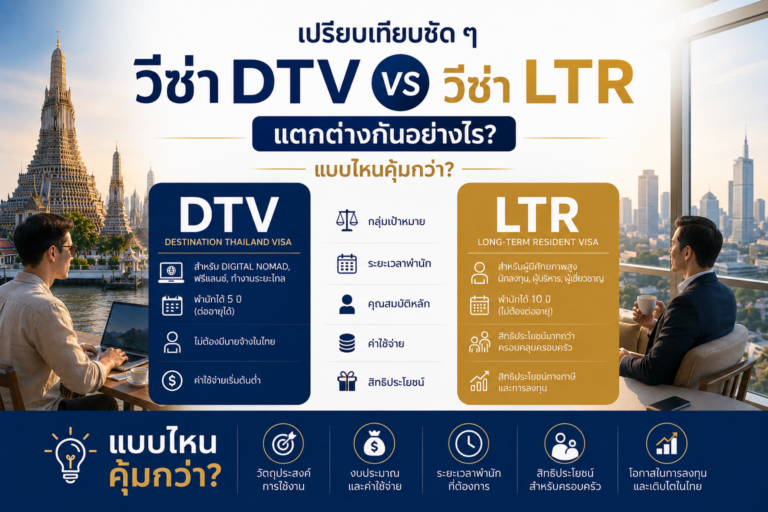
| DTV Visa | Digital nomads, remote workers, freelancers, soft power participants | 5-year multiple-entry visa with 180 days per entry | Must prove purpose and financial readiness |
| Tourist Visa | Tourism stay | Simpler for normal travel | Not designed for long-term remote-work lifestyle |
| ED Visa | Formal study in Thailand | Suitable for genuine education purpose | Must match real study activity |
| Non-B Visa | Employment or business in Thailand | Correct route for Thai employment | Usually requires employer documents and work permit process |
Approved Case vs Delayed Case: What Made the Difference?
From real client cases, consistency is the strongest advantage
| Topic | Delayed or Risky Case | Stronger Case |
|---|---|---|
| Work proof | Only says “I work online” with no contracts or portfolio | Employment certificate, contract, portfolio, invoices, and payment proof support the story |
| Financial proof | 500,000 THB appears suddenly with no explanation | Statement shows clear ownership, currency, date range, and source of funds |
| Category | Mixes remote work, Muay Thai, and tourism with no clear category | Documents match one clear DTV category |
| Dependents | Spouse or child included with missing relationship proof | Marriage certificate, birth certificate, or adoption certificate included and readable |
Common Thailand DTV Visa Mistakes
1. Thinking “online work” is enough
Saying you work online is not the same as proving it. A stronger application includes contracts, certificates, portfolio, invoices, payment records, or employer confirmation.
2. Showing money without proving work status
Financial proof is important, but DTV Workcation also needs proof of purpose. Without work evidence, the case may look like a long tourist stay.
3. Using a last-minute deposit
A sudden large deposit can raise questions. If your balance recently increased, explain the source with supporting documents.
4. Applying under the wrong category
DTV has different categories. A remote worker file should not look like a Muay Thai course file unless both are clearly supported and accepted by the embassy.
5. Assuming all embassies use the same checklist
Different embassies may ask for different proof, fee amounts, translations, or current-location documents.
6. Believing DTV allows any work in Thailand
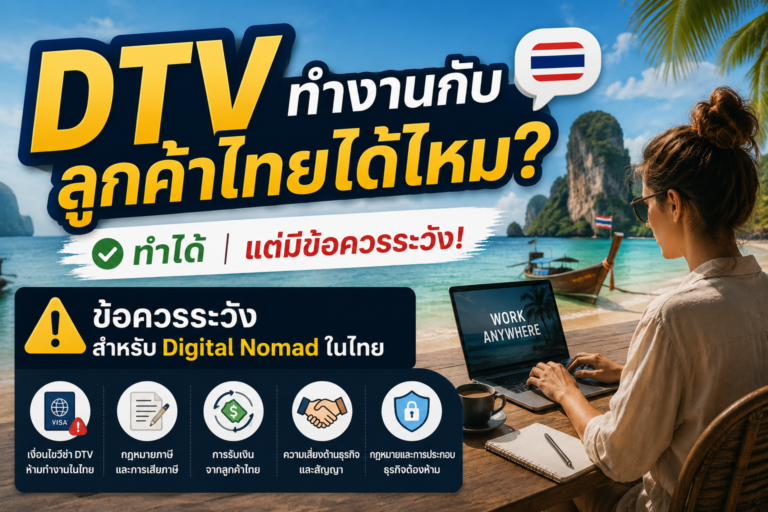
DTV is often discussed as a digital nomad visa, but it is not a general visa for local Thai employment. If you plan to work for a Thai company, check the correct Non-Immigrant and work permit route.
7. Ignoring dependent documents
Spouse and children under 20 need their own supporting documents, including proof of relationship and DTV holder details.
Summary: Thailand DTV Visa for Digital Nomads
Key points to remember:
- Thailand DTV Visa is officially called the Destination Thailand Visa.
- It is commonly used by digital nomads, remote workers, freelancers, foreign talents, soft power participants, and eligible dependents.
- Official embassy guidance commonly lists 5-year validity, multiple entries, and 180 days per entry.
- Extension through Thai Immigration may be possible, but it is not automatic.
- Several Thai embassy sources list financial evidence of at least 500,000 THB or equivalent.
- Digital nomads should prepare strong remote work proof, not only financial proof.
- DTV is not a general Thai employment visa.
- Embassy checklists can differ by location.
- Dependents need relationship documents and supporting evidence.
- Always check the latest official requirements before applying.
Let Co Journey Visa help prepare your Thailand DTV Visa application
A strong DTV application should clearly show who you are, how you work, where your income comes from, why DTV fits your stay, and how you can support yourself in Thailand.
ทำไมควรให้ Co Journey Visa ช่วยดูแลวีซ่าของคุณ
การขอ Thailand DTV Visa อาจมีขั้นตอนที่ซับซ้อนและต้องการความแม่นยำในการเตรียมเอกสาร หากคุณไม่ต้องการให้เกิดความผิดพลาดและต้องการความสะดวกสบายในการดำเนินการ Co Journey Visa พร้อมให้บริการช่วยเหลือคุณในทุกขั้นตอน:
Frequently Asked Questions About Thailand DTV Visa
What is the Thailand DTV Visa?
Thailand DTV Visa, or Destination Thailand Visa, is a long-stay multiple-entry visa for eligible travelers such as digital nomads, remote workers, freelancers, foreign talents, people joining Thai soft power activities, and eligible family members of DTV holders.
How long can digital nomads stay in Thailand with DTV?
Official embassy guidance commonly lists 180 days per entry. Royal Thai Embassy London also states that a one-time extension through Thai Immigration may be possible for a period not exceeding another 180 days per entry.
How long is the Thailand DTV Visa valid?
Several official embassy pages list DTV validity as 5 years with multiple entries. This does not mean you can stay in Thailand continuously for 5 years without following stay and re-entry rules.
How much financial proof is required for Thailand DTV Visa?
Many official Thai embassy and consulate pages list financial evidence of at least 500,000 THB or equivalent. Examples may include bank statements or sponsorship evidence depending on embassy and applicant category.
Can freelancers apply for Thailand DTV Visa?
Yes, freelancers may fall under the Workcation category if they can prove their professional status. Useful documents may include portfolio, client contracts, invoices, payment records, business registration, tax records, and professional profiles.
Can I work for a Thai company with DTV?
DTV is not a general Thai employment visa. It is mainly designed for remote work, digital nomad activity, foreign talent, freelancing, soft power participation, or eligible dependent stay. If you plan to work for a Thai employer, check the correct Non-Immigrant visa and work permit route.
Can my spouse or child apply with me for DTV?
Yes. Official DTV categories include spouse and children under 20 years old of DTV visa holders. They need supporting documents such as passport, photo, proof of location, financial evidence, DTV holder details, and proof of relationship.
Do DTV documents need to be translated?
It depends on where you apply and where the documents were issued. Some embassies have strict rules for certified English translations and notarization. Check the exact rule for your embassy before submitting.
หากคุณต้องการคำแนะนำเพิ่มเติมหรือต้องการให้ Co Journey Visa ดูแลการยื่นวีซ่าของคุณ ติดต่อเราได้เลย 24 ชั่วโมง
บทความที่เกี่ยวข้อง
ติดตามข้อมูลวีซ่าอัปเดตจาก Co Journey Visa
เพิ่มเว็บไซต์นี้เป็นแหล่งข้อมูลที่ต้องการใน Google เพื่อให้ค้นพบบทความจากเราได้สะดวกขึ้น