

An Indian professional working in Bangkok, a Pakistani national holding a Thai work permit, a Chinese national with a long-term Thai visa, and a European retiree living in Phuket may all legally reside in Thailand—but their Malaysia entry requirements may be completely different.
The reason is simple: Malaysia generally looks first at your passport nationality and purpose of travel. Your Thai visa, work permit or residence status is relevant because it may prove that you are lawfully residing in Thailand, but it does not normally change the visa requirement attached to your passport.
Therefore, before arranging a Malaysia visa as a foreign resident of Thailand, do not ask only “Can I apply from Thailand?” Instead, answer three questions together: What passport do you hold? What will you do in Malaysia? What legal status do you currently hold in Thailand?
1. Thai residence does not change your passport nationality. Malaysia visa-exemption or visa-required rules begin with the passport you use to travel.
2. For tourist or social visits where a visa is required, the official MyVISA eVISA system may be available. Malaysia Immigration announced that eVISA applications are available to eligible foreign nationals who require a visa and whose countries maintain diplomatic relations with Malaysia.
3. For work, study or long-term purposes, do not start with a tourist eVISA. You may first need an Employment Pass, Professional Visit Pass, Student Pass or another approval such as VDR, eVDR or eVAL, followed by an entry visa if your nationality requires one.
4. Multiple Entry Visa rules changed in September 2026. Older guidance suggesting that MEV is open to all nationalities should not be relied on because Malaysia Immigration announced on 2 September 2026 that MEV would no longer be available for all nationalities.
💬 Not Thai, but holding a Thai visa or work permit and planning to travel to Malaysia?
Send us your passport nationality, Thai immigration status and purpose of travel so we can help identify whether your case should start with visa exemption, eVISA, VDR or another Malaysia pass route.
📋 Table of Contents
- Does Malaysia look at nationality or Thai residence first?
- Visa, eVisa, VDR and Pass: what is the difference?
- Who needs a Malaysia visa?
- When should a foreign resident of Thailand use Malaysia eVISA?
- Can you apply through the Malaysian Embassy in Bangkok?
- India and China passport holders in 2026
- What changed with Multiple Entry Visa?
- Which route applies if you are going to work?
- Which route applies if you are going to study?
- Which family pass may apply?
- Long-stay options such as MM2H
- Do you still need MDAC if you have a visa?
- What should you check before entering by land?
- Decision flow for choosing the correct route
- Common mistakes
- Official sources to verify
- Frequently asked questions
If You Live in Thailand, Does Malaysia Look at Your Thai Visa or Your Passport Nationality First?
Start with your passport nationality.
The Immigration Department of Malaysia publishes visa requirements by country. The requirement is linked to the nationality of the travel document used to enter Malaysia—not simply to the country where the traveler currently lives.
This means:
- A Thailand Non-B visa does not give you the same Malaysia entry privileges as a Thai passport holder.
- A Thai work permit does not exempt you from a Malaysia visa if your nationality is visa-required.
- A Thai retirement visa does not cause Malaysia to treat you as a Thai national.
- However, your Thai visa or residence status may help prove that you are legally residing in Thailand when you apply from Thailand.
Passport → Purpose → Thailand Status → Malaysia Entry Route
Not: “I live in Thailand, so I use the same rules as Thai citizens.”
Malaysia Visa, eVisa, VDR and Pass: What Is the Difference?
Visa terminology is often mixed together, but these documents serve different purposes in Malaysia’s immigration system.
| Term | Purpose | Examples |
|---|---|---|
| Visa | Authorization required by certain nationalities to travel to Malaysia for entry consideration | Single Entry Visa, Transit Visa |
| eVISA | A Malaysian visa applied for and issued online through MyVISA | Tourist/social visit eVISA or an entry eVISA linked to an approved VDR/eVAL case |
| VDR / eVDR / eVAL | An approval issued before the visa stage for certain employment, study or long-term applications | Visa Approval Letter for expatriates or students |
| Pass | Immigration status that allows a specific activity or longer stay in Malaysia | Employment Pass, Student Pass, Dependant Pass |
| MDAC | Digital arrival information | Not a visa and not an immigration pass |
Current MyVISA terms state that eVISA holders must not take unauthorized employment or study without the appropriate status. An approved eVISA also does not guarantee admission because final entry remains subject to Immigration control at the border.
Who Needs a Malaysia Visa When Living in Thailand?
Check the Immigration Department of Malaysia’s current Visa Requirement by Country list and search for the nationality shown in your passport.
Current visa-required examples include nationalities such as Bangladesh, Bhutan, Nepal, Pakistan and Sri Lanka, among others, although individual countries may have special arrangements or temporary exemptions.
Malaysia Immigration marks certain nationalities in its country table with a note stating that they are allowed to enter Malaysia by air only. If you live in Thailand and plan to drive, take a bus or cross by train, check this restriction before making travel arrangements.
If your passport is visa-exempt for qualifying social visits, you may not need a tourist visa, but you still need to check permitted stay, MDAC and the other applicable entry requirements.
How Does Malaysia eVISA Work for Foreigners Living in Thailand?
Malaysia Immigration announced on 19 August 2025 that eVISA applications are available to foreign citizens who require a visa and whose countries maintain diplomatic relations with Malaysia.
For foreign residents of Thailand, this is useful because the application is online. You do not need to be a Thai citizen simply because you are applying while residing in Thailand. However, eligibility still depends on nationality, passport type and purpose of travel.
Documents MyVISA may require or use for assessment
- Passport biodata page with sufficient validity
- Passport-style photograph
- Confirmed return or onward ticket where applicable
- Proof of paid accommodation
- Bank statement or other evidence of sufficient funds where required
- Thai visa, current-country residence pass or other long-term Thai status when relevant
- Invitation letter or supporting documents depending on travel purpose
MyVISA documentation refers to a current residing-country pass or visa and long-term pass as possible supporting evidence. Your Thailand Non-B, Non-O, LTR or other lawful status may therefore help prove that you are legally residing in Thailand—but it does not change your Malaysia visa requirement based on nationality.
MyVISA also states that applicants cannot apply for an eVISA while they are physically inside Malaysia. If you are residing in Thailand, arrange the application before entering Malaysia rather than entering first and attempting to obtain a tourist eVISA after arrival.
Is eVISA Validity the Same as the Length of Stay?
No. These are different concepts.
MyVISA terms describe a Single Entry Visa as being usable for one journey during the period of visa validity. Current system guidance may provide a validity period of several months for certain SEV cases.
A visa may remain valid for months, but the number of days you are actually allowed to remain in Malaysia depends on your nationality, visa type and the period granted at entry. Never interpret “valid for 6 months” as permission to remain in Malaysia for 6 months.
Can Foreigners Living in Thailand Apply Through the Malaysian Embassy in Bangkok?
The Embassy of Malaysia in Bangkok maintains guidance specifically for foreign applicants, including documentation for Single Entry Visa, Single Entry Visa with Reference and Multiple Entry Visa applications.
For a Single Entry Visa, the embassy currently lists supporting documents such as:
- Passport with sufficient validity
- Photograph
- Visa application form
- Invitation letter where relevant
- Details of the inviter
- Confirmed return ticket
- Accommodation evidence
- Proof of sufficient funds
For a Single Entry Visa with Reference, an approval letter issued by Malaysian Immigration or another relevant authority is an important part of the application.
Do not choose only based on convenience. Check MyVISA eligibility and Embassy Bangkok guidance for your nationality, passport type and travel purpose. Certain travel documents or circumstances may require direct consular handling.
Indian and Chinese Passport Holders Living in Thailand: What Changed in 2026?
🇮🇳 Indian Passport
Malaysia Immigration’s current Visa Requirement by Country page states that Indian citizens are visa-exempt until 31 December 2026 under the applicable conditions.
Therefore, an Indian resident of Thailand traveling for a qualifying social or tourist visit should check the current exemption before paying for an eVISA unnecessarily.
🇨🇳 Chinese Passport
From 17 July 2025, the Malaysia–China Mutual Visa Exemption arrangement allows qualifying holders of ordinary or public affairs passports to make eligible social visits for up to 30 days per entry, with a maximum of 90 days within 180 days.
Whether you are an Indian or Chinese national, employment, study and other long-term activities still require the relevant approval and immigration pass.
Is Malaysia Multiple Entry Visa Still Available to Every Nationality in 2026?
This is one area where older online guidance can be misleading.
Previous eVISA FAQs and terms used broader language around Multiple Entry Visa availability.
However, Malaysia Immigration issued a new announcement dated 2 September 2026 stating that “Multiple Entry Visa (MEV) will no longer be available for all nationalities.”
If you need frequent entry into Malaysia, check the current options shown in MyVISA for your nationality and confirm with the Malaysian Embassy in Bangkok where necessary.
Embassy Bangkok still publishes a document checklist for MEV applications, including items such as flight bookings, accommodation, bank statements, company letters, business invitations and previous Malaysia entry records, but eligibility must now be read together with the September 2026 Immigration announcement.
If You Get a Job in Malaysia While Living in Thailand, Do You Apply for a Tourist eVisa or an Employment Pass First?
Start with the employment approval route, not a tourist eVISA.
| Work Structure | Route to Check First |
|---|---|
| Direct employment with a Malaysian company | Employment Pass (EP) |
| Foreign company sends you temporarily to Malaysia for professional services or a technical project | Professional Visit Pass (PVP) under the relevant category |
| Temporary foreign worker in an approved sector | Check Visitor’s Pass (Temporary Employment) and the relevant approvals |
For Employment Pass cases, Malaysia introduced revised salary categories effective 1 June 2026. The Malaysian employer or sponsoring company generally handles the relevant approval process. Once approval is granted, visa-required nationals may also need VDR/eVISA steps before traveling to Malaysia.
Work authorization is country-specific. Permission to work in Thailand does not provide any right to work in Malaysia.
If You Live in Thailand and Plan to Study in Malaysia, Do You Need eVISA or Student Pass?
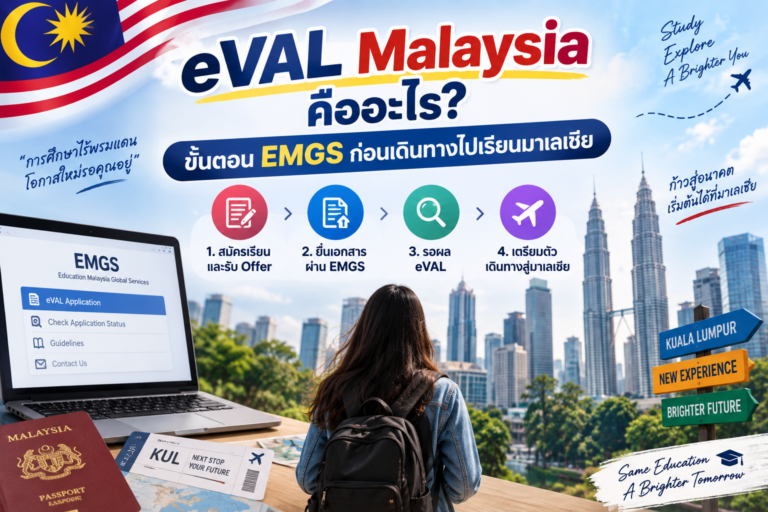
For a course that requires a Student Pass, start with the Student Pass process through the institution and EMGS route—not with a tourist eVISA.
The Malaysian education institution first confirms admission.
Documents are reviewed through the Education Malaysia process.
The electronic Visa Approval Letter is the pre-travel approval.
eVISA or SEV may be required after eVAL depending on nationality.
New students still complete post-arrival procedures after entering Malaysia.
Your Thailand student visa or residence status may prove lawful residence in Thailand, but it does not replace the Malaysia eVAL or Student Pass process.
If You Are Moving to Malaysia With a Spouse or Parent, Do You Need a Visa or a Family Pass?
If the principal applicant works in Malaysia on an Employment Pass, eligible family members may fall under routes such as:
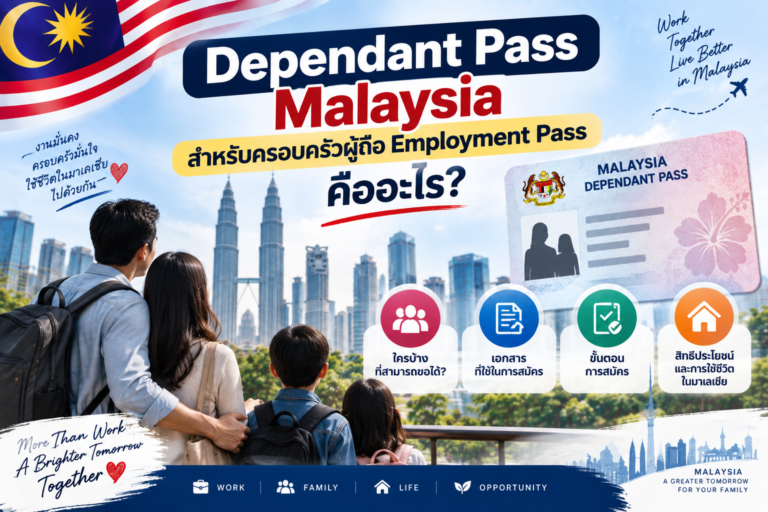
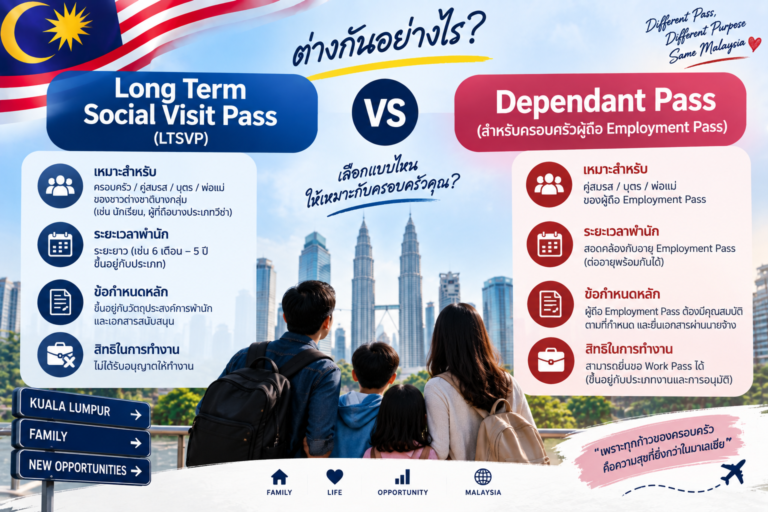
- Dependant Pass — commonly for eligible spouses and children
- Long-Term Social Visit Pass — for certain other family members such as parents or older children under the current ESD categories
A family pass deals with longer-term immigration status, while a visa deals with the entry requirement attached to the traveler’s passport. A visa-required dependant may therefore still need a VDR/eVISA stage after family-pass approval and before entering Malaysia.
If You Are an Expat or Retiree in Thailand and Want to Move to Malaysia Long-Term, What Options Exist?
If your goal is not employment or study, but long-term residence, you may consider Malaysia My Second Home (MM2H) if you meet the current eligibility requirements.
In 2026, the federal MM2H programme includes categories such as Silver, Gold, Platinum and SEZ/SFZ, each with different fixed-deposit, property, age and residence requirements.
If your actual plan is to relocate your main residence from Thailand to Malaysia for several years, assess a long-term immigration route designed for that purpose.
If You Already Have a Malaysia Visa or eVISA, Do You Still Need MDAC?
These are separate requirements.
The Malaysia Digital Arrival Card (MDAC) is arrival information. It is not a visa. Holding an eVISA therefore does not automatically exempt you from MDAC.
Malaysia Immigration requires applicable foreign travelers to submit MDAC within the prescribed period before arrival, while certain groups such as Malaysian permanent residents, long-term pass holders and other exempt categories may be excluded under current rules.
eVISA = visa permission before travel
MDAC = arrival information
Pass = immigration status for your stay/activity in Malaysia
You may encounter all three in one immigration journey, but they are not interchangeable.
If You Live in Thailand and Plan to Enter Malaysia by Land, What Else Must You Check?
For foreign passport holders residing in Thailand, driving, taking a train or using a bus across the Malaysia–Thailand border does not necessarily follow the same rules as air travel.
Malaysia Immigration marks certain visa-required nationalities with a note stating that they are allowed to enter Malaysia by air only.
Before booking land transportation, check whether your passport has an air-only restriction and whether the entry point is compatible with your visa and travel document.
Do You Need a Transit Visa When Connecting Through Malaysia?
Malaysia Immigration describes a Transit Visa for foreign nationals who require a visa and must enter Malaysia while continuing to another country.
However, passengers who remain in the airport transit area and continue under the qualifying same-flight or airside conditions may not require a Transit Visa according to the official visa guidance.
If you need to pass Immigration to collect baggage, change terminals or check in again, your journey may no longer qualify as a simple airside transit. Check your passport’s visa requirements before purchasing the ticket.
Decision Flow: Which Malaysia Route Should a Foreigner Living in Thailand Use?
Is your passport currently visa-exempt or visa-required?
Tourism, family visit, business meeting, employment, project work, study, family relocation or long-term residence?
Check official MyVISA eVISA eligibility and the Single Entry Visa route.
Obtain the relevant pass approval, VDR or eVAL first, then check whether your nationality requires an entry visa.
Prepare your Thai visa, work permit or long-term residence evidence if the application needs proof that you lawfully reside in Thailand.
Air, land or transit can matter because some passports are subject to entry-mode restrictions.
Visa approval alone does not determine whether you are exempt from MDAC.
⚡ Holding a Thai work permit but traveling on a Pakistani, Bangladeshi, Indian, Chinese, Nepali or other foreign passport?
Send us your nationality, Thai visa status, purpose and travel date so we can help identify the correct Malaysia visa, eVISA or pass route before you pay an application fee.
Four Examples Showing Why “Living in Thailand” Does Not Create One Malaysia Visa Rule
| Example | Main Issue | Route to Check |
|---|---|---|
| Pakistani national working in Bangkok traveling to Kuala Lumpur for tourism | Pakistan is on the visa-required list | Check tourist/social visit eVISA and Thai residence supporting documents |
| Indian national with a Thai work permit traveling to Penang | India is currently visa-exempt until 31 December 2026 | Check the current exemption and MDAC/entry requirements before paying for a tourist visa |
| Chinese national living in Bangkok attending a 5-day meeting | Check the mutual visa exemption and the purpose of travel | A tourist visa may not be required if the conditions are met, but entry requirements still apply |
| Bangladeshi national in Thailand receives a job offer from a Malaysian company | The purpose is employment, not tourism | The employer should begin the Employment Pass process first, followed by VDR/eVISA entry steps where required |
Passport type, diplomatic status, travel document, work sector, approving authority and new government announcements can change the route for an individual case.
8 Common Mistakes Foreigners Living in Thailand Make When Traveling to Malaysia
Malaysia visa requirements begin with your passport nationality.
Start with employment approval instead of changing the explanation to look like tourism.
For visa-required passports, the approval letter may only be the step before eVISA or SEV.
Malaysia Immigration changed the position on MEV availability on 2 September 2026.
MyVISA makes clear that entry remains subject to Immigration control.
A current residence-country visa or pass may be relevant supporting evidence.
Some visa-required nationalities have an entry-mode restriction in Malaysia Immigration’s country list.
They serve different purposes and some travelers need both.
Do Thai Documents Need to Be Translated Before Every Malaysia Visa Application?
Not necessarily. Do not translate every Thai document before you know which immigration route applies.
A Thai work permit, Thai visa, marriage certificate, birth certificate or company document may be used differently in a tourist eVISA, VDR, Student Pass or family-pass application.
If Thai-language documents are required, check the format requested by MyVISA, the Embassy, ESD, EMGS or the authority responsible for that specific pass before arranging document translation or certification.
Official Sources to Check Before Applying From Thailand
| Official Source | What to Verify |
|---|---|
| Immigration Department of Malaysia – Visa Requirement by Country | Nationality-based visa requirement, visa-required countries, air-only restrictions and VDR-related notes |
| Official MyVISA | eVISA eligibility, application route, VTR/VDR, supporting documents and application status |
| Embassy of Malaysia, Bangkok – Foreign Applicants | Single Entry Visa, Visa with Reference and consular requirements for applicants in Thailand |
| ESD / MYXpats | Employment Pass, Professional Visit Pass, Dependant Pass and Long-Term Social Visit Pass |
| Education Malaysia / EMGS | Student Pass and eVAL |
| MM2H / MOTAC | Malaysia My Second Home long-stay options |
| Immigration Malaysia – MDAC | Arrival registration and current exemptions |
| Immigration Announcements | New policy updates such as MEV eligibility, MyVISA changes and VDR/eVAL announcements |
Malaysia Immigration continues to organize visa requirements by country and nationality. MyVISA remains available for eligible foreign nationals who require a visa. The current Immigration country page shows the India visa exemption until 31 December 2026, while the Malaysia–China mutual visa exemption has applied since 17 July 2025. In addition, a new announcement dated 2 September 2026 states that Multiple Entry Visa is no longer available to all nationalities. Always check MyVISA again before applying, even if you previously qualified for MEV.
How Co Journey Visa Can Help Foreigners Living in Thailand
These cases require two immigration systems to be understood together: your passport/nationality and your legal residence status in Thailand.
- Nationality Check — visa-exempt, visa-required or temporarily exempt
- Thailand Status Check — how your Thai visa, work permit or long-term status may support an application
- Purpose Check — tourism, business, work, study, family or long-term residence
- eVISA vs VDR Check — avoiding a tourist application when prior approval is actually required
- Entry Mode Check — air or land, especially for nationalities with restrictions
- Document Review — tickets, accommodation, bank statements, invitations and Thai residence evidence
- Fact Freshness Check — reviewing new Malaysia Immigration announcements before submission
If you need visa consultation, send us your passport nationality, Thai visa or work permit, purpose of travel and intended travel date so we can help identify the correct route before you apply.
❓ FAQ: Malaysia Visa for Foreigners Living in Thailand
Do foreigners living in Thailand need a Malaysia visa based on nationality or their Thai visa?
Can foreigners living in Thailand apply for a Malaysia eVisa online?
What is the difference between a Malaysia eVisa and an Employment Pass or Student Pass?
Do Indian citizens living in Thailand need a Malaysia tourist visa in 2026?
Do Chinese citizens living in Thailand need a Malaysia visa?
Is a Malaysia Multiple Entry Visa available to all nationalities in 2026?
If I have a Malaysia eVisa, do I still need to submit MDAC?
📌 Key Takeaways for Foreigners Living in Thailand
- Malaysia visa requirements are based primarily on passport nationality, not simply on residence in Thailand.
- Your Thai visa, work permit or long-term status may be useful as proof of lawful residence.
- Visa-required social visitors can check the official MyVISA eVISA route.
- Work, study and family cases should start with the relevant immigration pass or approval—not a tourist eVISA.
- India is currently visa-exempt until 31 December 2026 under the published conditions.
- The China mutual visa exemption has applied since 17 July 2025, subject to its stay limits and conditions.
- MEV rules changed on 2 September 2026 and the option is no longer available to every nationality.
- Some visa-required nationalities may be restricted to air entry.
- An eVISA does not guarantee entry and does not replace MDAC or a long-term immigration pass.
Chaiyapat Promboriruk (ไชยภัทร พรหมบริรักษ์)
Visa and document preparation specialist with 5 years of experience in visa-related services.
Not Thai, but living in Thailand and planning a trip or move to Malaysia?
Send us your passport nationality, Thai visa or work permit, purpose of travel and intended travel date. Co Journey Visa can help you identify whether your case should start with visa exemption, eVISA, VDR or another Malaysia immigration pass.
📱 LINE: @cojourneyvisaบทความที่เกี่ยวข้อง


ติดตามข้อมูลวีซ่าอัปเดตจาก Co Journey Visa
เพิ่มเว็บไซต์นี้เป็นแหล่งข้อมูลที่ต้องการใน Google เพื่อให้ค้นพบบทความจากเราได้สะดวกขึ้น