Why Thailand Visa Applications Get Rejected: Common Refusal Reasons, Document Mistakes, e-Visa Errors, Financial Proof Issues, and Approval Checklist
You spend hours filling out the Thai e-Visa form, upload your passport, bank statement, hotel booking, and flight ticket — then the result comes back as “rejected.” Sometimes the reason is obvious. Sometimes it feels like the application disappeared into a black box.
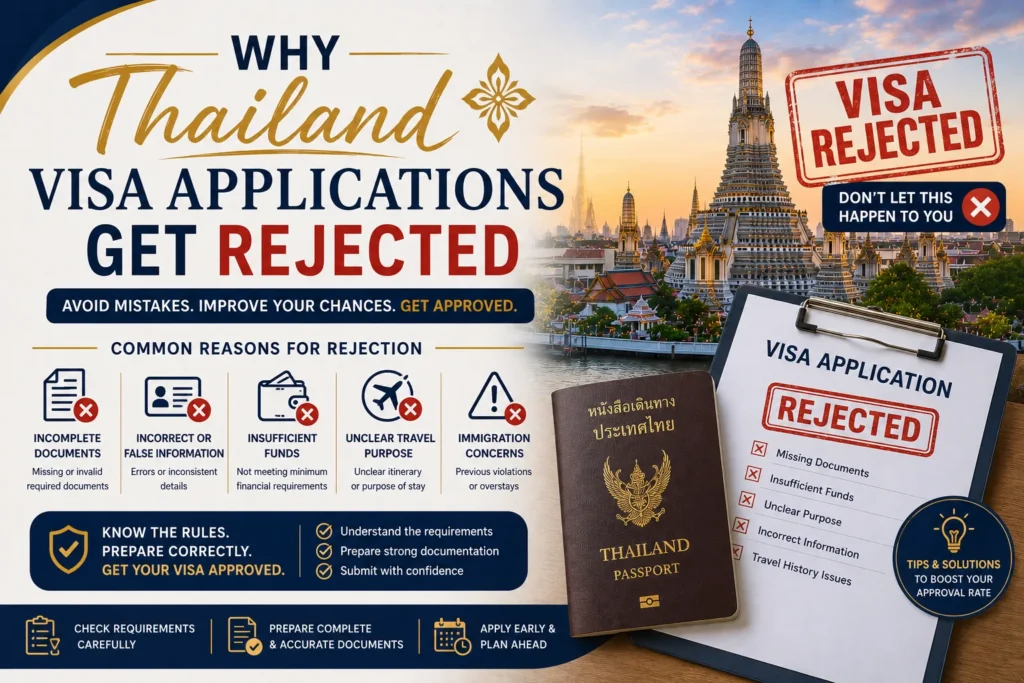
Thailand visa applications usually get rejected because the file is incomplete, inaccurate, inconsistent, unsupported, submitted under the wrong visa category, or contains documents that do not prove the stated purpose of travel.
From our visa handling experience, most avoidable refusals happen before the application is submitted: wrong visa type, weak financial proof, unclear travel purpose, inconsistent dates, unreadable uploads, passport data mistakes, or documents that do not match the embassy checklist.
Why Thailand Visa Applications Get Rejected
Most rejections come from document quality, category mismatch, or inconsistent information
A Thailand visa rejection does not always mean the applicant is permanently blocked from applying again. In many cases, the issue is practical: the wrong visa category was selected, the required documents were incomplete, or the file did not clearly prove the purpose of travel.
Official Thai Embassy guidance warns that simple mistakes can lead to rejection, visa fees may not be refunded, and the Embassy may not be able to edit personal details after submission. You can check official e-Visa guidance from the Thai e-Visa official website and Thai Embassy visa instructions such as the Royal Thai Embassy Switzerland common mistakes page.
Rejection Reason
What It Looks Like
Practical Fix
Wrong visa category
Tourist visa used for study, work, business, or long-stay purpose
Choose visa type based on real activity, not what seems easiest
Incomplete documents
Missing bank statement, accommodation proof, invitation, or official letter
Follow the embassy checklist before submitting
Data-entry mistake
Wrong name, passport number, nationality, or date of birth
Compare every field with the passport before payment
Unclear purpose
Documents do not explain why the applicant is going to Thailand
Add purpose-specific documents and a short explanation if needed
Assess your approval chances: Co Journey Visa can review your visa type, travel purpose, financial proof, document checklist, and previous visa history before you submit the application.
Wrong Visa Category: A Common Reason for Thailand Visa Refusal
The visa type must match the real purpose of travel
Many applicants choose a visa category because it looks easier, not because it matches their real plan. This creates risk. A tourist visa file should look like tourism. A student visa file should clearly show study. A business visa file should show business purpose. A medical visa file should show treatment documents.
From real client cases, category mismatch is one of the fastest ways to weaken an application. Officers review the file based on the visa type selected. If the documents tell a different story, the application may be delayed, questioned, or refused.
Visa Purpose
Documents Should Prove
Common Weak Point
Tourism
Travel plan, accommodation, finances, return or onward plan
Application suggests long-term stay or work
Education
School acceptance, course details, study timeline
School documents are missing or unclear
Business
Invitation, meeting purpose, company support, business relationship
Common mistake: A remote worker applies for a tourist visa but uploads documents showing long-term work activity. The issue is not only income — the purpose no longer looks like tourism.
Incomplete or Inaccurate Thailand e-Visa Application
Small mistakes can become expensive mistakes
Thai Embassy guidance warns that simple mistakes can lead to rejection, and that visa fees may not be refunded. Once submitted, many applications cannot be amended by the Embassy, especially when personal information is wrong.
From our visa handling experience, the most common online mistakes are name spelling errors, wrong passport numbers, incorrect nationality, wrong current location, wrong visa category, missing email access, and uploading the wrong document under the wrong section.
Application Field
Why It Matters
Practical Review Tip
Full name
Must match passport exactly
Use passport spelling and spacing
Passport number
Wrong number can invalidate the application
Check 0/O, 1/I, 5/S, 8/B carefully
Email address
Embassy communication and e-Visa delivery may use this email
Use an email you can access daily
Current location
Determines embassy jurisdiction
Apply through the correct embassy or consulate
Get your application checked: Co Journey Visa can review your Thai e-Visa form details before payment to catch spelling, passport, nationality, category, and upload errors.
Weak Financial Proof and Bank Statement Problems
Financial proof should be readable, recent, complete, and relevant
Weak financial proof is a common reason a Thailand visa application becomes risky. The officer needs to see that the applicant can support the trip or stay. A cropped screenshot, unclear account name, missing pages, or unexplained low balance can weaken the file.
From real client cases, applicants often upload only the first page of a bank statement, a mobile banking screenshot without their name, or a statement with a sudden large deposit and no explanation. These may raise more questions than they answer.
Financial Document Issue
Why It Creates Risk
How to Strengthen It
No applicant name
Officer cannot confirm account ownership
Use official statement showing full or clear account holder name
Partial statement
Missing pages make the record incomplete
Upload complete statement period as requested
Low or unstable balance
May not support the stated stay period
Add sponsor proof or explanation if appropriate
Sudden large deposit
May look artificial without context
Provide source explanation and supporting document
Real client case: A tourist applicant had enough money but uploaded only a mobile screenshot with no full name. The file looked weak because the officer could not clearly connect the funds to the applicant.
Inconsistent Travel Dates and Unclear Purpose of Stay
Your documents should tell one clear story
A strong Thailand visa application should make the officer’s review easy. Your form, flight booking, hotel booking, invitation letter, employer letter, school letter, medical letter, and bank statement should support the same timeline and purpose.
From common mistakes we often see, applicants upload documents that contradict each other. The form says 60 days, the hotel booking shows 5 nights, the flight date shows 30 days, and the bank statement does not support the stay length. These inconsistencies create doubt.
Document
Should Match
Common Problem
Application form
Travel purpose, dates, address, visa type
Purpose is vague or category is wrong
Flight booking
Expected entry and exit dates
Return date conflicts with requested stay
Accommodation proof
Stay period and location
Booking covers only a small part of the trip with no explanation
Invitation or support letter
Visa purpose and relationship
Letter is informal, undated, or missing contact details
Strengthen your file: Co Journey Visa can review your dates, bookings, letters, financial proof, and explanation so the application tells one consistent travel story.
Fake Documents and False Statements
This is one of the highest-risk mistakes
Do not submit edited bank statements, fake hotel bookings, false employment letters, invented invitation letters, or misleading financial documents. Official Thai Embassy guidance warns that fraudulent documents or false information can result in rejection and may affect future entry to Thailand.
From our visa handling experience, a weak but honest file can sometimes be improved. A false document can create a much bigger problem because it affects credibility, not just document completeness.
High-Risk Document
Why It Is Dangerous
Safer Alternative
Edited bank statement
May be treated as fraudulent evidence
Use official bank-issued statement
Fake hotel booking
Can damage credibility if verified
Use genuine booking or explain accommodation plan
False employment letter
Can create refusal and future visa risk
Provide real employer, freelance, or sponsor evidence
Misleading invitation letter
Purpose may not match the actual trip
Use a truthful letter with dates, purpose, and contact details
Common mistake: Applicants sometimes try to “fix” weak financial proof with edited documents. This is much riskier than explaining sponsorship, income source, or alternative financial support honestly.
How to Reduce the Risk of Thailand Visa Rejection
Step 1: Choose the correct visa type
Start with the real purpose of travel. Tourism, study, business, work, remote work, retirement, medical treatment, family visit, and guardianship all require different evidence.
Step 2: Read the official embassy checklist
Thailand visa requirements can differ by embassy or consulate. Check the official checklist for the embassy handling your application, not only a general online article.
Step 3: Build a consistent travel story
Your documents should answer: who you are, why you are going, how long you will stay, where you will stay, how you will pay, and why the visa category fits.
Step 4: Prepare financial proof properly
Use complete, readable, recent bank statements that show the applicant’s name, account details, statement period, transactions, balance, and currency. If sponsored, prepare sponsor documents and relationship proof.
Step 5: Check all personal details before submission
Compare the application with your passport. Check full name, passport number, nationality, date of birth, passport expiry, gender, visa type, travel dates, and email address.
Step 6: Upload clear and complete documents
Avoid blurry images, cropped passport pages, password-protected PDFs, partial bank statements, screenshots with missing names, or documents in the wrong language.
Step 7: Respond quickly to additional document requests
Some embassies may request additional documents. Check your email, spam folder, and visa portal regularly so the application is not delayed or cancelled because of a missed request.
Speak with a visa consultant: Co Journey Visa can review your application before submission and identify missing documents, weak proof, inconsistent dates, or category mismatch.
Thailand Visa Rejection Prevention Checklist
Item
Why It Matters
Practical Tip
Done
Correct visa type
Matches purpose of stay
Choose based on real activity
☐
Complete form
Required for processing
Do not leave unclear fields
☐
Passport details
Avoids identity mismatch
Copy exactly from passport
☐
Clear travel purpose
Helps officer understand the case
Use documents, not only explanation
☐
Financial proof
Shows ability to support stay
Use full recent statements
☐
Accommodation proof
Supports travel plan
Match dates with application
☐
Flight or travel plan
Shows entry and exit intention
Avoid conflicting dates
☐
Invitation letter
Needed for business or family cases
Include dates, purpose, and contact
☐
School, hospital, or employer documents
Supports special visa types
Use official letters
☐
Final review
Catches small errors before payment
Review before submission
☐
Download our checklist: Contact Co Journey Visa to request a Thailand visa rejection prevention checklist based on your visa type, embassy location, documents, and travel purpose.
Approved Case vs Rejected Case: What Made the Difference?
From real client cases, clarity is often more important than volume
Topic
Rejected or Risky Case
Stronger Case
Visa category
Applicant chooses tourist visa while documents suggest work or study
Visa type is selected based on the real purpose of travel
Financial proof
Cropped screenshot with no name or incomplete statement
Full recent statement showing account holder, balance, and transactions
Travel dates
Form, flight, hotel, and invitation show different dates
All documents support one clear timeline
Unusual history
Previous overstay or repeated entries are ignored
Applicant provides honest explanation and correct visa route
Common Thailand Visa Rejection Mistakes
1. Choosing the wrong visa category
This is one of the most common mistakes. The visa category must match the real purpose of travel, not only what appears easier to obtain.
2. Submitting an incomplete form
Missing fields, wrong current location, unclear travel details, or incorrect passport information can delay or weaken the application.
3. Missing required documents
If the official checklist asks for financial proof, accommodation, invitation, school letter, hospital letter, or employer document, do not submit until the required item is ready.
4. Uploading weak financial proof
A bank statement without the applicant’s name, unclear balance, missing pages, or unexplained large deposits can make the file harder to approve.
5. Using inconsistent dates
Flight, hotel, invitation letter, school letter, and application form should not tell different timelines.
6. Giving an unclear purpose of travel
A vague explanation such as “visit Thailand” may be too weak for some visa categories. Use supporting documents that prove the specific purpose.
7. Submitting fake or edited documents
This is a high-risk mistake. Fake documents or false statements can lead to rejection, cancellation, and future visa or entry problems.
8. Applying too late
Even a strong application can become risky if submitted too close to travel. Processing times can vary, and embassies may request additional documents.
9. Ignoring previous immigration history
Previous overstays, repeated entries, refused entry, or cancelled visas should be reviewed before submission. Complicated history may need a stronger explanation.
Summary: Why Thailand Visa Applications Get Rejected
Key points to remember:
Thailand visa applications are often rejected because the file is incomplete, inaccurate, inconsistent, unsupported, or submitted under the wrong visa category.
The visa type should match the real purpose of travel.
Small mistakes in name, passport number, nationality, or email can create serious problems.
Visa fees are often non-refundable after submission.
Financial proof should be complete, readable, recent, and connected to the applicant.
Travel dates, hotel bookings, flights, and invitation letters should be consistent.
Fake or misleading documents can lead to immediate rejection and future risk.
Embassy checklists can differ by location, so always follow the official checklist for the embassy handling your application.
A visa approval does not always guarantee entry; Immigration officers make the final entry decision at the checkpoint.
Always check the latest official requirements before submitting your documents.
Let Co Journey Visa help review your Thailand visa application
A strong Thailand visa application should make your case easy to understand: who you are, why you are going to Thailand, how long you will stay, how you will pay, and why your documents match the visa category.
Start with a pre-submission review: Send us your visa type, embassy location, passport details, travel purpose, financial proof, invitation or support documents, and previous Thailand travel history. Co Journey Visa can help identify weak points before you submit.
ทำไมควรให้ Co Journey Visa ช่วยดูแลวีซ่าของคุณ
การขอ Thailand Visa Application Review อาจมีขั้นตอนที่ซับซ้อนและต้องการความแม่นยำในการเตรียมเอกสาร หากคุณไม่ต้องการให้เกิดความผิดพลาดและต้องการความสะดวกสบายในการดำเนินการ Co Journey Visa พร้อมให้บริการช่วยเหลือคุณในทุกขั้นตอน:
✅ ความเชี่ยวชาญระดับมืออาชีพ – Co Journey Visa มีประสบการณ์ในการยื่นขอ Thailand LTR Visa หลายประเทศ
Frequently Asked Questions About Thailand Visa Rejection
Why do Thailand visa applications get rejected?
Thailand visa applications are often rejected because the application is incomplete, inaccurate, unsupported, inconsistent, or submitted under the wrong visa category. The documents must clearly prove the stated purpose of travel.
Can I reapply after a Thailand visa rejection?
In many cases, yes. Before reapplying, review the rejection reason, check the official embassy checklist, correct weak or missing documents, and make sure the new application is stronger than the first one.
Will I get my Thailand visa fee back if my application is rejected?
Usually, visa fees are not refunded after submission or rejection. Some Thai Embassy guidance clearly states that visa fees are non-refundable when mistakes lead to rejection, so applicants should review carefully before payment.
Can a small mistake cause a Thai e-Visa rejection?
Yes. Mistakes such as wrong name spelling, wrong passport number, incorrect nationality, wrong passport type, or mismatched personal details can lead to rejection because the Embassy may not be able to edit the applicant’s information after submission.
What happens if I submit fake documents for a Thailand visa?
Fake or fraudulent documents can lead to visa rejection, cancellation, and future entry risk. Applicants should never submit edited bank statements, false employment letters, fake bookings, or misleading invitation letters.
Does a Thailand visa guarantee entry into Thailand?
No. A visa helps you travel to Thailand and request entry, but Immigration officers at the checkpoint make the final decision. Travelers should carry relevant supporting documents when entering Thailand.
What should I do after my Thai visa is rejected?
Read the rejection message carefully, review the embassy checklist, identify missing or weak documents, correct mistakes, and reapply only when the file is stronger. If the case involves false documents, overstay history, or refused entry, get advice before reapplying.
How can I make my Thailand visa application stronger?
Use the correct visa type, complete every required field, upload clear documents, make sure dates match, show reliable financial proof, explain unusual points, and follow the official checklist of the embassy handling your application.
หากคุณต้องการคำแนะนำเพิ่มเติมหรือต้องการให้ Co Journey Visa ดูแลการยื่นวีซ่าของคุณ ติดต่อเราได้เลย 24 ชั่วโมง