
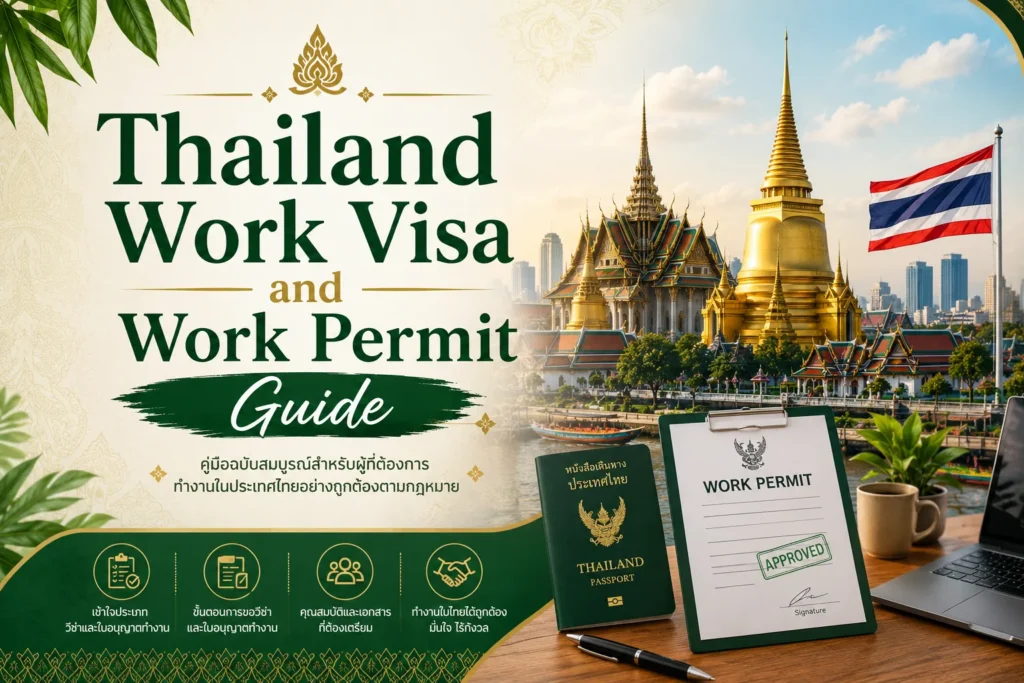
Thailand Work Visa and Work Permit Guide: Non-B Visa, Employer Documents, Legal Work Steps, and Common Mistakes
You have a job offer in Thailand, the company is ready to hire you, and everyone says, “Just get a work visa.” Then the confusion starts: Is a Non-B visa enough? Do you need a work permit before starting? Who prepares the company documents? Can you work while waiting?
For most foreign employees, working legally in Thailand requires both the correct visa status and a valid work permit. A Non-Immigrant “B” Visa is commonly used for foreigners entering Thailand to work or conduct business, while the work permit authorizes the actual work activity in Thailand.
From our visa handling experience, many work visa cases are delayed not because the employee is unqualified, but because the visa documents, employer documents, job title, workplace address, and work permit timeline do not tell the same story.
Thailand Work Visa vs Work Permit: What Is the Difference?
A visa allows the right immigration route; a work permit allows the work itself
Thailand’s Ministry of Foreign Affairs states that foreigners who wish to work, conduct business, or undertake investment activities in Thailand must apply for a Non-Immigrant Visa through Royal Thai Embassies or Consulates-General. For normal employment, the Non-Immigrant “B” route is commonly used.
A work permit is separate. It is normally connected to the employer, job title, job description, workplace, and approved work conditions. This is why a Non-B visa alone should not be treated as permission to start work automatically.
| Topic | Work Visa / Non-B Visa | Work Permit |
|---|---|---|
| Main purpose | Supports entry or stay for work/business-related purpose | Authorizes approved work activity in Thailand |
| Usually linked to | Immigration category and purpose of stay | Employer, role, workplace, and permitted work |
| Common mistake | Thinking the visa alone allows work | Thinking one permit allows any job anywhere |
Official sources to check before applying
Rules, document lists, online systems, and labour procedures can change. You can check Non-Immigrant “B” visa information from the Ministry of Foreign Affairs of Thailand, apply where available through the official Thai e-Visa website, and review work permit processes through the Department of Employment e-WorkPermit system.
Do You Need Both a Non-B Visa and a Work Permit?
In most employment cases, yes
For most foreign employees, the visa and work permit serve different purposes. The Non-B visa supports the immigration side of the employment route, while the work permit authorizes the actual work.
From real client cases, the most risky misunderstanding is starting work after receiving the visa but before the work permit is approved. Unless a specific legal exception applies, the safer assumption is that the work permit must be completed before actual work begins.
| Situation | Route to Review | Practical Advice |
|---|---|---|
| Foreign employee hired by Thai company | Non-B Visa + Work Permit | Employer documents are critical |
| Teacher in Thailand | Employment-related visa + work permit route | School documents and qualifications must match the role |
| BOI company employee | BOI-supported route where eligible | Follow BOI-specific procedures |
| Digital nomad with overseas clients | DTV may be reviewed if eligible | DTV is not a general Thai employment permit |
Can You Work in Thailand on a Tourist Visa?
Tourist status is not a work route
A tourist visa, visa exemption entry, or Visa on Arrival is designed for tourism or short permitted purposes, not employment. Thailand’s labour-side guidance separates work permit eligibility from tourist or transit status, so workers should not assume they can enter as tourists and “fix it later.”
From our visa handling experience, this mistake creates unnecessary risk for both the employee and employer. A job offer should trigger planning for the correct visa and work permit route before work begins.
| Entry Status | Can It Support Employment? | What to Do Instead |
|---|---|---|
| Tourist Visa | Not designed for employment | Review Non-B or other work-related route |
| Visa Exemption | Not a work route | Plan the correct visa before starting work |
| Non-B Visa | Supports work/business immigration purpose | Complete work permit process before actual work |
Employee Documents for Thailand Work Visa
The employee file must support the role clearly
For a Non-B employment case, the employee usually prepares personal documents that show identity, qualification, work history, current immigration status, and employment purpose.
Common mistakes we often see include outdated passport scans, incomplete CVs, missing qualification documents, job titles that do not match the contract, and application forms that use different company names from the employer file.
| Employee Document | Why It Matters | Practical Tip |
|---|---|---|
| Passport | Confirms identity and travel document details | Keep validity long enough for visa and permit processing |
| Application form and photo | Core visa application records | Details must match passport and employer documents |
| Employment contract or job offer | Shows job role and conditions | Job title should match across all documents |
| CV / qualifications | Supports role suitability | Useful for skilled, specialist, teacher, or manager roles |
| Previous Thai visa / work records | Shows immigration and work history | Prepare copies if you previously worked in Thailand |
Employer Documents for Thailand Work Permit
The employer file often decides how smooth the case will be
A strong employee profile cannot fix a weak employer file. The company may need to prepare legal, tax, financial, office, employment, and authorized-signatory documents depending on the case.
From real client cases, many delays come from employer documents rather than the employee’s passport or photo. Old company affidavits, missing tax records, unclear office address, and inconsistent job descriptions can slow down the process.
| Employer Document | What It Proves | Common Issue |
|---|---|---|
| Company affidavit / registration | Employer exists legally | Document is outdated or company details changed |
| Shareholder list | Company ownership structure | Not updated or inconsistent with company file |
| Tax and VAT documents | Employer compliance and business activity | Missing months or incomplete filing records |
| Social security records | Thai staff and employer obligations | Employee ratio or staff records not ready |
| Office map and photos | Workplace existence | Address differs from company or work permit documents |
| Employment letter and job description | Role, duties, and work conditions | Too vague or inconsistent job title |
How to Apply for Thailand Work Visa and Work Permit
Step 1: Confirm the correct visa route
Start with the real work situation. If the foreigner is being employed by a Thai company, the common route is Non-Immigrant “B” for employment. If the case involves BOI, teaching, investment, journalism, dependent status, or other special situations, the route may differ.
Step 2: Prepare employee documents
Prepare passport, visa application form, photo, CV, qualifications, employment contract, job offer, proof of current location if applying from abroad, and previous Thai visa or work permit records if relevant.
Step 3: Prepare employer documents
The employer should prepare company registration documents, tax records, financial statements, VAT documents, social security records, office photos, employment letter, job description, and authorized signatory documents where required.
Step 4: Apply for the Non-B Visa
If the applicant is outside Thailand, the visa is usually handled through a Royal Thai Embassy, Royal Thai Consulate, or Thai e-Visa system where available. If already in Thailand, the pathway may involve conversion or applying from abroad depending on current rules.
Step 5: Apply for the work permit
After the correct visa status is in place, the employer normally proceeds with the work permit application through labour-side procedures. The Department of Employment provides an e-WorkPermit system for work permit-related processes.
Step 6: Check the approved work permit details
Review name, passport number, employer name, job title, job description, workplace address, validity date, and conditions. If actual work differs from the permit, the permit may need updating.
Step 7: Apply for extension of stay if needed
A Non-B visa often gives an initial stay period, commonly up to 90 days depending on the visa and entry. The employee may later apply for an extension of stay based on employment, depending on eligibility and complete documents.
Step 8: Maintain compliance after approval
Track visa extension expiry, work permit expiry, 90-day reporting if applicable, re-entry permit needs, employer changes, job title changes, workplace changes, and passport renewal.
Thailand Work Visa and Work Permit Checklist
| Item | Why It Matters | Practical Tip | Done |
|---|---|---|---|
| Correct visa category | Supports lawful entry or stay | Non-B is common for employment, but not the only route | ☐ |
| Employer sponsorship | Work permit usually needs a Thai employer or approved entity | Confirm employer eligibility early | ☐ |
| Employment contract | Shows job role and conditions | Match job title across all documents | ☐ |
| Company registration documents | Proves employer exists legally | Use updated versions | ☐ |
| Tax and social security records | Supports employer compliance | Check completeness before submission | ☐ |
| Employee passport | Confirms identity and status | Keep validity long enough for visa and permit | ☐ |
| Work permit approval | Authorizes actual work | Do not start work before approval unless legally permitted | ☐ |
| Extension of stay | Allows longer stay after initial period | Track deadlines carefully | ☐ |
| Re-entry permit | Protects stay permission when leaving Thailand | Check before international travel | ☐ |
Approved Case vs Delayed Case: What Made the Difference?
From real client cases, the cleanest cases tell one employment story
| Topic | Delayed or Risky Case | Stronger Case |
|---|---|---|
| Job title | Contract says Marketing Manager, work permit file says Sales Consultant | Job title and duties match across all documents |
| Employer file | Old company affidavit, missing tax records, unclear office address | Updated company documents and clear workplace details |
| Work timing | Employee starts work before permit approval | Start date planned after work authorization is ready |
| Visa route | Tourist entry used for a job offer with no conversion plan | Correct Non-B or work-related route planned before employment |
Common Thailand Work Visa and Work Permit Mistakes
1. Starting work before the work permit is approved
A Non-B visa may support the employment route, but it does not replace the work permit. Starting too early can create risk for both employee and employer.
2. Using a tourist entry first and planning to fix it later
Some cases may have conversion options, but do not assume this is possible or simple. If the real purpose is work, plan the correct route before starting.
3. Job title and duties do not match
The job title on the employment contract, company letter, visa application, and work permit file should be consistent.
4. Employer documents are outdated
Company documents often need recent versions. Old affidavits, missing tax filings, and incomplete social security records can cause delays.
5. Assuming freelance work is automatically allowed
A Thai work permit is usually tied to an approved employer or business structure. Local freelancing without proper authorization can create legal risk.
6. Forgetting the re-entry permit
If your extension of stay is approved and you leave Thailand without a re-entry permit when one is needed, your permission to stay may be affected.
7. Not updating the work permit after changes
If the employee changes employer, job title, workplace, or duties, the work permit may need cancellation, amendment, or a new application.
Summary: Thailand Work Visa and Work Permit
Key points to remember:
- A Thailand work visa and a work permit are not the same.
- The Non-Immigrant “B” Visa is commonly used for employment or business-related entry.
- The work permit authorizes the actual approved work activity in Thailand.
- Tourist Visa, visa exemption, and Visa on Arrival are not work routes.
- The employer’s documents are often as important as the employee’s documents.
- Job title, duties, workplace, contract, company documents, and visa route should match.
- Do not start work before the proper authorization is ready unless a specific legal exception applies.
- After approval, track extension, reporting, re-entry permit, work permit expiry, and employer changes.
- Always check the latest official requirements before applying.
Let Co Journey Visa help prepare your Thailand work visa and work permit case
A strong Thailand work authorization case is not just about submitting many documents. It is about making the employment relationship clear: who is hiring, what the foreigner will do, where the work will happen, and why the visa and work permit route legally supports the role.
ทำไมควรให้ Co Journey Visa ช่วยดูแลวีซ่าของคุณ
การขอ Thailand Work Visa and Work Permit อาจมีขั้นตอนที่ซับซ้อนและต้องการความแม่นยำในการเตรียมเอกสาร หากคุณไม่ต้องการให้เกิดความผิดพลาดและต้องการความสะดวกสบายในการดำเนินการ Co Journey Visa พร้อมให้บริการช่วยเหลือคุณในทุกขั้นตอน:
Frequently Asked Questions About Thailand Work Visa and Work Permit
Do I need both a work visa and a work permit in Thailand?
Yes, in most normal employment cases. The visa gives the correct immigration status, while the work permit authorizes the actual work activity in Thailand.
What visa do I need to work in Thailand?
The common route is a Non-Immigrant Visa Category “B” for employment. Thailand’s Ministry of Foreign Affairs states that foreigners who wish to work or conduct business in Thailand must apply for a Non-Immigrant Visa through Royal Thai Embassies or Consulates-General.
Can I work in Thailand on a tourist visa?
No. A tourist visa is not a work route. If you have a job offer, plan the correct visa and work permit pathway before starting work.
Can I start working once I receive my Non-B visa?
Not usually. A Non-B visa supports the employment route, but the work permit is the document that authorizes work. Start only when the correct work authorization is in place or when a specific legal exception applies.
How long can I stay with a Non-B visa?
A Non-B visa holder may initially be allowed to stay for up to 90 days depending on the visa and entry. Later extension of stay based on employment may be possible if documents and eligibility requirements are met.
Who applies for the Thailand work permit?
The employer usually plays a major role. The foreign employee provides personal documents, while the employer prepares company and employment documents for the labour-side process.
Can I change employers with the same work permit?
Usually, no. A work permit is generally tied to a specific employer, role, workplace, and permitted activity. If you change employers, job duties, or work location, the permit may need cancellation, amendment, or a new application depending on the case.
What happens if I work without a work permit in Thailand?
Working without proper authorization can create legal risk for both the foreign worker and employer. Consequences can include fines, cancellation of permission, removal from Thailand, or future authorization issues depending on current rules and enforcement.
หากคุณต้องการคำแนะนำเพิ่มเติมหรือต้องการให้ Co Journey Visa ดูแลการยื่นวีซ่าของคุณ ติดต่อเราได้เลย 24 ชั่วโมง
บทความที่เกี่ยวข้อง

ติดตามข้อมูลวีซ่าอัปเดตจาก Co Journey Visa
เพิ่มเว็บไซต์นี้เป็นแหล่งข้อมูลที่ต้องการใน Google เพื่อให้ค้นพบบทความจากเราได้สะดวกขึ้น