Thailand LTR Visa Guide: Long-Term Resident Visa Requirements, Benefits, 10-Year Structure, BOI Process, and Application Checklist
You want to live in Thailand long-term without renewing a short visa every few months, but the options can feel overwhelming. Retirement visa, DTV, Thailand Privilege, Non-B, marriage visa, business visa — and then there is the Thailand LTR Visa, which sounds attractive but comes with strict eligibility rules.
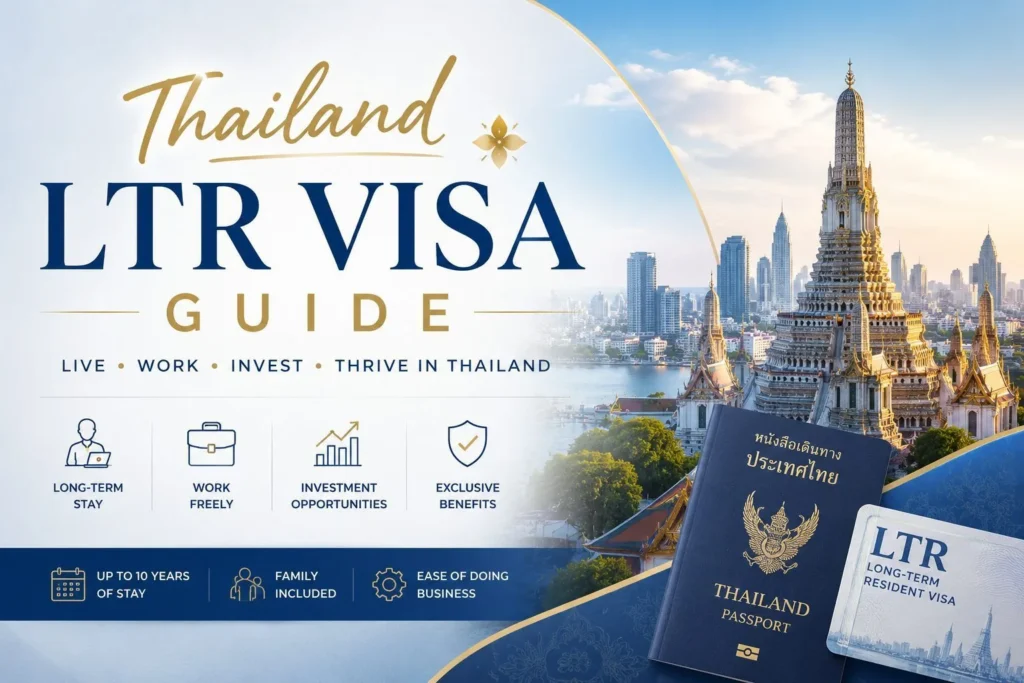
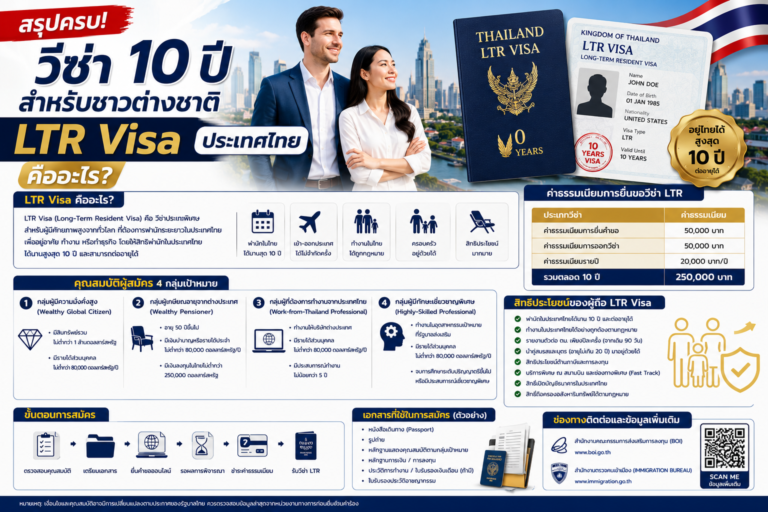
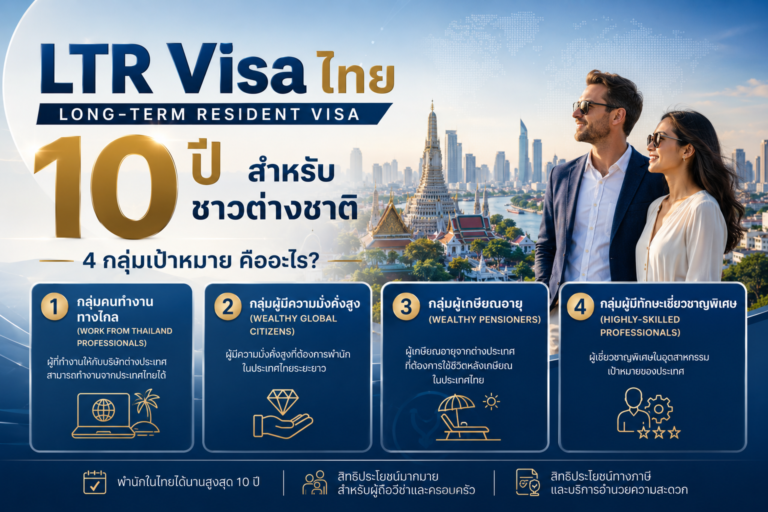
Thailand’s LTR Visa, or Long-Term Resident Visa, is a long-stay visa designed for selected groups of high-potential foreigners: Wealthy Global Citizens, Wealthy Pensioners, Work-from-Thailand Professionals, Highly Skilled Professionals, and eligible dependents.
From our visa handling experience, many LTR Visa cases are not delayed because the applicant lacks potential. They are delayed because the applicant chooses the wrong category, underestimates the document proof, or cannot clearly connect income, assets, employer profile, investment, insurance, and long-term eligibility.
What Is the Thailand LTR Visa?
A qualification-based long-term visa, not a general long-stay visa
The Thailand LTR Visa is designed to attract high-potential foreign residents who can bring value to Thailand through investment, spending power, professional expertise, remote work, or retirement income.
The official BOI LTR website lists four main LTR Visa categories: Wealthy Global Citizens, Wealthy Pensioners, Work-from-Thailand Professionals, and Highly Skilled Professionals. Spouse and children of LTR holders or applicants may also apply as dependents.
LTR Category
Best For
Practical Caution
Wealthy Global Citizen
High-net-worth individuals with assets and Thai investment
Asset ownership and investment proof must be clear
Wealthy Pensioner
Retirees aged 50+ with pension or passive income
Passive income proof matters more than general savings alone
Work-from-Thailand Professional
Remote workers employed by qualifying overseas companies
Employer profile is often the weak point
Highly Skilled Professional
Experts in targeted industries or eligible Thai-linked institutions
Job, employer, expertise, and industry must fit the category
Dependent
Spouse and children under 20 of LTR holders
Relationship proof and health coverage or deposit proof are still required
Get your LTR category checked: Co Journey Visa can review your income, assets, employer profile, investment, pension, professional background, insurance, and family documents before you prepare the full LTR Visa application.
Thailand LTR Visa Benefits
LTR is attractive because it reduces long-stay friction
The Thailand LTR Visa is popular because it offers a long-term structure and several practical benefits for qualified foreigners. BOI describes LTR as a renewable 10-year visa structure, with permission first granted for five years and extendable for another five years if qualifications are met.
From real client cases, applicants are usually attracted to the 10-year structure, multiple re-entry, one-year reporting instead of standard 90-day reporting, fast-track airport service, and work permit facilitation where applicable.
Benefit
Why It Matters
Practical Caution
10-year structure
Reduces repeated short-stay renewals
Usually structured as 5 + 5 years, subject to qualification maintenance
Multiple re-entry
Useful for international travelers
Passport and visa validity still need tracking
One-year reporting
Less frequent than standard 90-day reporting
Reporting is reduced, not removed
Digital work permit facilitation
Useful for eligible work categories
Work rules depend on LTR category and actual activity
Common mistake: Applicants see “10-year visa” and assume approval is automatic once issued. BOI notes that conditions and requirements must be maintained during the visa period.
Thailand LTR Visa Requirements by Category
Each category has its own proof standard
LTR is not a “one checklist fits all” visa. A wealthy applicant, pensioner, remote professional, skilled expert, and dependent all need different evidence.
From our visa handling experience, the strongest LTR applications start with category screening before document collection. If the category is wrong, even a large document file can still be weak.
LTR Category
Core Proof
Common Weak Point
Wealthy Global Citizen
Assets, income, Thai investment, insurance or deposit
Investment not clearly owned by applicant
Wealthy Pensioner
Age 50+, pension or passive income, investment where required
Confusing earned salary with pension or passive income
Expertise, target industry, employment or institutional link
Job title looks skilled but industry link is unclear
Dependent
Marriage certificate, birth certificate, main applicant linkage, health proof
Relationship documents are missing or not translated
Assess your approval chances: Co Journey Visa can screen your profile first and tell you whether LTR looks realistic or whether DTV, retirement visa, Non-B, marriage visa, or Thailand Privilege may fit better.
Health Insurance, Social Security, or Deposit Requirement
This requirement is often missed until late
BOI and Thai Embassy guidance commonly state that LTR applicants need health insurance with at least USD 50,000 coverage, Thai social security benefits, or a qualifying bank deposit. For main applicants, BOI guidance refers to at least USD 100,000 deposit under the applicant’s name for at least 12 months where using the deposit route.
For dependents, BOI guidance refers to health insurance, Thai social security, or a qualifying deposit amount for each dependent. This is why family applications need financial and insurance planning early.
Health / Security Option
What It Shows
Practical Tip
Health insurance
Medical coverage in Thailand
Check coverage amount, validity, and policy wording before buying
Thai social security
Access to Thai social security benefits
Prepare official proof, not only a verbal statement
Qualifying bank deposit
Financial security if insurance is not used
Timing and account ownership must match BOI rules
Real client case: A high-income remote worker prepared employment and income documents well, but had no acceptable insurance or deposit proof. The application could not be finalized until the health-security requirement was addressed.
How to Apply for a Thailand LTR Visa
Step 1: Identify the correct LTR category
Choose from Wealthy Global Citizen, Wealthy Pensioner, Work-from-Thailand Professional, Highly Skilled Professional, or Dependent. Do not choose based on which category sounds easiest. Choose the one your documents can prove.
Step 2: Check category-specific criteria
Review income, assets, investment, pension, employer profile, professional expertise, target industry, dependent relationship, and health insurance or deposit requirements.
Step 3: Prepare category-specific documents
A Wealthy Global Citizen may need asset and investment proof. A Wealthy Pensioner may need pension and passive income documents. A Work-from-Thailand Professional may need overseas employer and income records. A Highly Skilled Professional may need professional and target-industry evidence.
Step 4: Submit for BOI qualification endorsement
The LTR process starts with qualification endorsement through BOI’s online LTR system. BOI states that applicants register and submit the online application with supporting documents for endorsement by relevant agencies.
Step 5: Receive approval and arrange visa issuance
After qualification endorsement, applicants can proceed with visa issuance through the correct channel. BOI states that the processing fee for a 10-year multiple-entry LTR Visa is 50,000 THB per person if collecting the visa in Thailand. Fees at embassies, consulates, or e-Visa may vary.
Step 6: Apply for work permission if required
If your LTR category and activity involve working for an entity in Thailand, the digital work permit process must be handled properly. Work-from-Thailand Professionals are different because they normally work remotely for overseas employers.
Step 7: Maintain conditions after approval
Track insurance, investment, employment, bank deposit, dependent status, passport validity, one-year reporting, and extension timing. LTR is a long-term visa, so maintenance matters.
Get your documents checked: Co Journey Visa can review your LTR file before submission to identify category mismatch, missing proof, weak employer evidence, unclear investment ownership, or incomplete health insurance documents.
Thailand LTR Visa Checklist
Item
Why It Matters
Practical Tip
Done
Correct LTR category
Determines every requirement
Choose based on provable documents
☐
Passport
Confirms identity and visa eligibility
Keep long validity
☐
Income proof
Required for several categories
Use tax records, pension letters, salary slips, or official statements
☐
Asset proof
Key for Wealthy Global Citizen
Show ownership clearly
☐
Thai investment proof
Required in some categories
Investment should meet BOI rules and ownership standards
☐
Employer documents
Critical for remote and skilled professionals
Check employer revenue and structure early
☐
Professional qualifications
Supports skilled category
Use CV, degree records, certificates, and employment letters
☐
Health insurance or deposit
Required across LTR cases
Prepare before submission
☐
Dependent relationship proof
Needed for spouse and children
Use legal marriage or birth documents
☐
BOI endorsement
Required before visa issuance
Apply through LTR online system
☐
Download our checklist: Contact Co Journey Visa to request an LTR Visa checklist based on your category, family structure, income source, employer profile, and document location.
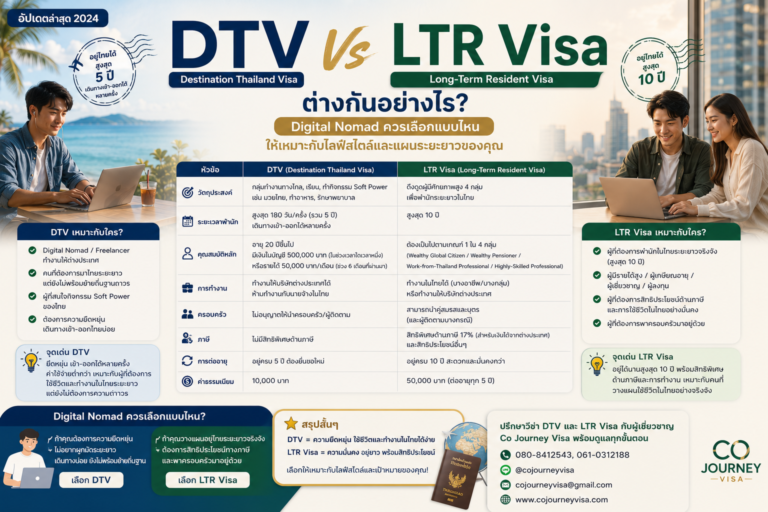
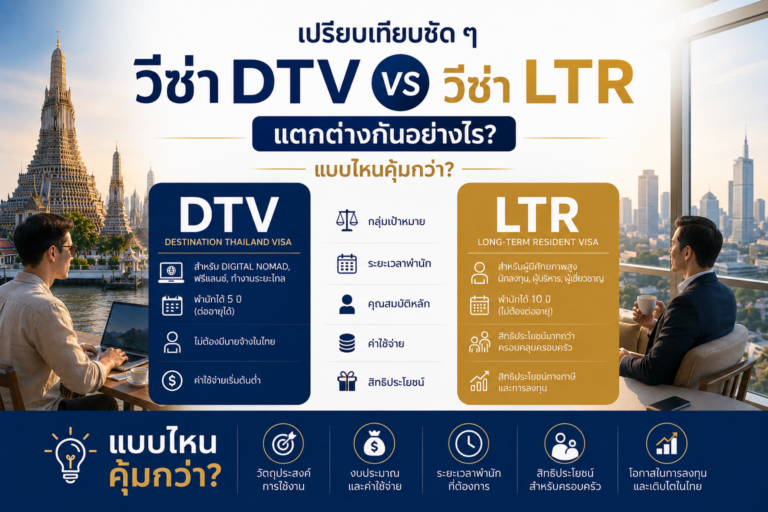
LTR Visa vs DTV, Retirement Visa, Non-B, and Thailand Privilege
The best long-stay visa depends on your real profile
Many applicants compare LTR with other Thailand long-stay routes. The right answer depends on your documents, not only your lifestyle goal.
Not a qualification-based professional or work route
Approved Case vs Delayed Case: What Made the Difference?
From real client cases, category fit is the biggest difference
Topic
Delayed or Risky Case
Stronger Case
Category choice
Remote worker applies without checking employer qualification
Category is screened before document collection
Income proof
Bank statement only, no tax or official income records
Income is supported by tax records, salary slips, pension letters, or official documents
Investment ownership
Property is jointly owned but full value is claimed by one applicant
Ownership share and qualifying value are explained clearly
Insurance
Insurance or deposit proof is prepared after BOI asks
Health security proof is prepared before submission
Common Thailand LTR Visa Mistakes
1. Choosing the wrong LTR category
This is the most common problem. A remote worker may have good income, but if the employer does not meet the BOI profile, the case may not fit.
2. Focusing only on income
Income matters, but LTR may also review assets, investment, employer profile, age, passive income, insurance, professional status, or Thai entity connection.
3. Investment is not clearly in the applicant’s name
For investment-based categories, ownership matters. Joint ownership, company ownership, or unclear asset title can reduce the value counted toward the applicant.
4. Weak employer documents for remote workers
For Work-from-Thailand Professionals, the employer profile is critical. A strong personal CV cannot always fix an employer that does not meet BOI requirements.
5. Forgetting health insurance or deposit proof
Applicants often prepare income documents first and leave insurance for later. This can delay the case.
6. Assuming LTR allows any work
LTR can provide work-permit facilitation, but the rules depend on category and actual activity. Work-from-Thailand Professionals are different from those working for Thai entities.
7. Not maintaining qualifications after approval
If you sell qualifying investment, lose qualifying employment, drop insurance, or change dependent status, review the impact before assuming your LTR remains unaffected.
Summary: Thailand LTR Visa
Key points to remember:
Thailand LTR Visa is a Long-Term Resident Visa for selected high-potential foreigners.
The main categories are Wealthy Global Citizen, Wealthy Pensioner, Work-from-Thailand Professional, Highly Skilled Professional, and Dependent.
LTR is a qualification-based visa, not a general long-stay visa.
The visa offers a renewable 10-year structure, commonly 5 + 5 years if qualifications are maintained.
Benefits may include multiple re-entry, one-year reporting, fast-track service, and work permit facilitation where applicable.
Applicants must prepare category-specific documents.
Health insurance, Thai social security, or qualifying deposit proof is usually required.
Remote worker cases often depend heavily on employer qualification.
Dependents need relationship proof and their own health-security evidence.
Always check the latest official BOI and Thai Embassy requirements before applying.
Let Co Journey Visa help prepare your Thailand LTR Visa application
A strong LTR Visa file should make your category obvious: what you qualify for, how your documents prove it, whether you meet health-security requirements, and how you will maintain eligibility after approval.
Start with an LTR case assessment: Send us your profile, income source, employer details, assets, investment, pension records, insurance proof, and family plan. Co Journey Visa can help identify whether LTR is realistic or whether another Thailand long-stay visa route may fit better.
ทำไมควรให้ Co Journey Visa ช่วยดูแลวีซ่าของคุณ
การขอ Thailand LTR Visa อาจมีขั้นตอนที่ซับซ้อนและต้องการความแม่นยำในการเตรียมเอกสาร หากคุณไม่ต้องการให้เกิดความผิดพลาดและต้องการความสะดวกสบายในการดำเนินการ Co Journey Visa พร้อมให้บริการช่วยเหลือคุณในทุกขั้นตอน:
✅ ความเชี่ยวชาญระดับมืออาชีพ – Co Journey Visa มีประสบการณ์ในการยื่นขอ Thailand LTR Visa หลายประเทศ
Frequently Asked Questions About Thailand LTR Visa
What is the Thailand LTR Visa?
The Thailand LTR Visa is a Long-Term Resident Visa for selected categories of high-potential foreigners, including wealthy global citizens, wealthy pensioners, work-from-Thailand professionals, highly skilled professionals, and eligible dependents.
How long is the Thailand LTR Visa valid?
BOI describes the LTR as a renewable 10-year visa structure, with permission first granted for five years and extendable for another five years if qualifications are met.
Who can apply for Thailand LTR Visa?
The main categories are Wealthy Global Citizen, Wealthy Pensioner, Work-from-Thailand Professional, and Highly Skilled Professional. Spouse and children under 20 of LTR holders may also apply as dependents.
Does Thailand LTR Visa require health insurance?
Applicants generally need health insurance, Thai social security, or a qualifying deposit. BOI and Thai Embassy guidance commonly refer to health insurance coverage of at least USD 50,000 or qualifying deposit evidence.
Can LTR Visa holders work in Thailand?
It depends on the category and work activity. LTR holders working for an entity in Thailand may need to apply for permission to work, while Work-from-Thailand Professionals are generally linked to remote work for overseas employers.
How much is the Thailand LTR Visa fee?
BOI lists the LTR Visa processing fee as 50,000 THB per person for a 10-year multiple-entry visa when collecting the visa in Thailand. Fees at embassies, consulates, or e-Visa channels may vary.
Do LTR Visa holders need 90-day reporting?
LTR holders receive a reporting benefit. Instead of standard 90-day reporting, BOI guidance refers to one-year reporting for LTR holders staying in Thailand longer than one year consecutively.
Can family members join an LTR Visa holder?
Yes. Dependents may include spouse and children under 20 years old of LTR holders, with BOI guidance listing a maximum of four dependents in total per LTR holder. Dependents need relationship proof and health insurance, Thai social security, or qualifying deposit proof.
หากคุณต้องการคำแนะนำเพิ่มเติมหรือต้องการให้ Co Journey Visa ดูแลการยื่นวีซ่าของคุณ ติดต่อเราได้เลย 24 ชั่วโมง