
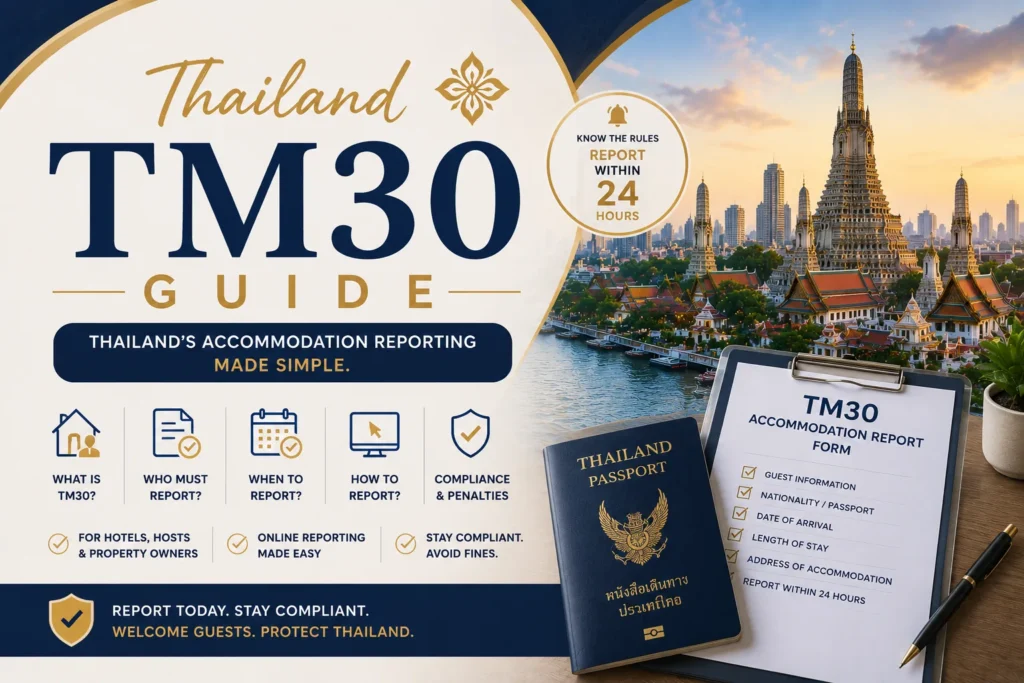
Thailand TM30 Guide: Residence Notification, Online Filing, Required Documents, Landlord Duties, Visa Extension Issues, and Immigration Checklist
You arrive in Thailand, move into a condo, and think the visa part is finished. Then, when you go to Immigration for a visa extension or 90-day report, the officer asks for your TM30 record — and your landlord has no idea what you mean.
Thailand TM30 is the Notification of Residence for Foreigners. It is the residence report connected to where a foreigner is staying in Thailand, usually filed by the house master, property owner, landlord, hotel, possessor of the residence, or accommodation provider.
From our visa handling experience, TM30 problems usually appear at the worst time: on the day of a visa extension, 90-day report, student visa support, retirement renewal, marriage extension, or work-related Immigration service. The issue is often not the visa itself, but a missing, incorrect, or outdated address record.
What Is Thailand TM30?
A residence notification for foreigners staying in Thailand
TM30 is the common name for Thailand’s residence notification for foreigners. Its purpose is to notify Thai Immigration where a foreign national is staying in Thailand. In practical terms, it connects the foreigner’s passport information with a Thai address.
Thai Immigration’s official website links to the TM30 online service, and provincial Immigration offices describe it as the “Notification of Residence for Foreigners (TM.30)” system. You can check the official TM30 online service through the Thai Immigration TM30 online system and general Immigration services through the official Thai Immigration Bureau website.
| Accommodation Type | Who Usually Handles TM30 | Practical Caution |
|---|---|---|
| Hotel or serviced apartment | Hotel or accommodation operator | Tourists may never receive a receipt because the hotel handles it internally |
| Rented condo | Landlord, owner, or property manager | Ask for proof before your Immigration appointment |
| Spouse or family home | House owner or person responsible for the residence | House registration and Thai ID may be needed |
| Company or school accommodation | Employer, school, admin team, or authorized person | Address record should match visa and extension documents |
Who Is Responsible for Filing TM30?
The duty usually belongs to the accommodation side, but the foreigner is often affected
The foreigner is the person staying at the address, but the TM30 filing responsibility usually belongs to the person or entity responsible for the residence. This may be a house owner, landlord, hotel, condo owner, serviced apartment operator, company housing administrator, or possessor of the residence.
From real client cases, the foreigner often suffers the consequence even when the landlord is the one who should file. Immigration may ask for the TM30 record during a visa extension or 90-day report, and if the record is missing, the applicant may need to fix the address issue before the main service can continue.
| Person / Entity | Typical Role | What the Foreigner Should Do |
|---|---|---|
| Landlord or condo owner | Files residence notification for the tenant | Request a receipt, screenshot, or confirmation |
| Hotel or serviced apartment | Reports foreign guests through accommodation systems | Ask for confirmation if needed for Immigration |
| Thai spouse or family house owner | May file if the foreigner stays at the family home | Prepare Thai ID, house registration, and address proof |
| Employer or school | May assist if accommodation is linked to work or study | Coordinate before extension or 90-day reporting |
Thailand TM30 Online System
Online filing is now commonly used, but details still matter
Thai Immigration provides an online TM30 residence notification system. Provincial Immigration announcements also stated that the new Notification of Residence for Foreigners system became available from 15 September 2023. You can check the official online system at tm30.immigration.go.th.
From our visa handling experience, online filing is convenient when the landlord or accommodation provider already knows the system. Problems often happen when the property owner has never registered, uploads unclear documents, enters the wrong passport number, or reports an address that does not match the foreigner’s visa forms.
| Online TM30 Issue | Why It Happens | Practical Fix |
|---|---|---|
| Landlord cannot log in | No registration or forgotten access details | Check official TM30 system instructions or contact local Immigration |
| Wrong passport number | Typing error or unclear passport copy | Send a clear passport scan and verify receipt details |
| Wrong address | Property address does not match lease or Immigration form | Use one consistent current address across documents |
| No proof saved | Filing was done but no receipt was kept | Save screenshot, PDF, or printed confirmation |
Thailand TM30 Required Documents
The foreigner and property side usually need different documents
TM30 is not only about the foreigner’s passport. The person filing may also need property-related documents, owner identification, house registration, rental agreement, or authorization documents depending on the filing method and local Immigration practice.
From common mistakes we often see, foreigners prepare only their passport copy but forget to ask the landlord for owner-side documents. This can become a problem if online filing fails and in-person filing is needed.
| Document | Who Provides It | Practical Tip |
|---|---|---|
| Passport biodata page | Foreigner | Send a clear scan, not a blurry photo |
| Visa or entry stamp | Foreigner | Useful for long-stay and extension cases |
| Current Thai address | Foreigner and landlord | Match address with lease and visa forms |
| Owner ID or passport | Owner or responsible person | Signed copy may be requested |
| House registration | Owner or house master | Known as tabien baan |
| Rental agreement | Foreigner and landlord | Helpful for condo tenants and long-stay residents |
| Power of attorney | Owner or representative | May be needed if someone files on behalf of the owner |
How to File or Check Thailand TM30
Step 1: Identify who controls the residence
Start by asking who is responsible for the property. For a hotel, ask the front desk. For a condo, ask the landlord or property manager. For a spouse’s home, ask the house owner or person named in the house registration.
Step 2: Gather the foreigner’s information
Prepare the foreigner’s full name, nationality, passport number, arrival date, visa or entry type, current Thai address, move-in date, passport copy, and entry stamp copy where requested.
Step 3: Prepare property-side documents
The owner or responsible person may need Thai ID or passport, house registration, property documents, rental agreement, company documents if relevant, and power of attorney if someone files on behalf of the owner.
Step 4: Submit through the TM30 online system or Immigration office
The responsible person may submit through the official TM30 online system or at the local Immigration office responsible for the residence address. Local practice can vary, so check current instructions before filing.
Step 5: Save the TM30 receipt
Keep proof of filing, such as a printed receipt, screenshot, PDF confirmation, or stamped acknowledgement from Immigration. Long-stay foreigners should keep it with visa extension and 90-day report documents.
Step 6: Recheck after moving or returning
If you move to a new address, the new accommodation provider should check whether a new TM30 is required. If you leave Thailand and return, check local Immigration practice and your accommodation provider’s process.
TM30 vs TM47 vs TM7: What Is the Difference?
TM30 does not extend your visa and does not replace 90-day reporting
Many foreigners confuse TM30 with TM47 and TM7 because all three are connected to Immigration. However, they serve different purposes.
TM30 reports where a foreigner is staying. TM47 is the 90-day address report used when a foreigner stays in Thailand for more than 90 consecutive days. TM7 is the visa extension application form used when the foreigner requests more time to stay in Thailand.
| Form | Main Purpose | Who Usually Handles It | Does It Extend Stay? |
|---|---|---|---|
| TM30 | Notification of foreigner staying at a residence | House owner, landlord, hotel, possessor, or accommodation provider | No |
| TM47 | 90-day address report | Foreigner or authorized person | No |
| TM7 | Visa extension application | Foreigner applying for extension | Yes, if approved |
Thailand TM30 Checklist
| Item | Why It Matters | Practical Tip | Done |
|---|---|---|---|
| Foreigner’s passport copy | Identifies the foreign guest | Use a clear biodata page copy | ☐ |
| Entry stamp or visa page | Shows current entry record | Useful for long-stay cases | ☐ |
| Current Thai address | Core of the notification | Match address with visa forms | ☐ |
| Move-in date | Shows when the foreigner arrived at the residence | Keep lease or check-in date consistent | ☐ |
| Landlord or owner ID | Identifies the responsible person | Use signed copy if required | ☐ |
| House registration | Confirms property address | Known as tabien baan | ☐ |
| Rental agreement | Supports long-term stay address | Helpful for condo tenants | ☐ |
| Power of attorney | Needed if representative files | Check local office requirement | ☐ |
| TM30 receipt | Proof of filing | Save screenshot and PDF if filed online | ☐ |
| Updated record after move | Avoids address mismatch | Recheck when changing residence | ☐ |
Approved Case vs Delayed Case: What Made the Difference?
From real client cases, address consistency is the biggest difference
| Topic | Delayed or Risky Case | Stronger Case |
|---|---|---|
| Landlord awareness | Landlord does not know TM30 and no record is filed | Landlord files TM30 shortly after move-in and shares proof |
| Address consistency | TM30, lease, TM7, and TM47 show different addresses | All Immigration forms use one accurate current address |
| Passport details | Passport number is typed incorrectly in the TM30 record | Receipt is checked immediately after filing |
| Timing | Applicant waits until visa extension day to check TM30 | TM30 is checked before the Immigration appointment |
Common Thailand TM30 Mistakes
1. Thinking the foreigner is always the one who must file
The foreigner often needs the receipt, but the reporting duty usually belongs to the accommodation side. In practice, the foreigner should still follow up because they are affected during Immigration services.
2. Assuming a hotel TM30 covers a condo stay
A hotel may file TM30 for the hotel stay only. If you later move to a condo, private house, or long-term residence, the new address should be reported separately.
3. Waiting until visa extension day
This is one of the most common problems. A foreigner arrives at Immigration for an extension and learns that the address record is missing or incorrect.
4. Address on forms does not match TM30
If your TM7 extension form, TM47 90-day report, rental agreement, and TM30 show different addresses, Immigration may ask questions. Use one accurate current address.
5. Landlord files with wrong passport details
One wrong digit in the passport number can create a mismatch. Check the receipt carefully after filing.
6. Losing the TM30 receipt
You may need proof later for visa extension, 90-day reporting, school support, employer support, or other Immigration services. Save both paper and digital copies.
7. Confusing TM30 with TM47
TM30 is residence notification by the accommodation provider. TM47 is 90-day reporting by the foreigner. They are separate processes.
Summary: Thailand TM30
Key points to remember:
- Thailand TM30 is the Notification of Residence for Foreigners.
- It reports where a foreigner is staying in Thailand.
- The duty usually belongs to the house owner, landlord, hotel, possessor, or accommodation provider.
- Foreigners should still keep proof because TM30 may be requested during Immigration services.
- TM30 is different from TM47 90-day reporting.
- TM30 is different from TM7 visa extension.
- TM30 does not give you more days in Thailand.
- The official TM30 online system is available through Thai Immigration.
- A missing or incorrect TM30 can delay visa extensions, 90-day reports, and long-stay services.
- Always check the latest official Immigration requirements before filing or visiting Immigration.
Let Co Journey Visa help check your Thailand TM30 record
A clean TM30 situation should answer three questions clearly: where the foreigner is staying now, who is responsible for the property, and whether proof of filing can be shown if Immigration asks.
ทำไมควรให้ Co Journey Visa ช่วยดูแลวีซ่าของคุณ
การขอ Thailand TM30 อาจมีขั้นตอนที่ซับซ้อนและต้องการความแม่นยำในการเตรียมเอกสาร หากคุณไม่ต้องการให้เกิดความผิดพลาดและต้องการความสะดวกสบายในการดำเนินการ Co Journey Visa พร้อมให้บริการช่วยเหลือคุณในทุกขั้นตอน:
Frequently Asked Questions About Thailand TM30
What is TM30 in Thailand?
TM30 is the Notification of Residence for Foreigners. It reports where a foreigner is staying in Thailand and connects the foreigner’s passport information with a Thai address.
Who is responsible for filing TM30?
TM30 is usually handled by the house master, property owner, landlord, hotel, possessor of the residence, or accommodation provider. The foreigner often needs the receipt, but the accommodation side is usually responsible for filing.
Is TM30 the same as 90-day reporting?
No. TM30 reports where a foreigner is staying at a residence. TM47 90-day reporting is the foreigner’s address notification after staying in Thailand for more than 90 consecutive days.
Do hotels file TM30 for foreign guests?
Hotels normally report foreign guests through accommodation reporting systems. Long-stay foreigners usually face TM30 issues when moving into private accommodation such as a condo, rented house, spouse’s home, or company accommodation.
Do I need TM30 for a Thailand visa extension?
Many Immigration offices may check TM30 records when processing visa extensions or other long-stay services. A missing or incorrect TM30 can delay the process, so it is best to check before your appointment.
Can TM30 be filed online?
Yes. Thai Immigration provides an official TM30 online residence notification system. Landlords, owners, hotels, or responsible accommodation providers may use the online system depending on their registration and local Immigration practice.
What happens if my landlord refuses to file TM30?
First, explain that TM30 is an Immigration residence notification and that you may need proof for visa services. If the landlord still refuses, contact the local Immigration office or speak with a visa consultant to check what options may be available.
Do I need a new TM30 when I move address?
Usually, a new residence should be reported by the new accommodation provider. If you move to a new condo, house, hotel, or long-term address, check whether a new TM30 record is needed before your next Immigration service.
หากคุณต้องการคำแนะนำเพิ่มเติมหรือต้องการให้ Co Journey Visa ดูแลการยื่นวีซ่าของคุณ ติดต่อเราได้เลย 24 ชั่วโมง
บทความที่เกี่ยวข้อง
ติดตามข้อมูลวีซ่าอัปเดตจาก Co Journey Visa
เพิ่มเว็บไซต์นี้เป็นแหล่งข้อมูลที่ต้องการใน Google เพื่อให้ค้นพบบทความจากเราได้สะดวกขึ้น