
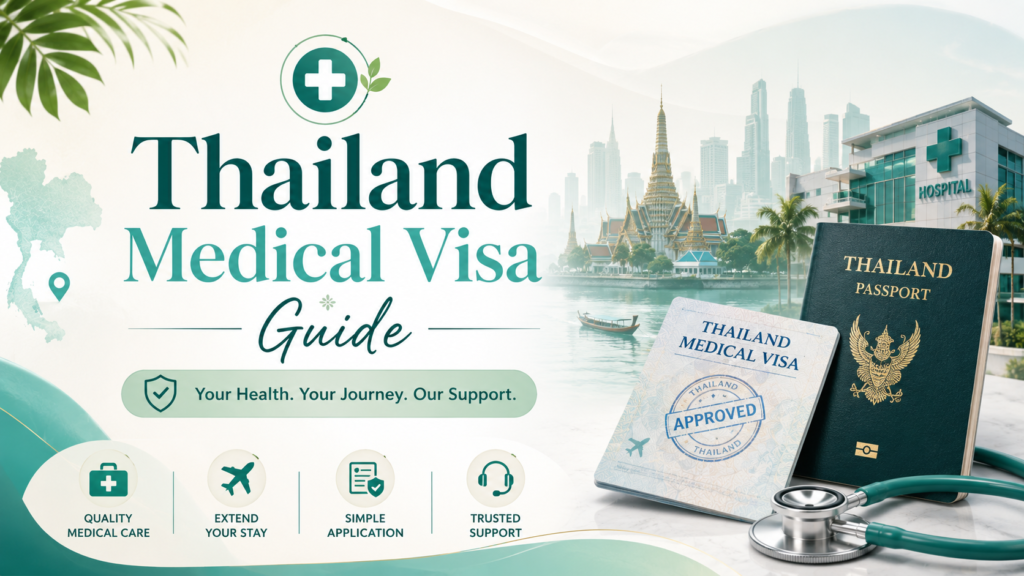
Thailand Medical Visa Guide: Hospital Letter, Treatment Plan, Non-O Visa, DTV Medical Treatment, and Patient Checklist
You have already contacted a hospital in Thailand, received an appointment date, and started comparing flights. Then the visa question becomes urgent: is a normal tourist visa enough, or do you need a medical visa?
A Thailand Medical Visa is a practical term for visa routes used when a foreign patient travels to Thailand for medical treatment, hospital care, surgery, rehabilitation, fertility treatment, dental treatment, or other healthcare-related purposes.
From our visa handling experience, medical visa cases are strongest when the treatment timeline is clear. The visa file should explain why the patient needs to enter Thailand, how long treatment may take, who will pay, and whether a companion is needed.
What Is a Thailand Medical Visa?
It may be Tourist Visa, Non-Immigrant O, DTV, or another route
“Thailand Medical Visa” is not always one single visa category. Depending on treatment length and purpose, the route may be Tourist Visa for medical treatment, Non-Immigrant O for medical treatment, DTV for medical treatment under Thai soft power activities, or another route based on the patient’s situation.
Royal Thai Embassy Kuala Lumpur separates medical treatment into Tourist Visa for medical treatment of less than 60 days and Non-Immigrant O for medical treatment of more than 60 days. You can check the latest guidance on the Royal Thai Embassy Kuala Lumpur medical treatment page.
| Medical Route | Best For | Practical Caution |
|---|---|---|
| Tourist Visa for Medical Treatment | Short treatment, check-up, dental, minor procedure | Hospital letter still matters |
| Non-Immigrant O for Medical Treatment | Longer treatment or recovery | More medical and financial documents may be needed |
| DTV for Medical Treatment | Eligible long-stay medical treatment cases | Requires DTV-level financial proof and hospital appointment evidence |
Official sources to check before applying
Visa rules, hospital document requirements, financial evidence, processing times, and extension policies can change. You can check the latest requirements from the official Thai e-Visa website, the Royal Thai Embassy or Consulate responsible for your location, and the hospital or medical center preparing your treatment documents.
Thailand Medical Visa: Short Treatment vs Long Treatment
Treatment length should drive the visa decision
The first question is not “Which visa is easiest?” The first question is: “How long does the medical treatment realistically require?” A same-week health check-up is different from surgery, cancer treatment, cardiac care, IVF treatment, rehabilitation, or multi-visit dental work.
From real client cases, many applicants choose a visa based only on the first appointment date. A stronger approach includes pre-treatment tests, operation date, recovery time, medication adjustment, wound checks, physiotherapy, and follow-up appointments.
| Treatment Situation | Practical Visa Question | Document Focus |
|---|---|---|
| Health check-up | Is a tourist medical route enough? | Appointment confirmation |
| Dental treatment | How many visits are needed? | Treatment schedule |
| Surgery | Is recovery time included? | Hospital letter and medical plan |
| Cancer treatment | Will follow-up exceed 60 days? | Long treatment evidence |
| Rehabilitation | How long is therapy expected? | Doctor letter and stay plan |
| Fertility treatment | Are multiple visits needed? | Clinic schedule and appointment proof |
Hospital Letter for Thailand Medical Visa
The hospital letter is usually the central document
A medical visa application usually needs a clear letter from a hospital or medical facility in Thailand. Some embassy guidance asks for a letter specifying the medical purpose and duration of treatment.
From practical cases, vague hospital letters create delays. A letter that says only “patient will visit our hospital” is weaker than a letter explaining the appointment, medical purpose, treatment duration, and follow-up schedule.
| Strong Hospital Letter | Weak Hospital Letter |
|---|---|
| Shows patient full name and passport number | Only shows appointment screenshot |
| States hospital, doctor, department, and contact details | No hospital contact or authorized signature |
| Explains medical purpose and expected duration | No treatment duration or reason for stay |
| Mentions follow-up or caregiver need if relevant | Companion travels with no explanation |
Thailand Medical Visa Documents Checklist
Your documents should tell one medical story
A strong medical visa file should quickly answer: what treatment is needed, why Thailand, how long the patient will stay, who will pay, where the patient will recover, and whether a companion is medically necessary.
| Document | Why It Matters | Practical Tip |
|---|---|---|
| Passport | Confirms identity and travel eligibility | Keep at least 6 months validity where required |
| Recent photo | Required for visa application | Use embassy-specified size and format |
| Hospital appointment letter | Proves medical purpose | Include treatment duration and appointment date |
| Treatment plan | Explains why stay is needed | Ask hospital for clear details |
| Financial proof | Shows ability to pay for treatment and stay | Match funds to treatment cost and stay length |
| Accommodation proof | Shows where patient will stay or recover | Include recovery accommodation if outside hospital |
| Companion documents | Supports caregiver or family travel | Include relationship proof and patient documents |
| Yellow fever certificate | Required for some travelers | Check if you traveled from or through listed countries |
How to Apply for a Thailand Medical Visa
Step 1: Confirm the treatment plan with the hospital
Ask the hospital or clinic for a written treatment plan showing diagnosis or treatment purpose, appointment date, expected duration, inpatient or outpatient status, follow-up visits, and whether a companion is recommended.
Step 2: Choose the right visa route
Use the expected treatment period to narrow the route. Short treatment may fit a tourist medical route. Longer treatment may require Non-Immigrant O. Some eligible cases may review DTV medical treatment if they meet DTV requirements.
Step 3: Prepare patient documents
Prepare passport, photo, visa application form, proof of current location, hospital letter, treatment plan, financial evidence, flight itinerary, accommodation proof, previous medical records, and yellow fever certificate if applicable.
Step 4: Prepare companion documents
If a family member or caregiver travels with the patient, prepare their passport, photo, relationship proof, patient’s hospital documents, shared travel itinerary, accommodation details, and financial evidence.
Step 5: Check embassy-specific rules
Each embassy may use slightly different wording, routes, financial proof, processing time, and companion rules. Use the checklist for the embassy or consulate handling your application.
Step 6: Submit through the correct channel
Depending on location, the application may be submitted through a Royal Thai Embassy, Royal Thai Consulate-General, or the official Thai e-Visa system.
Step 7: Plan for extensions if treatment takes longer
Medical cases can change. Ask the hospital early what documents they can provide if treatment continues, recovery takes longer, or the patient is not medically fit to travel.
DTV for Medical Treatment in Thailand
DTV may be possible, but it has its own requirements
Some Thai Embassy guidance lists medical treatment under DTV2 Thai soft power related activities. Royal Thai Embassy London lists financial evidence of no less than 500,000 THB or equivalent and proof of confirmation to attend the activity or letter of appointment from a hospital or medical center for this route. You can check the latest DTV details on the Royal Thai Embassy London DTV page.
| Route | Best For | Key Caution |
|---|---|---|
| Tourist Visa for Medical Treatment | Short treatment or check-up | Not ideal if recovery exceeds expected stay |
| Non-Immigrant O Medical Treatment | Longer treatment or recovery | Requires stronger medical documents |
| DTV Medical Treatment | Eligible longer-stay medical treatment cases | Requires DTV financial proof and hospital appointment evidence |
Companion and Caregiver Documents
The companion needs their own clear purpose
Some patients need a spouse, parent, adult child, nurse, or helper to travel with them. The companion should not look like an unrelated tourist if their real purpose is medical support.
From real client cases, companion files become stronger when the hospital letter mentions the need for assistance, especially for surgery, mobility limits, elderly patients, children, or serious conditions.
| Companion Document | Why It Matters | Practical Tip |
|---|---|---|
| Companion passport and photo | Confirms identity | Prepare a separate visa file |
| Relationship proof | Shows family connection | Translate or certify if required |
| Patient hospital letter | Connects companion to patient case | Ask hospital to mention caregiver need if medically relevant |
| Shared travel and accommodation | Shows support plan | Dates should match the patient’s treatment timeline |
Approved Case vs Delayed Case: What Made the Difference?
From real client cases, the clearest treatment timeline usually wins
| Topic | Delayed or Risky Case | Stronger Case |
|---|---|---|
| Hospital letter | Only appointment screenshot, no treatment duration | Hospital letter explains treatment purpose, date, duration, and follow-up |
| Travel dates | Patient plans 90 days but letter mentions one appointment only | Medical plan explains why the stay length is needed |
| Financial proof | Funds look too low for treatment and recovery | Bank documents support hospital cost, accommodation, and living expenses |
| Companion | Family member travels with no relationship proof or explanation | Companion role, relationship, and medical need are documented |
Common Thailand Medical Visa Mistakes
1. Using a tourist plan for a long medical case
If treatment clearly needs more time, a normal short-stay plan may create problems. Choose the visa based on the full medical timeline.
2. Hospital letter is too vague
A weak letter may not explain treatment purpose, appointment date, or expected duration. Ask for a clear hospital letter before applying.
3. Ignoring recovery time
Medical travel includes tests, procedure, recovery, medicine adjustment, wound checks, physiotherapy, and follow-up appointments.
4. Companion documents are missing
If someone accompanies the patient, their role should be clear. Prepare relationship proof and medical documents connecting them to the patient.
5. Financial proof does not match treatment cost
A low bank balance can look inconsistent if the treatment is expensive or long. Prepare financial documents that support the expected medical and living costs.
6. Choosing DTV without checking requirements
Medical treatment may appear under DTV soft power activities in some embassy guidance, but DTV has its own rules, including financial evidence and appointment proof.
7. Forgetting yellow fever rules
Thailand’s MFA states that travelers from or through listed yellow fever countries must provide an International Health Certificate. Check this before travel if relevant.
Summary: Thailand Medical Visa
Key points to remember:
- Thailand Medical Visa is a practical term, not always one single visa category.
- Short treatment may fit Tourist Visa for medical treatment.
- Longer treatment may require Non-Immigrant O for medical treatment.
- DTV may be considered for eligible medical treatment cases under Thai soft power activities.
- The hospital letter is usually one of the most important documents.
- The visa route should match the full treatment and recovery timeline.
- Companions need their own documents and clear purpose.
- Financial proof should support treatment, accommodation, and living costs.
- Some travelers may need a yellow fever certificate.
- Always check the latest official requirements before applying.
Let Co Journey Visa help prepare your Thailand Medical Visa application
A strong medical visa file should make the patient’s situation easy to understand: what treatment is needed, why Thailand, how long the stay should be, who will cover the cost, and whether a companion is medically necessary.
ทำไมควรให้ Co Journey Visa ช่วยดูแลวีซ่าของคุณ
การขอ Thailand Medical Visa อาจมีขั้นตอนที่ซับซ้อนและต้องการความแม่นยำในการเตรียมเอกสาร หากคุณไม่ต้องการให้เกิดความผิดพลาดและต้องการความสะดวกสบายในการดำเนินการ Co Journey Visa พร้อมให้บริการช่วยเหลือคุณในทุกขั้นตอน:
Frequently Asked Questions About Thailand Medical Visa
What is a Thailand Medical Visa?
A Thailand Medical Visa is a practical term for visa routes used by foreign patients entering Thailand for medical treatment. Depending on treatment length, the route may be Tourist Visa for medical treatment, Non-Immigrant O for medical treatment, DTV medical treatment, or another suitable visa route.
Do I need a hospital letter for a Thailand Medical Visa?
Yes, in most medical treatment cases. Embassy guidance commonly asks for a letter from a hospital or medical facility in Thailand specifying the medical purpose and duration of treatment.
Can a family member accompany me for medical treatment in Thailand?
Yes, in many cases, but the accompanying person usually needs their own visa or entry status. Prepare relationship proof, patient medical documents, shared travel details, and a hospital letter mentioning the need for assistance where possible.
Can I use a tourist visa for medical treatment in Thailand?
Possibly, if the treatment is short and the embassy’s rules allow that route. Royal Thai Embassy Kuala Lumpur separates Tourist Visa for medical treatment of less than 60 days from Non-Immigrant O for medical treatment of more than 60 days.
What if my medical treatment takes longer than expected?
You may need to apply for an extension or adjust your visa status depending on your case. Ask the hospital early for updated medical documents if you are not fit to travel or need continued treatment.
Is medical treatment included under Thailand DTV?
Some embassy guidance includes medical treatment under DTV Thai soft power related activities. Royal Thai Embassy London lists medical treatment under DTV2 and requires financial evidence of no less than 500,000 THB plus proof of appointment from a hospital or medical center.
How much money do I need to show for a Thailand Medical Visa?
It depends on the visa route and embassy. Short medical tourist routes may require evidence of adequate finance for the stay, while DTV medical treatment may require higher financial proof such as 500,000 THB or equivalent.
Do I need a yellow fever certificate for a Thailand Medical Visa?
Only certain travelers need it. Thailand’s MFA states that travelers from or through listed yellow fever countries must submit an International Health Certificate with the visa application and present it to Immigration upon arrival.
หากคุณต้องการคำแนะนำเพิ่มเติมหรือต้องการให้ Co Journey Visa ดูแลการยื่นวีซ่าของคุณ ติดต่อเราได้เลย 24 ชั่วโมง
บทความที่เกี่ยวข้อง

ติดตามข้อมูลวีซ่าอัปเดตจาก Co Journey Visa
เพิ่มเว็บไซต์นี้เป็นแหล่งข้อมูลที่ต้องการใน Google เพื่อให้ค้นพบบทความจากเราได้สะดวกขึ้น