
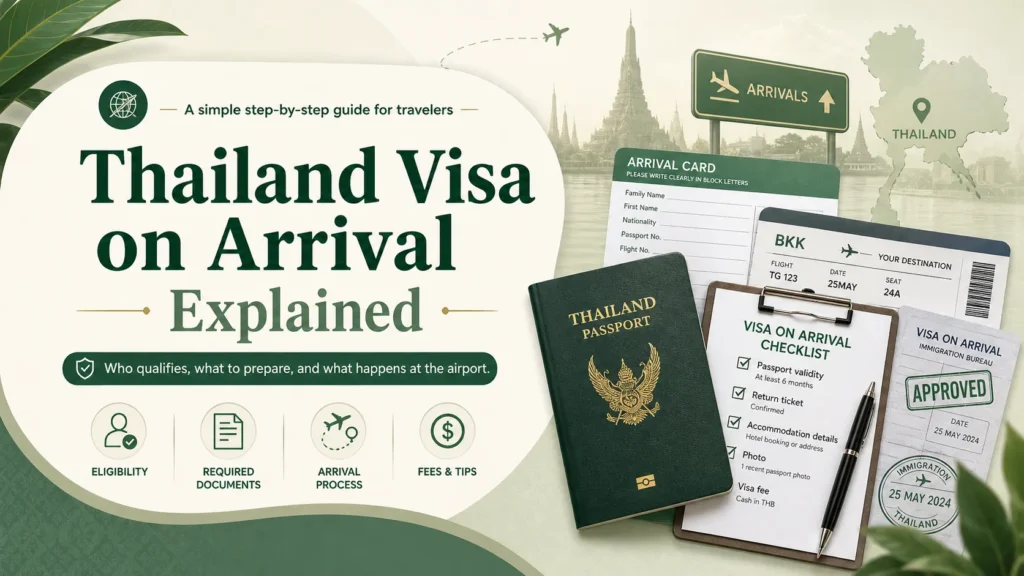
Thailand Visa on Arrival Explained: Who Can Apply, Fee, Documents, and Practical Checklist
You have booked your flight to Thailand, your hotel is confirmed, and your trip is only a short holiday. Then one question appears at the worst possible moment: “Do I need a visa before flying, or can I get one when I arrive?”
Thailand Visa on Arrival, often called VOA, allows eligible passport holders to apply for a short-stay tourist visa at immigration checkpoints when they arrive in Thailand. Under current official tourism guidance, VOA is generally for tourism stays of up to 15 days, with a visa fee of 2,000 THB.
From our visa handling experience, the biggest VOA problem is not complicated law. It is usually simple preparation: the wrong passport eligibility, no Thai Baht, unclear hotel booking, return ticket outside the allowed period, or confusing Visa on Arrival with visa exemption.
What Is Thailand Visa on Arrival?
A short-stay tourist visa applied for when you arrive
Thailand Visa on Arrival is a short-term entry option for travelers from eligible countries and territories who are visiting Thailand for tourism. It is not a universal backup option for every foreign traveler.
Official Thai tourism information states that Thailand allows nationals of 31 countries and territories to apply for VOA at immigration checkpoints on arrival, and visitors under this scheme are allowed to stay for tourism purposes for a period not exceeding 15 days.
| Topic | Thailand Visa on Arrival | Practical Caution |
|---|---|---|
| Main purpose | Short tourism trip | Not for work, study, or long-term stay |
| Stay length | Up to 15 days | Your return or onward ticket should match this period |
| Fee | 2,000 THB under official tourism guidance | Carry Thai Baht unless you use a confirmed official online payment route |
Official sources to check before traveling
Visa rules, eligible nationalities, fees, and arrival procedures can change. You can check current information from the Tourism Authority of Thailand, the official Thai e-Visa website, or the official Thailand Digital Arrival Card website.
Who Can Apply for Thailand Visa on Arrival?
VOA is nationality-based
Visa on Arrival is available only to nationals of eligible countries and territories. Under the policy effective from 15 July 2024, official Thai guidance refers to 31 countries and territories for VOA eligibility.
Common mistakes we often see include travelers assuming they can “just get a visa at the airport” without checking whether their passport is on the eligible list. If your passport is not eligible, you may need a Tourist Visa, visa exemption, or another route before departure.
| What to Check | Why It Matters | Practical Advice |
|---|---|---|
| Passport nationality | Only eligible countries and territories can use VOA | Check official sources before booking non-refundable travel |
| Purpose of visit | VOA is for short tourism purposes | If the real purpose is work, study, or long stay, review another visa |
| Trip length | VOA is for a stay not exceeding 15 days | If your stay is longer, check visa exemption or Tourist Visa instead |
Thailand Visa on Arrival Fee and Stay Length
VOA is short and fee-based
The current official tourism guidance lists Thailand Visa on Arrival as allowing a stay for tourism purposes for a period not exceeding 15 days, with a visa fee of 2,000 Baht.
From real traveler cases, one of the easiest mistakes to avoid is not carrying Thai Baht. Many travelers plan to exchange money after immigration, but VOA payment happens before regular entry.
| Item | Current Practical Guidance | Common Mistake |
|---|---|---|
| Stay length | Not exceeding 15 days | Booking return flight after the allowed stay |
| VOA fee | 2,000 THB | Arriving without Thai Baht cash |
| Payment timing | Before normal immigration entry | Planning to exchange money only after immigration |
Thailand Visa on Arrival Documents Checklist
VOA is on arrival, but it is not document-free
Even though you apply at the airport or checkpoint, you should prepare your documents before leaving your country. Airlines may check your entry eligibility before boarding, and immigration officers may ask for supporting documents when you arrive.
| Document | Why It Matters | Practical Tip |
|---|---|---|
| Eligible passport | VOA is only for specific nationalities | Check the latest official list before flying |
| Passport validity | Weak or nearly expired passports may cause issues | Some e-VOA guidance refers to at least 30 days from arrival for that process |
| Return or onward ticket | Shows you plan to leave Thailand | Keep it within the allowed stay period |
| Accommodation proof | Confirms where you will stay | Keep hotel booking or host address ready |
| Recent photo | Used for VOA processing | Bring a passport-style photo, not a cropped casual image |
| Visa fee | Required for VOA issuance | Prepare Thai Baht cash unless using a confirmed official online route |
| TDAC confirmation | Separate arrival requirement | Complete through the official Thai Immigration channel if required |
Visa on Arrival vs Visa Exemption vs Tourist Visa
Choosing the wrong route can waste time and money
Many travelers search for Thailand Visa on Arrival even when they actually qualify for visa exemption, which may allow a longer stay. Others try to use VOA for a trip that should have been a Tourist Visa or long-stay visa.
| Option | Best For | Stay Length | Key Point |
|---|---|---|---|
| Visa on Arrival | Eligible travelers taking short tourist trips | Up to 15 days | Fee applies and documents are checked at arrival |
| Visa Exemption | Eligible nationalities visiting for allowed short purposes | Up to 60 days under current official consular guidance | May be better than VOA if your passport qualifies |
| Tourist Visa | Travelers who need more certainty or a longer planned tourist stay | Generally up to 60 days after arrival under tourist visa guidance | Apply before travel through the correct channel |
How to Apply for Thailand Visa on Arrival
Step 1: Check your passport eligibility
Before booking your flight, confirm whether your passport is eligible for Thailand Visa on Arrival. Do not rely only on airline staff, old blogs, or social media comments.
Step 2: Confirm that your trip is 15 days or less
VOA is for a stay not exceeding 15 days. If your return ticket is later, check whether visa exemption, Tourist Visa, DTV, ED Visa, or another route is more suitable.
Step 3: Prepare your documents before flying
Prepare passport, return or onward ticket, accommodation proof, photo, proof of funds, Thai Baht for the fee, completed form if available, and TDAC confirmation if required.
Step 4: Follow signs to Visa on Arrival after landing
At major airports, VOA counters are usually located before normal immigration counters. Follow signs for “Visa on Arrival” before proceeding to immigration.
Step 5: Submit documents and pay the fee
Submit your form and supporting documents, then pay the visa fee. Carry Thai Baht cash unless you are using an official electronic process that confirms online payment.
Step 6: Receive VOA and proceed to immigration
After VOA is issued, proceed to immigration for entry stamping. Keep your documents accessible until you have fully cleared immigration.
Thailand e-VOA: Can You Apply Online?
e-VOA availability depends on nationality and official channels
Some travelers may be able to use Thailand e-VOA through an official authorized service channel. However, e-VOA availability can differ by nationality, airport, and policy update.
For example, one official Consulate-General guidance notes that e-VOA service is available only for certain nationalities based on its update. Because this can change, always check the latest official or authorized e-VOA website before applying.
| Route | How It Works | Key Caution |
|---|---|---|
| VOA at checkpoint | Apply when arriving at a designated Thai checkpoint | Queue, document check, and payment happen on arrival |
| e-VOA | Apply online through an official authorized route if eligible | Not available to every nationality |
| Thai e-Visa | Apply online before travel for eligible visa types and locations | Different from e-VOA and must match the visa purpose |
TDAC and Thailand Visa on Arrival
TDAC is separate from VOA
Thailand Digital Arrival Card, or TDAC, is an arrival information system. It is not a visa and does not replace Visa on Arrival. Having VOA does not automatically mean the arrival card requirement is skipped.
The official TDAC portal states that foreign travelers submit arrival information through the official Thai Immigration channel. To avoid scams, use the official TDAC website and do not pay unofficial websites for a free arrival form service.
| Item | Purpose | Important Note |
|---|---|---|
| VOA | Short tourist visa for eligible passport holders | Fee and document check apply |
| TDAC | Arrival information submission | Not a visa and should be submitted through official channels |
| Passport stamp | Final permission to stay | Check the admitted-until date after entry |
Approved Entry vs Problematic Entry: What Made the Difference?
From real client cases, preparation is the difference
| Topic | Problematic Case | Stronger Case |
|---|---|---|
| Eligibility | Arrives assuming every nationality can get VOA | Checks official eligibility before flying |
| Trip length | Return ticket is outside 15 days | Return or onward ticket matches the permitted stay |
| Payment | No Thai Baht available for VOA fee | Carries Thai Baht and backup payment plan |
| Purpose | Says tourism but plans work or long stay | Travel purpose clearly matches short tourism |
Common Thailand Visa on Arrival Mistakes
1. Confusing VOA with visa exemption
Visa on Arrival is a paid visa process at arrival. Visa exemption allows eligible travelers to enter without applying for a visa first.
2. Assuming every nationality can get VOA
VOA is nationality-based. If your passport is not eligible, arriving without the right visa can create a serious problem.
3. Not carrying Thai Baht
The VOA fee is listed in Thai Baht. Carry cash unless you are using a confirmed official online route.
4. Booking a return ticket outside the allowed stay
Your return or onward ticket should match your permitted stay. If VOA allows up to 15 days, your travel plan should reflect that.
5. Using an unclear hotel booking
Officers may ask where you will stay. Keep a clear hotel booking or host address ready.
6. Forgetting that VOA is for tourism
VOA is not a work visa. If you plan to work, study, or stay long-term, review another visa route before departure.
7. Trusting unofficial websites too quickly
Use official Thai government, embassy, consulate, immigration, tourism, or authorized service channels for visa and arrival information.
Summary: Thailand Visa on Arrival
Key points to remember:
- Thailand Visa on Arrival is for eligible passport holders entering for short tourism trips.
- VOA is generally for a stay not exceeding 15 days.
- The current official tourism guidance lists the VOA fee as 2,000 THB.
- VOA is not available to every nationality.
- VOA is not the same as visa exemption.
- You should prepare passport, return or onward ticket, accommodation proof, photo, funds, fee, and TDAC if required.
- Carry Thai Baht unless using a confirmed official online route.
- If your stay is longer or your purpose is more complex, check another visa route before traveling.
- Always verify the latest official rules before making travel decisions.
Let Co Journey Visa help you choose the right Thailand entry route
Thailand Visa on Arrival can be useful for a short tourist trip, but it is not the best route for every passport or every travel plan. Starting with the right entry strategy can help avoid airport stress, boarding issues, unnecessary fees, and document problems.
ทำไมควรให้ Co Journey Visa ช่วยดูแลวีซ่าของคุณ
การขอ Thailand Visa on Arrival อาจมีขั้นตอนที่ซับซ้อนและต้องการความแม่นยำในการเตรียมเอกสาร หากคุณไม่ต้องการให้เกิดความผิดพลาดและต้องการความสะดวกสบายในการดำเนินการ Co Journey Visa พร้อมให้บริการช่วยเหลือคุณในทุกขั้นตอน:
Frequently Asked Questions About Thailand Visa on Arrival
What is Thailand Visa on Arrival?
Thailand Visa on Arrival is a short-stay tourist visa that eligible passport holders can apply for when arriving at Thai immigration checkpoints. It is generally for tourism stays of up to 15 days.
How long can I stay in Thailand with Visa on Arrival?
Thailand Visa on Arrival generally allows a stay not exceeding 15 days. If you want to stay longer, check whether you qualify for visa exemption, Tourist Visa, DTV Visa, or another visa category before traveling.
How much is Thailand Visa on Arrival?
The current official tourism guidance lists the Thailand Visa on Arrival fee as 2,000 THB. Fees can change, so travelers should check the latest official information before departure.
Can everyone get Visa on Arrival in Thailand?
No. Only nationals of eligible countries and territories can apply for Thailand Visa on Arrival. Official Thai tourism guidance refers to 31 countries and territories under the expanded VOA measure.
Is Visa on Arrival the same as visa exemption?
No. Visa on Arrival is a visa issued at arrival for eligible travelers and usually involves a fee. Visa exemption allows eligible travelers to enter without applying for a visa first and may allow a longer stay for some nationalities.
Do I need a return ticket for Thailand Visa on Arrival?
You should have a confirmed return or onward ticket that matches your permitted stay. This is important because it shows that you plan to leave Thailand within the allowed period.
Can I apply for Thailand Visa on Arrival online?
Some travelers may be able to use Thailand e-VOA through an official authorized service channel, but availability depends on nationality, airport, and policy updates. Check the latest official or authorized e-VOA website before applying.
Do I still need TDAC if I use Visa on Arrival?
VOA and TDAC are separate. TDAC is an arrival information system, while VOA is a visa process. Check the latest TDAC requirements and complete it through official Thai Immigration channels if required.
หากคุณต้องการคำแนะนำเพิ่มเติมหรือต้องการให้ Co Journey Visa ดูแลการยื่นวีซ่าของคุณ ติดต่อเราได้เลย 24 ชั่วโมง
บทความที่เกี่ยวข้อง
ติดตามข้อมูลวีซ่าอัปเดตจาก Co Journey Visa
เพิ่มเว็บไซต์นี้เป็นแหล่งข้อมูลที่ต้องการใน Google เพื่อให้ค้นพบบทความจากเราได้สะดวกขึ้น