
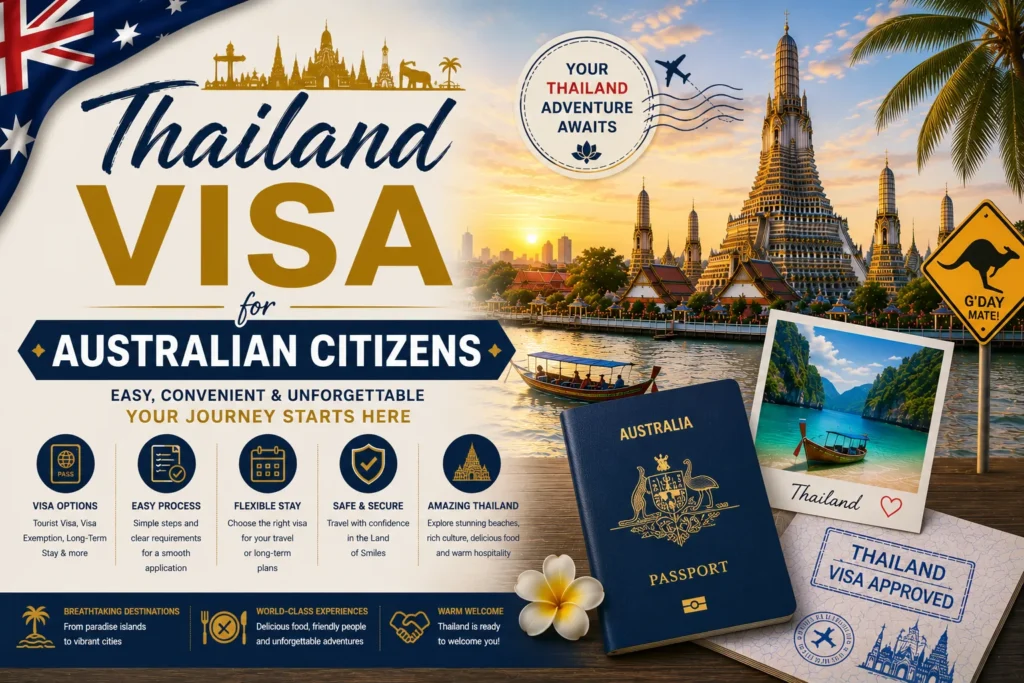
Thailand Visa for Australian Citizens: 60-Day Visa Exemption, TDAC, e-Visa, DTV, Retirement, Work, Study, Family, and Long-Stay Checklist
You book a flight from Sydney, Melbourne, Brisbane, Perth, Adelaide, or Canberra to Bangkok, Phuket, Chiang Mai, or Koh Samui — then the visa advice gets confusing. Some pages still say Australians get 30 days. Others say 60 days. Then someone mentions TDAC, e-Visa, DTV, retirement visa, or work permit.
Australian ordinary passport holders can currently enter Thailand under the 60-day visa exemption for tourism, short-term business engagements, and urgent or ad-hoc work, with a possible extension of up to 30 days through Thai Immigration. But this does not mean every Australian citizen can use visa exemption for every purpose.
From our visa handling experience, the biggest mistake Australian travelers make is assuming “I can enter without a visa” means “I do not need visa planning.” For a short holiday, that may be fine. For work, study, retirement, remote work, family stay, or long-term living, it can create problems later.
Do Australian Citizens Need a Visa for Thailand?
For many short trips, no — but purpose matters
For tourism, short-term business engagements, and urgent or ad-hoc work, Australian ordinary passport holders can currently enter Thailand visa-free for up to 60 days. The Royal Thai Embassy in Canberra announced Thailand’s latest visa exemption measures effective from 15 July 2024.
You can check the latest official information from the Royal Thai Embassy Canberra visa exemption update, the Australian Government Smartraveller Thailand page, and the official Thai e-Visa website.
| Purpose | Likely Route | Practical Caution |
|---|---|---|
| Short holiday or short business travel | 60-day visa exemption | TDAC and supporting documents may still be needed |
| Longer tourism | Tourist Visa or extension review | Extension approval depends on Thai Immigration |
| Remote work or freelancing | DTV or LTR if qualified | Must prove remote-work purpose and financial readiness |
| Thai employment | Non-B + Work Permit | Do not start work on visa exemption |
| Retirement, study, family, medical, relocation | O, O-A, ED, medical, LTR, Thailand Privilege, or other route | Choose by real purpose, not convenience |
Thailand 60-Day Visa Exemption for Australian Citizens
Best for short trips, not long-term living
Visa exemption is often suitable for holidays, family visits, beach stays, short business meetings, wellness trips, property-viewing trips, or a short scouting visit before deciding on a longer visa.
The Australian Government’s Smartraveller also states that Australians can get visa-free entry for up to 60 days for tourism and short-term business travel. If you need a longer stay, the 60-day visa-exempt stay may be extended for up to 30 days through Thai Immigration, subject to approval.
| Visa Exemption Item | What It Means | Practical Tip |
|---|---|---|
| 60 days | Current visa-free stay for eligible Australian ordinary passport holders | Check the actual stamp after arrival |
| Possible 30-day extension | May support a longer tourist stay if approved | Apply before the permitted stay expires |
| Short-term business engagement | May cover short meetings or brief engagements | Carry meeting invitation or schedule if relevant |
| Not a work visa | Does not authorize Thai employment or local work | Review Non-B and work permit before local work |
Thailand Digital Arrival Card for Australian Citizens
TDAC is separate from a visa
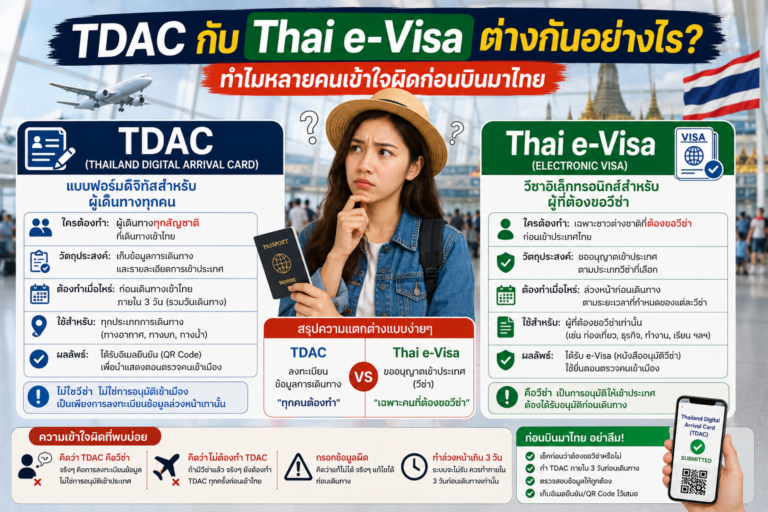
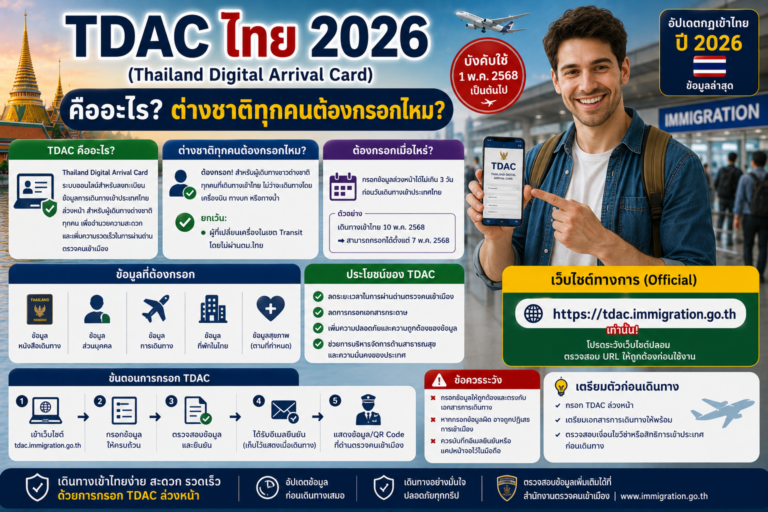
The Thailand Digital Arrival Card, or TDAC, is not a visa. It is an online arrival form submitted before entry. So an Australian traveler may have two separate questions: “Do I need a visa?” and “Do I need to complete TDAC?”
Thailand Immigration’s official TDAC site states that foreigners are required to submit arrival card information 3 days in advance of arrival. Use the official Immigration website and be careful with unofficial paid websites.
| TDAC Item | Why It Matters | Practical Tip |
|---|---|---|
| Passport details | Used for arrival record | Match exactly with your passport |
| Flight or transport details | Supports Immigration processing | Prepare flight number and arrival date |
| Accommodation in Thailand | Shows address after arrival | Hotel, condo, host address, or lease should be ready |
| Official website only | Avoids scams and unnecessary fees | Use the Immigration Bureau TDAC system |
Thai e-Visa for Australian Citizens
Used when visa exemption is not enough
If visa exemption does not fit your purpose, you may need to apply for a Thai visa. The Royal Thai Consulate-General in Sydney states that Thai e-Visa is available and applicants can apply online, with e-Visa starting in Australia from 1 January 2025.
The Royal Thai Embassy in Canberra also states that residents in most Australian states and territories apply through Canberra, while New South Wales residents submit applications to the Royal Thai Consulate-General in Sydney. This jurisdiction detail matters because applying through the wrong office can delay the process.
| e-Visa Step | What to Check | Common Mistake |
|---|---|---|
| Choose visa category | Tourist, DTV, Non-B, ED, O, O-A, medical, or other route | Applying as tourist when the real purpose is work or study |
| Check jurisdiction | Canberra or Sydney may handle different applicants | Submitting through the wrong office |
| Upload documents | Files must be readable and complete | Cropped bank screenshots or blurry passport pages |
| Match dates | Flights, hotel, invitation, school, hospital, and work documents should align | Application says 60 days but hotel shows 3 nights |
DTV Visa for Australian Remote Workers and Freelancers
A better route than repeated visa-free entries for many remote workers
Many Australian citizens want to spend several months in Thailand while working remotely for an Australian employer or overseas clients. For this, the Destination Thailand Visa, or DTV, may be worth reviewing.
DTV is generally designed for remote-work and workcation-style stays, including digital nomads, freelancers, soft power activities, and dependents where eligible. However, DTV is not a general permission to work for Thai employers, Thai clients, schools, or local businesses.
| DTV Applicant Type | Useful Evidence | Common Weak Point |
|---|---|---|
| Remote employee | Employment contract, employer letter, salary proof, remote-work confirmation | Employer letter does not confirm remote work |
| Freelancer | Portfolio, invoices, client contracts, payment records | Only saying “I work online” without proof |
| Soft power or medical-related activity | Course, event, appointment, hospital letter, or activity confirmation | Activity document is informal or missing dates |
| Dependent of DTV holder | Marriage or birth certificate and main applicant proof | Relationship documents are missing or not certified where required |
Work, Retirement, Study, Family, and Medical Routes
Visa exemption is not the right route for every purpose
An Australian passport can make short entry easier, but it does not remove the need for a proper visa when the purpose changes. Working locally, studying formally, retiring long-term, joining Thai family, or receiving ongoing medical treatment may require a specific visa route.
From common cases, problems usually begin when a short visit slowly becomes long-term living without a proper structure.
| Purpose | Likely Route | Practical Warning |
|---|---|---|
| Thai employment | Non-B + Work Permit | Do not start work while “sorting paperwork later” |
| Study | ED Visa | School documents and attendance may matter |
| Retirement | Non-O, O-A, LTR Pensioner, or Thailand Privilege | Financial proof and insurance rules should be reviewed early |
| Thai spouse or family | Non-O or family route | Relationship documents must be official and consistent |
| Medical treatment | Medical visa or suitable route | Hospital letter and treatment plan may be required |
How Australian Citizens Should Choose and Apply
Step 1: Define the real purpose of stay
Start with one clear sentence: “I am visiting Thailand for a 2-week holiday,” “I want to stay in Thailand for 90 days as a tourist,” “I work remotely for an Australian company,” “I have a job offer from a Thai employer,” “I want to retire in Thailand,” “I am married to a Thai citizen,” “I will study at a Thai school,” or “I need medical treatment in Thailand.”
Step 2: Check whether visa exemption fits
Visa exemption may fit if you hold an Australian ordinary passport, your stay is within the permitted period, your purpose is tourism or another eligible short-term purpose, you have a temporary travel plan, and you are not entering to work, study, retire, or live long-term.
Step 3: Complete TDAC before arrival
Submit the Thailand Digital Arrival Card through the official Immigration system before traveling. Prepare passport information, flight or transport details, arrival date, accommodation in Thailand, contact information, and any health or travel-history details requested.
Step 4: Apply for Thai e-Visa if needed
If visa exemption is not enough, apply for the visa that matches your purpose. Common options include Tourist Visa, DTV, Non-B, ED, Non-O, O-A, LTR, Thailand Privilege, or medical visa routes where suitable.
Step 5: Prepare documents that match the purpose
Tourism needs travel plan and accommodation. Remote work needs contracts and income evidence. Employment needs Thai employer documents. Study needs school documents. Retirement needs financial and insurance documents where required. Family cases need official relationship proof.
Step 6: Check your entry stamp after arrival
Your entry stamp controls your permitted stay. Do not rely only on visa validity, e-Visa approval, TDAC confirmation, hotel booking, flight booking, or advice from previous trips.
Step 7: Plan extensions or long-stay changes early
If you want to stay longer, start early. Possible options may include extension at Thai Immigration, Tourist Visa, DTV, retirement route, marriage route, work visa and work permit, education visa, LTR, or Thailand Privilege.
Thailand Travel Checklist for Australian Citizens
| Item | Why It Matters | Practical Tip | Done |
|---|---|---|---|
| Australian passport | Determines visa exemption eligibility | Keep enough validity for travel | ☐ |
| Purpose of stay | Determines visa route | Tourism, remote work, study, work, retirement, family | ☐ |
| TDAC | Required arrival information | Submit through official Immigration site 3 days before arrival | ☐ |
| Return/onward ticket | Supports temporary stay | Keep booking ready | ☐ |
| Accommodation proof | Shows where you will stay | Hotel, condo, host address, or lease | ☐ |
| Financial proof | May be checked or required | Keep recent evidence available | ☐ |
| e-Visa approval | Needed if applying for a visa | Save digital and printed copy | ☐ |
| Work documents | Needed for DTV or Non-B | Match real work activity | ☐ |
| Entry stamp | Shows stay deadline | Check immediately after arrival | ☐ |
| Extension plan | Prevents overstay | Prepare before the deadline | ☐ |
Approved Case vs Risky Case: What Made the Difference?
From real client cases, the smoothest Thailand plans begin with the purpose, not the entry stamp
| Topic | Risky Case | Stronger Case |
|---|---|---|
| Visa information | Traveler relies on old 30-day advice | Traveler checks latest Embassy, Smartraveller, and Immigration guidance |
| TDAC | Traveler remembers TDAC at the airport | TDAC is completed in advance through the official Immigration system |
| Remote work | Applicant says only “I work online” | Applicant prepares employer letter, contract, invoices, portfolio, and bank evidence |
| Deadline | Traveler checks extension options near the final day | Entry stamp, extension date, TDAC, 90-day report, and re-entry needs are tracked early |
Common Mistakes Australian Citizens Make
1. Relying on old 30-day advice
Thailand’s exemption period changed under the new visa measures. Check official sources before planning a 60-day or 90-day stay.
2. Forgetting TDAC
TDAC is separate from visa exemption. Even if you do not need a visa, you still need to complete the arrival card process before arrival.
3. Treating visa exemption as a long-stay plan
Visa exemption is useful for short visits. If you are effectively living in Thailand, working remotely, retiring, studying, or staying with family long-term, choose a proper visa structure.
4. Working locally without permission
A Thai job, Thai client work, local consulting, teaching, or managing a Thai business may require a work visa and work permit. Visa-free entry is not enough.
5. Applying through the wrong Thai office
The responsible Thai office can depend on where you live in Australia. Check jurisdiction before applying to avoid preventable delays.
6. Confusing visa validity with permitted stay
Your visa may be valid for entry during a certain period, but your actual stay deadline is the stamp issued by Thai Immigration.
7. Applying for DTV with weak proof
Remote workers should prepare documents that prove real work status. A simple statement saying “I work online” is usually weaker than an employer letter, contract, invoices, portfolio, payment records, or business documents.
Summary: Thailand Visa for Australian Citizens
Key points to remember:
- Australian ordinary passport holders can currently enter Thailand without a visa for up to 60 days under the visa exemption scheme for eligible short visits.
- The 60-day visa-exempt stay can be extended for up to 30 days through Thai Immigration, subject to approval.
- TDAC is separate from a visa and should be submitted through the official Immigration system before arrival.
- Thai e-Visa is available for Australians when a visa is required.
- Visa exemption is useful for short visits, but it is not a long-term residence or work solution.
- DTV may suit eligible Australian remote workers, freelancers, soft power participants, medical-related cases, and dependents.
- Thai employment usually requires Non-B and work permit planning.
- Study, family stay, retirement, medical treatment, and long stay require the correct visa route.
- Always check your entry stamp after arrival because it controls your permitted stay.
- Rules, stay periods, TDAC requirements, e-Visa procedures, fees, and Immigration practice may change.
Let Co Journey Visa help identify the right Thailand visa route for Australian citizens
A safe Thailand visa plan should match your real purpose: tourism, remote work, Thai employment, study, family stay, retirement, medical treatment, or long stay.
ทำไมควรให้ Co Journey Visa ช่วยดูแลวีซ่าของคุณ
การขอ Thailand Visa for Australian Citizens อาจมีขั้นตอนที่ซับซ้อนและต้องการความแม่นยำในการเตรียมเอกสาร หากคุณไม่ต้องการให้เกิดความผิดพลาดและต้องการความสะดวกสบายในการดำเนินการ Co Journey Visa พร้อมให้บริการช่วยเหลือคุณในทุกขั้นตอน:
Frequently Asked Questions About Thailand Visa for Australian Citizens
Do Australian citizens need a visa for Thailand?
For many short trips, no. Australian ordinary passport holders can currently enter Thailand visa-free for up to 60 days under Thailand’s visa exemption scheme for eligible short visits.
How long can Australians stay in Thailand without a visa?
Australians can currently stay up to 60 days under visa exemption for tourism and short-term business travel. Check the latest Embassy, Smartraveller, and Thai Immigration information before traveling.
Can Australians extend their visa-free stay in Thailand?
Yes, they may apply for an extension of up to 30 days through the Thai Immigration Bureau, subject to approval. Apply before the current stay expires.
Do Australian citizens need TDAC for Thailand?
Yes. Thailand Immigration’s official TDAC site says foreigners are required to submit arrival card information 3 days in advance of arrival. TDAC is separate from a visa.
How do Australians apply for a Thailand visa?
When a visa is required, Australians can apply through Thailand’s e-Visa system. The Royal Thai Consulate-General in Sydney says Thai e-Visa is available from 1 January 2025 and allows applicants to apply online.
Can Australians work in Thailand on visa exemption?
No. Visa exemption is not a general work route. If an Australian citizen will work for a Thai employer, Thai client, school, or local business, they should review the correct work visa and work permit route.
What visa is best for Australian remote workers in Thailand?
DTV may be suitable for many Australian remote workers, freelancers, and digital nomads. The best route depends on work proof, client location, income source, financial evidence, and whether any work connects to Thailand.
Can Australians retire in Thailand?
Yes, if they meet the relevant retirement or long-stay requirements. Common options include Non-O retirement, Non-O-A, LTR Wealthy Pensioner, and Thailand Privilege. The best choice depends on age, savings, pension income, insurance, travel frequency, and long-term plans.
หากคุณต้องการคำแนะนำเพิ่มเติมหรือต้องการให้ Co Journey Visa ดูแลการยื่นวีซ่าของคุณ ติดต่อเราได้เลย 24 ชั่วโมง
บทความที่เกี่ยวข้อง
ติดตามข้อมูลวีซ่าอัปเดตจาก Co Journey Visa
เพิ่มเว็บไซต์นี้เป็นแหล่งข้อมูลที่ต้องการใน Google เพื่อให้ค้นพบบทความจากเราได้สะดวกขึ้น