
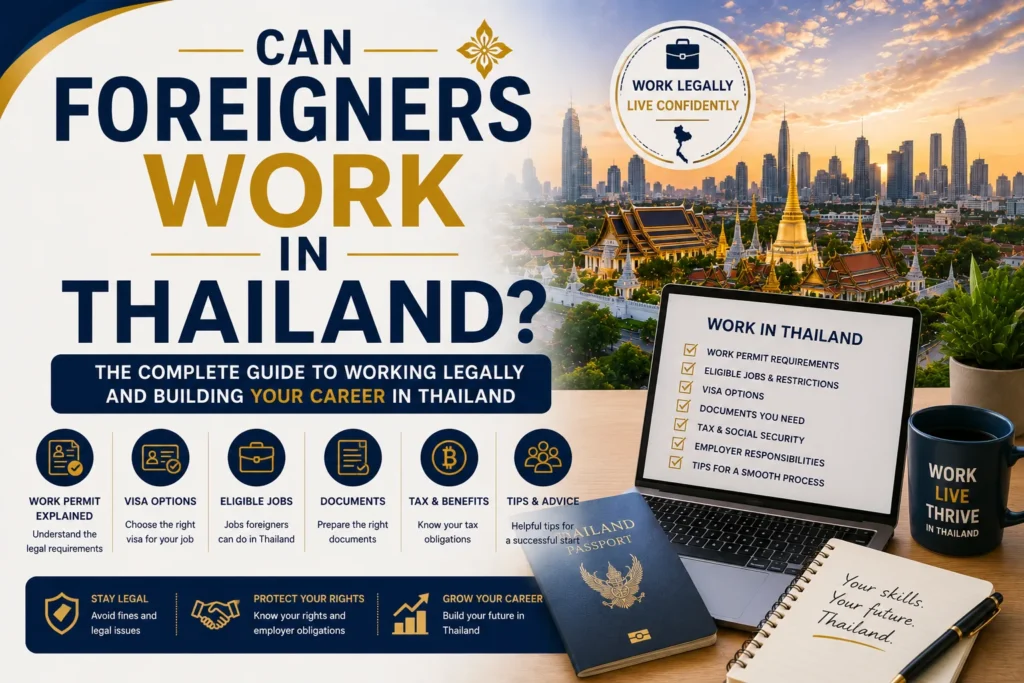
Can Foreigners Work in Thailand? Non-B Visa, Work Permit, Employer Documents, Restricted Jobs, Freelance Risks, and Legal Work Checklist
You get a job offer in Bangkok, a friend asks you to help with a café, or a Thai company wants to pay you for consulting. The work sounds simple — but the legal question is not simple at all: can a foreigner actually work in Thailand?
Yes, foreigners can work in Thailand, but they normally need the correct visa status and a valid work permit before starting work. The common route is a Non-Immigrant B Visa plus a work permit issued for a specific employer, job, and place of work.
From our visa handling experience, many work-related problems happen because foreigners think a visa alone allows work, employers are not ready with company documents, the job title does not match the real duties, or the person starts working before the work permit is approved.
Can Foreigners Work in Thailand?
Yes, but work authorization is usually required
Foreigners can work in Thailand when the work is legally structured. In most normal employment cases, this means having the correct visa status and a valid work permit before starting work.
Thailand’s Ministry of Foreign Affairs explains that the Non-Immigrant B Visa is issued to applicants who wish to enter Thailand to work or conduct business, and that a visa holder who wishes to work must be granted a work permit before starting work. You can check the official information on the Ministry of Foreign Affairs Non-Immigrant B Visa page.
| Concept | What It Means | Common Mistake |
|---|---|---|
| Visa status | Permission to enter or stay in Thailand under a specific category | Thinking a visa alone allows work |
| Work permit | Permission to perform approved work in Thailand | Starting work before approval |
| Employer sponsorship | Company-side documents supporting the foreign worker | Assuming the employee profile alone is enough |
| Restricted occupation check | Some occupations are reserved or restricted for foreigners | Accepting a job before checking whether the role is allowed |
Non-B Visa vs Work Permit in Thailand
A Non-B visa is not the same as permission to start work
A Non-Immigrant B Visa is commonly used for foreigners entering Thailand for employment or business purposes. However, a Non-B visa alone does not automatically allow the foreigner to start working.
From real client cases, many applicants misunderstand this point. They receive a Non-B visa, arrive in Thailand, and assume they can start work immediately. In normal employment planning, the work permit must also be granted before work begins.
| Topic | Visa | Work Permit |
|---|---|---|
| Main purpose | Allows entry or stay under a category | Allows approved work |
| Common authority | Embassy, Consulate, e-Visa, or Immigration | Department of Employment or labour authority |
| Linked to | Purpose of stay | Employer, job title, duties, and work location |
| Common mistake | Thinking visa alone allows work | Thinking permit allows any job or employer |
Can Foreigners Work in Thailand on a Tourist Visa?
Tourist status is not a work route
A tourist visa, visa exemption entry, or transit status is for visiting Thailand, not for employment. Thailand’s Ministry of Labour states that alien employment law controls foreign employment and reserves certain occupations for Thai workers. You can check the official overview on the Ministry of Labour labour law page.
From our visa handling experience, many foreigners enter Thailand first as tourists and later receive a job offer. The safest approach is not to start working immediately. The correct visa conversion, Non-B route, or apply-from-abroad process should be reviewed first.
| Current Status | Can It Support Normal Employment? | Practical Action |
|---|---|---|
| Tourist visa | Not a normal work route | Review change of status or Non-B application |
| Visa exemption | Not a normal work route | Do not start work before legal review |
| Transit status | Not for employment | Use the correct employment route |
| Non-B employment route | Common route for employment | Prepare employer documents and work permit |
Employer Documents for Thailand Work Permit
The employer file is often the real bottleneck
For normal employment, the Thai employer usually prepares the company-side documents. A strong employee profile cannot fix a weak company file. From real client cases, many delays happen because company registration, tax records, shareholder documents, or social security records are incomplete.
The exact list can vary by company type, location, job type, and labour office practice, but employers should be ready before telling a foreigner to start work.
| Employer Document | Why It Matters | Common Weak Point |
|---|---|---|
| Company affidavit / registration | Proves the company exists and is active | Outdated company documents |
| Shareholder list | Shows ownership structure | Not matching current company records |
| Tax and VAT documents | Shows business compliance | Missing or late filings |
| Employment contract | Explains role, salary, and employment terms | Job title does not match real duties |
| Office address evidence | Connects work permit to workplace | Address differs from application or company records |
Restricted Jobs and Prohibited Occupations for Foreigners
Not every job is open to foreigners
Even with an employer, not every role is legally available to foreigners. Thailand’s Ministry of Labour notes that alien employment law controls foreign employment and reserves certain occupations for Thai workers. The Department of Employment has also published rules on prohibited occupations for foreigners.
This is especially important for roles involving manual work, retail, front-line service, driving, certain crafts, and work traditionally reserved for Thai nationals. The job title alone is not enough; the real duties matter.
| Risk Area | Why It Matters | Practical Review |
|---|---|---|
| Manual or craft work | Some roles may be reserved or restricted | Check prohibited occupation list before hiring |
| Retail or front-line service | May be sensitive depending on duties | Describe actual tasks, not only title |
| Teaching or training | Often requires school documents and proper permission | Do not teach while paperwork is only being prepared |
| Consulting or freelancing | Can still count as work | Review client base, location, and work-permit route |
How Foreigners Can Work Legally in Thailand
Step 1: Confirm the real work activity
Start with the actual activity. Will you be employed by a Thai company, teach at a school, work for a BOI-promoted company, manage a Thai business, freelance for Thai clients, or work remotely for an overseas employer?
Step 2: Check whether the job is allowed
Before preparing a visa, check whether the position is open to foreigners. The job title and real duties should not fall under prohibited or restricted occupations.
Step 3: Prepare the correct visa route
For standard employment, the common route is Non-Immigrant B. Some cases may involve BOI-supported processes, Smart Visa, LTR, DTV, education-related permission, or special approvals depending on the activity.
Step 4: Prepare employer documents
The employer should prepare company registration, shareholder list, tax documents, VAT records, financial documents, employment contract, job description, office evidence, and authorized director documents where required.
Step 5: Apply for work permit
The work permit application is usually supported by the employer and submitted through the relevant labour authority process. Do not start working just because documents are being prepared.
Step 6: Check work permit conditions
After approval, review employer name, job title, permitted duties, workplace address, validity period, passport number, and any special conditions.
Step 7: Maintain compliance after approval
Track visa extension date, work permit expiry, 90-day reporting if applicable, re-entry permit before travel, employer changes, role changes, office relocation, passport renewal, and termination obligations.
Foreigner Work Legality Checklist
| Item | Why It Matters | Practical Tip | Done |
|---|---|---|---|
| Real work activity | Determines legal route | Describe actual duties, not only job title | ☐ |
| Correct visa status | Supports stay for work | Non-B is common for employment | ☐ |
| Work permit | Authorizes actual work | Do not start before approval | ☐ |
| Employer sponsorship | Usually needed for standard employment | Confirm company readiness early | ☐ |
| Company documents | Supports work permit application | Use updated company records | ☐ |
| Job title and duties | Must match permit | Avoid vague or misleading titles | ☐ |
| Workplace address | Often tied to work permit | Update if office changes | ☐ |
| Restricted occupation check | Some jobs are reserved for Thai nationals | Review before accepting job | ☐ |
| Visa extension | Maintains stay after initial visa | Track deadlines | ☐ |
| Re-entry permit | Protects stay during travel | Apply before leaving Thailand if needed | ☐ |
Approved Case vs Risky Case: What Made the Difference?
From real client cases, alignment is the biggest factor
| Topic | Risky Case | Stronger Case |
|---|---|---|
| Timing | Foreigner starts work while permit is still being prepared | Foreigner waits until work authorization is granted |
| Employer file | Company documents are incomplete or outdated | Employer prepares updated company, tax, and employment documents |
| Job duties | Actual duties do not match the job title | Job title, contract, and duties are consistent |
| Visa status | Applicant tries to work from tourist status | Correct work visa route is prepared before work starts |
Common Mistakes Foreigners Make When Working in Thailand
1. Starting work before the work permit is issued
A job offer, employment contract, company letter, or Non-B visa does not always mean you can start working. Wait for proper authorization.
2. Working on a tourist entry
Tourist status is not a work route. If you entered as a tourist and received a job offer, check the proper route before starting.
3. Job title does not match actual duties
A work permit may say one role, but the foreigner actually performs another. This mismatch can create compliance problems.
4. Employer documents are weak
Some companies want to hire foreigners but are not ready with company registration, tax records, financials, or employment documents.
5. Assuming marriage visa allows work automatically
Being married to a Thai citizen can support your stay in Thailand, but it does not automatically authorize employment.
6. Freelancing locally without checking rules
Freelancing for Thai clients, teaching private lessons, consulting local companies, or selling services inside Thailand may count as work.
7. Working outside the permit conditions
A work permit is usually specific to employer, job title, duties, and location. Changes may require updates or a new permit.
Summary: Can Foreigners Work in Thailand?
Key points to remember:
- Foreigners can work in Thailand if the work is legally structured.
- In most normal cases, a correct visa status and valid work permit are required.
- Non-Immigrant B is a common visa route for employment or business.
- A Non-B visa alone does not automatically allow work.
- Tourist visa, visa exemption, and transit status are not normal work routes.
- The employer’s company documents are critical for work permit approval.
- Some occupations are restricted or prohibited for foreigners.
- Marriage, retirement, student, or guardian stay does not automatically authorize work.
- Remote work and local work should be reviewed separately.
- Always check the latest official MFA, Ministry of Labour, Department of Employment, and Immigration guidance before starting work.
Let Co Journey Visa help review your Thailand work route
A strong Thailand work case should make everything align: the foreigner’s visa status, employer documents, job title, real duties, workplace address, and work permit conditions.
ทำไมควรให้ Co Journey Visa ช่วยดูแลวีซ่าของคุณ
การขอ Thailand Work Permit อาจมีขั้นตอนที่ซับซ้อนและต้องการความแม่นยำในการเตรียมเอกสาร หากคุณไม่ต้องการให้เกิดความผิดพลาดและต้องการความสะดวกสบายในการดำเนินการ Co Journey Visa พร้อมให้บริการช่วยเหลือคุณในทุกขั้นตอน:
Frequently Asked Questions About Foreigners Working in Thailand
Can foreigners work in Thailand?
Yes, foreigners can work in Thailand if they have the correct visa status and work authorization. For most employment cases, this means a Non-Immigrant B Visa and a valid work permit before starting work.
Can I work in Thailand with a tourist visa?
No. Tourist status is not a normal work route. If you entered Thailand as a tourist and received a job offer, you should review the correct visa and work permit route before starting work.
Is a Non-B visa enough to start work in Thailand?
No, not by itself. Thailand’s Ministry of Foreign Affairs states that a Non-B visa holder who wishes to work must be granted a work permit before starting work.
Who applies for the Thailand work permit?
In most employment cases, the employer prepares and supports the work permit application. The foreign employee provides personal documents, while the employer provides company and job-related documents.
Can foreigners freelance in Thailand?
Freelancing can be legally sensitive. If the work involves Thai clients, Thai companies, local services, or business activity in Thailand, work authorization may be needed. Remote work for foreign clients may fit other visa routes depending on the case.
Are some jobs prohibited for foreigners in Thailand?
Yes. Thailand’s labour framework reserves certain occupations for Thai workers, and the Department of Employment has published prohibited occupation rules for foreigners. The real duties should be checked before accepting a job.
Can a foreigner work in Thailand after marrying a Thai citizen?
Marriage to a Thai citizen can support long-term stay, but it does not automatically allow work. A foreign spouse who wants to work still needs the proper work permit route.
What happens if a foreigner works without a permit in Thailand?
Working without proper authorization can create legal risk for both the foreigner and the employer. Penalties, deportation, bans, and employer fines can change, so check current law and get advice before starting any work.
หากคุณต้องการคำแนะนำเพิ่มเติมหรือต้องการให้ Co Journey Visa ดูแลการยื่นวีซ่าของคุณ ติดต่อเราได้เลย 24 ชั่วโมง
บทความที่เกี่ยวข้อง
ติดตามข้อมูลวีซ่าอัปเดตจาก Co Journey Visa
เพิ่มเว็บไซต์นี้เป็นแหล่งข้อมูลที่ต้องการใน Google เพื่อให้ค้นพบบทความจากเราได้สะดวกขึ้น