
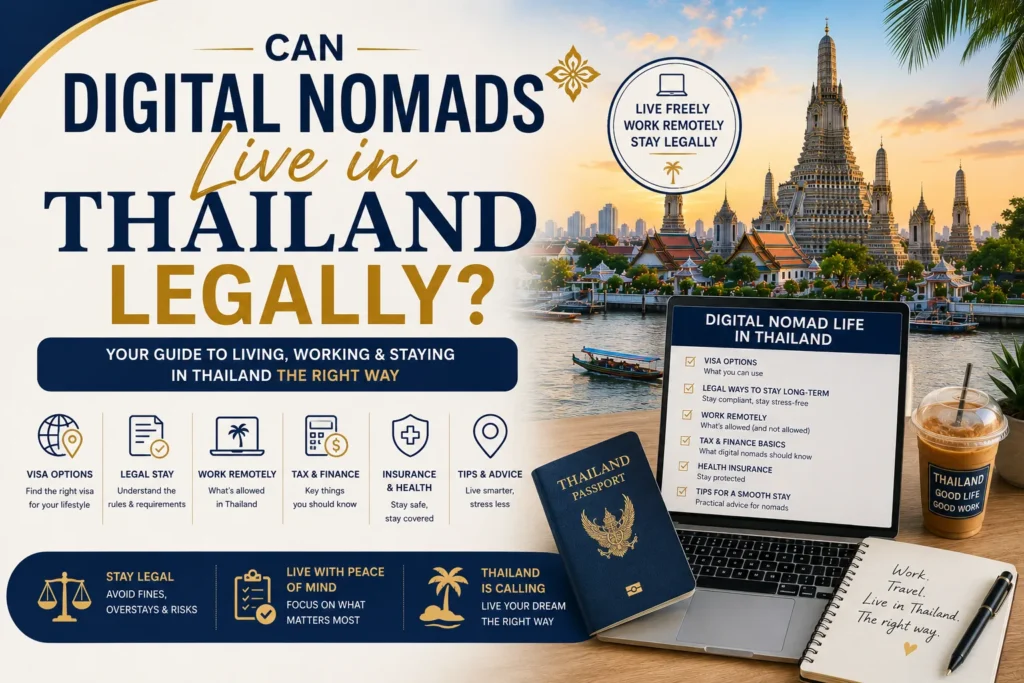
Can Digital Nomads Live in Thailand Legally? DTV Visa, Remote Work Rules, LTR Options, Work Permit Risks, Documents, and Approval Checklist
You want to rent a condo in Bangkok, work from cafés in Chiang Mai, spend weekends in Phuket, and keep serving clients or an employer overseas. Then the question appears: is that actually legal, or are digital nomads just hoping nobody asks?
Yes, digital nomads can live in Thailand legally if they use the right visa route and their work matches the allowed purpose. For many applicants, the most relevant route is the Destination Thailand Visa, or DTV, which official Thai Embassy guidance lists for workcation purposes, including digital nomads, remote workers, foreign talent, and freelancers.
From our visa handling experience, most digital nomad problems happen when applicants use tourist entries for long-term remote work, cannot prove overseas income, submit weak freelance documents, work with Thai clients without checking work-permit rules, or assume DTV allows every kind of work in Thailand.
Can Digital Nomads Live in Thailand Legally?
Yes, but the visa route must match the real work activity
Digital nomads can live in Thailand legally when their stay status fits their actual activity. A remote employee working for an overseas employer, a freelancer serving foreign clients, and a foreigner working for a Thai company are not the same from a visa and work-permit perspective.
Official guidance from the Royal Thai Embassy in Washington lists DTV purposes including workcation for digital nomads, remote workers, foreign talent, and freelancers. You can check the latest DTV requirements on the Royal Thai Embassy Washington DTV page and general e-Visa application information on the official Thai e-Visa website.
| Digital Nomad Situation | Possible Route | Practical Caution |
|---|---|---|
| Remote employee working for an overseas company | DTV or LTR Work-from-Thailand Professional if qualified | Employer and work proof must be clear |
| Freelancer serving foreign clients | DTV workcation route | Portfolio, invoices, client contracts, and payment proof help strengthen the case |
| Online business owner serving overseas customers | DTV or other long-stay route depending on structure | Business registration and income source should be easy to understand |
| Working for Thai clients or Thai company | Non-B visa and work permit may be needed | Local work can create work-permit issues |
Destination Thailand Visa for Digital Nomads
DTV is currently the most direct route for many remote workers
The Destination Thailand Visa is designed for workcation and Thai soft power-related purposes. Official Thai Embassy guidance lists workcation applicants as digital nomads, remote workers, foreign talent, and freelancers.
The Royal Thai Embassy in Washington lists DTV validity as 5 years and a fee of 400 USD at that embassy. It also lists required documents for workcation applicants, including passport, recent photo, proof of current location, financial evidence, and employment contract, employment certificate, or professional portfolio showing digital nomad, remote worker, foreign talent, or freelancer status.
| DTV Requirement | What It Shows | Practical Tip |
|---|---|---|
| Passport | Identity and travel eligibility | Check validity before applying |
| Current-location proof | Shows where you are applying from | Use documents accepted by the embassy handling your case |
| Financial evidence | Shows ability to support long stay | Official Washington guidance lists at least 500,000 THB or 16,000 USD ending balance for each of the last three months |
| Workcation proof | Shows remote worker, freelancer, or digital nomad status | Use contract, employment certificate, portfolio, invoices, or business evidence |
DTV Stay Length, 180 Days Per Entry, and 5-Year Validity
DTV validity and length of stay are different
Official embassy guidance lists DTV validity as 5 years. Other official Thai Embassy pages describe DTV as allowing a maximum period of stay of 180 days per entry. This means digital nomads should not assume they can stay inside Thailand continuously for five years without managing entry stamps, extensions, and travel timing.
From real client cases, this is a common misunderstanding. Applicants see “5 years” and plan a full uninterrupted stay, but the practical timeline must be built around each entry stamp and Immigration rules.
| DTV Term | What It Means | Practical Caution |
|---|---|---|
| 5-year validity | Period during which the visa can be used according to its conditions | Not the same as one continuous 5-year stay |
| 180 days per entry | Maximum stay granted per entry under DTV guidance | Always check the actual stamp after arrival |
| Extension possibility | Some guidance refers to possible extension through Immigration | Check latest Immigration rules before relying on it |
| Multiple-entry use | Useful for nomads who travel in and out | Track each entry stamp carefully |
DTV Is Not the Same as a Thai Work Permit
Remote work and local work are not the same risk profile
DTV supports workcation and remote-work purposes, but it should not be treated as a general permission to work for Thai companies or serve Thai clients locally. BOI/OSOS guidance states that foreigners who intend to remain in Thailand to work or conduct business must comply with visa requirements and obtain a work permit.
BOI/OSOS guidance also notes that transit, visitor transit, and tourist visa holders are not authorized to work in Thailand. The safer distinction is this: overseas remote work may fit DTV; local work in Thailand may require Non-B and work permit review.
| Work Activity | Risk Level | Recommended Review |
|---|---|---|
| Remote employee paid by overseas company | Often more suitable for DTV or LTR review | Prepare employer contract and remote-work confirmation |
| Freelancer serving foreign clients | May fit DTV if documented well | Prepare portfolio, invoices, contracts, and payment records |
| Working for Thai company | Higher risk without work permit | Review Non-B visa and work permit route |
| Serving Thai clients or local customers | Needs careful work-permit analysis | Get advice before accepting local work |
LTR Work-from-Thailand Professional for Higher-Income Remote Workers
LTR can be powerful, but it is more qualification-based than DTV
Some digital nomads may qualify for Thailand’s Long-Term Resident Visa under the Work-from-Thailand Professional category. BOI lists Work-from-Thailand Professional as one of the main LTR categories, along with Wealthy Global Citizen, Wealthy Pensioner, Highly Skilled Professional, and dependents.
The official BOI LTR website notes that work permits will not be granted for Work-from-Thailand Professional holders because this category is for foreigners working remotely from Thailand for foreign employers abroad. This makes LTR attractive for qualified remote employees, but not a general route for local Thai employment.
| Route | Best For | Main Caution |
|---|---|---|
| DTV | Freelancers, remote workers, digital nomads, foreign talent | Must prove workcation purpose and financial readiness |
| LTR Work-from-Thailand Professional | Qualified remote professionals employed by overseas companies | Strict criteria and employer proof |
| Non-B + Work Permit | People working for Thai employers or local business activities | Employer and work permit support required |
| Thailand Privilege | Lifestyle long-stay residents | Not a general work visa |
How Digital Nomads Can Live in Thailand Legally
Step 1: Define your real work situation
Write down whether you are employed by an overseas company, freelancing for foreign clients, running an overseas business, serving Thai clients, or planning to work for a Thai company. The visa route depends on the real activity.
Step 2: Consider DTV for remote work or freelance status
DTV may fit digital nomads, remote workers, freelancers, and foreign talent who can prove financial readiness and workcation purpose. Prepare evidence such as employment contract, employment certificate, professional portfolio, invoices, payment records, and business documents.
Step 3: Consider LTR if you meet higher criteria
LTR Work-from-Thailand Professional may suit qualified remote professionals working for overseas employers. It is more document-heavy than DTV and requires stronger profile screening.
Step 4: Use Non-B and work permit for local work
If you will work for a Thai company, serve Thai clients locally, manage local operations, or receive Thai-source work income, review the Non-B visa and work permit route before working.
Step 5: Avoid building long-term stay on tourist entries
Tourist entries may be useful for short visits, but they are not a strong long-term legal strategy for living in Thailand while working online full-time.
Step 6: Keep organized records
Digital nomads should keep visa approvals, entry stamps, TM30 receipts, bank statements, employment contracts, invoices, portfolio records, tax documents, lease agreements, and travel history.
Digital Nomad Legal Stay Checklist
| Item | Why It Matters | Practical Tip | Done |
|---|---|---|---|
| Real work source | Determines visa and work-permit risk | Separate foreign clients from Thai clients | ☐ |
| Correct visa type | Supports legal stay | DTV or LTR may fit remote work | ☐ |
| Financial proof | Required for DTV and other long-stay routes | Use clear recent bank statements | ☐ |
| Work contract | Proves remote employment | Ask employer to confirm overseas role | ☐ |
| Portfolio | Helps freelancers prove real work | Show real projects and clients | ☐ |
| Current-location proof | Often required for e-Visa | Use accepted local documents | ☐ |
| Passport validity | Required for application and stay planning | Keep at least 6 months validity | ☐ |
| TM30/address record | Useful for Immigration services | Ask landlord or hotel for proof | ☐ |
| Tax review | Separate from visa legality | Get advice if staying long-term | ☐ |
| Re-entry planning | Avoids losing stay status where relevant | Check before leaving Thailand | ☐ |
Approved Case vs Risky Case: What Made the Difference?
From real client cases, the difference is usually proof of remote work
| Topic | Risky Case | Stronger Case |
|---|---|---|
| Work proof | Applicant only says “I work online” with no contract or portfolio | Applicant provides contract, employer letter, portfolio, invoices, and payment records |
| Client base | Applicant works mainly with Thai clients but applies as remote worker | Applicant clearly shows overseas employer or foreign client base |
| Financial proof | Sudden deposit or unclear bank screenshot | Recent bank statements show stable balance and applicant name |
| Stay plan | Applicant assumes DTV means unlimited continuous stay | Applicant tracks 180-day entry periods, extension rules, and travel timing |
Common Digital Nomad Visa Mistakes in Thailand
1. Thinking “remote” means “no rules”
Working online does not automatically remove visa and work-permit issues. The visa must match the activity and income source.
2. Using tourist status for long-term living
A short tourist stay is different from living in Thailand for months while working full-time online. If Thailand is becoming your base, review DTV, LTR, or another suitable route.
3. Applying for DTV with weak work proof
A vague statement is not enough. DTV workcation applicants should prepare employment proof, portfolio, invoices, client records, or other documents that show real remote work.
4. Ignoring the financial requirement
Several official DTV pages list financial evidence of no less than 500,000 THB or equivalent. A clean bank statement is stronger than a sudden last-minute deposit.
5. Working with Thai clients without checking rules
A freelancer serving Thai businesses may have a different legal profile from someone serving overseas clients. If your work connects to Thai companies, get proper advice.
6. Assuming DTV allows continuous 5-year stay
DTV validity and length of stay are different. Plan around entry stamps, 180-day stay periods, possible extensions, and re-entry timing.
7. Forgetting tax and banking questions
Visa approval does not automatically solve tax, banking, invoicing, or corporate-structure questions. Long-term digital nomads should seek qualified tax advice.
Summary: Can Digital Nomads Live in Thailand Legally?
Key points to remember:
- Digital nomads can live in Thailand legally if their visa route matches their real work activity.
- DTV is currently one of the most relevant routes for digital nomads, remote workers, freelancers, and foreign talent.
- Official DTV guidance lists 5-year validity and workcation purposes.
- DTV applicants commonly need financial evidence and proof of remote-work or freelancer status.
- DTV is not the same as a Thai work permit for local employment.
- Tourist visa holders are not authorized to work in Thailand under BOI/OSOS guidance.
- LTR Work-from-Thailand Professional may suit higher-income remote employees who meet BOI criteria.
- Working for Thai clients or Thai companies may require Non-B and work permit review.
- Tax treatment is separate from visa legality.
- Always check the latest official Thai Embassy, Thai e-Visa, BOI, and Immigration information before applying.
Let Co Journey Visa help identify your legal Thailand visa route
A strong digital nomad visa strategy should make your case easy to understand: who pays you, where your employer or clients are based, how you work remotely, how long you plan to stay, and which visa route matches your real activity.
ทำไมควรให้ Co Journey Visa ช่วยดูแลวีซ่าของคุณ
การขอ Thailand Digital Nomad Visa Route อาจมีขั้นตอนที่ซับซ้อนและต้องการความแม่นยำในการเตรียมเอกสาร หากคุณไม่ต้องการให้เกิดความผิดพลาดและต้องการความสะดวกสบายในการดำเนินการ Co Journey Visa พร้อมให้บริการช่วยเหลือคุณในทุกขั้นตอน:
Frequently Asked Questions About Digital Nomads Living in Thailand Legally
Can digital nomads legally live in Thailand?
Yes, digital nomads can legally live in Thailand if they use a visa route that fits their activity. DTV is officially available for workcation purposes, including digital nomads, remote workers, freelancers, and foreign talent.
What is the best Thailand visa for digital nomads?
For many digital nomads, DTV is the most direct option. For higher-income remote professionals working for qualifying overseas companies, LTR Work-from-Thailand Professional may also be worth reviewing.
Can I work remotely in Thailand on a tourist visa?
Tourist status is not designed for work. BOI/OSOS guidance states that tourist visa holders are not authorized to work in Thailand. For ongoing remote work, review DTV, LTR, or another suitable route.
How long can I stay in Thailand on DTV?
Official Thai Embassy guidance lists DTV validity as 5 years and other official DTV guidance describes a maximum stay of 180 days per entry. Always check your actual passport stamp after entering Thailand.
How much money do I need for Thailand DTV?
Several official DTV pages list financial evidence of no less than 500,000 THB or equivalent. The Royal Thai Embassy Washington page asks for recent saving or checking bank statements for the last three months with an ending balance of no less than 500,000 THB or 16,000 USD for each month.
Can freelancers apply for Thailand DTV?
Yes, freelancers may apply if they can prove their freelancer, digital nomad, remote worker, or foreign talent status. Official guidance mentions professional portfolios for applicants without employment, as well as employment contracts or certificates for employed remote workers.
Can I work for Thai clients on DTV?
Be careful. DTV supports workcation and remote-work purposes, but local work for Thai companies or Thai clients may raise work-permit issues. If your income or activity connects to Thailand, get proper advice before working.
Is LTR better than DTV for digital nomads?
It depends on your profile. LTR can offer stronger long-term privileges but has stricter qualification requirements. DTV is often more practical for freelancers and remote workers who can prove financial readiness and remote-work status.
หากคุณต้องการคำแนะนำเพิ่มเติมหรือต้องการให้ Co Journey Visa ดูแลการยื่นวีซ่าของคุณ ติดต่อเราได้เลย 24 ชั่วโมง
บทความที่เกี่ยวข้อง
ติดตามข้อมูลวีซ่าอัปเดตจาก Co Journey Visa
เพิ่มเว็บไซต์นี้เป็นแหล่งข้อมูลที่ต้องการใน Google เพื่อให้ค้นพบบทความจากเราได้สะดวกขึ้น