
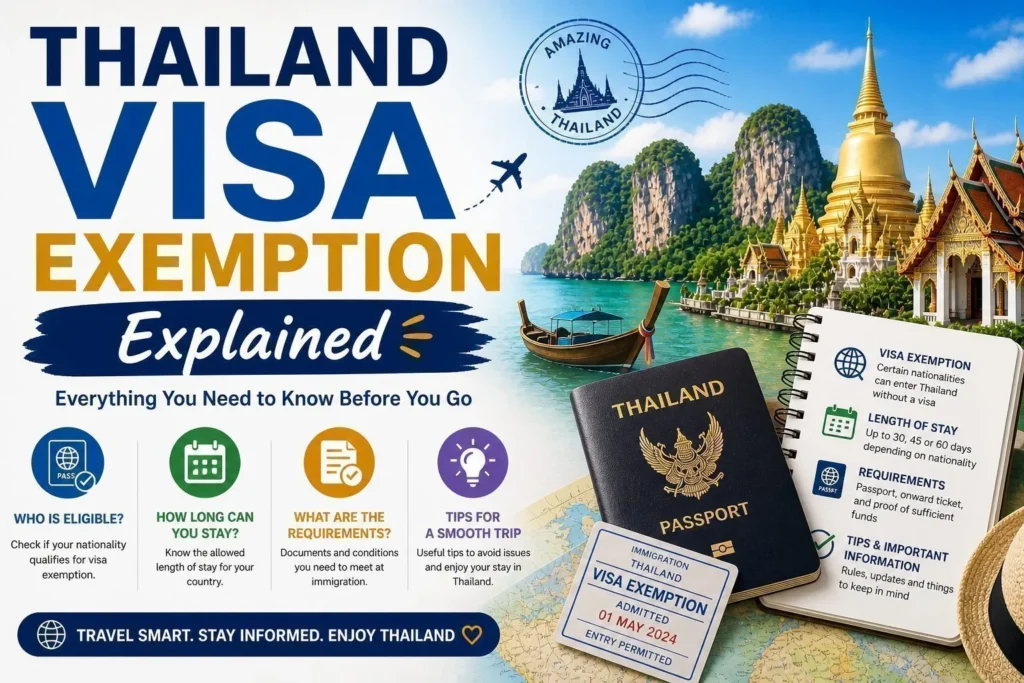
Thailand Visa Exemption Explained: Who Can Enter Thailand Without a Visa and What to Check Before You Fly
You found a cheap flight to Bangkok, your hotel is booked, and your friends say, “You don’t need a visa for Thailand.” Then you check online and see different answers: 30 days, 60 days, Visa on Arrival, Tourist Visa, TDAC, extension, onward ticket. It gets confusing fast.
Thailand visa exemption means eligible passport holders can enter Thailand without applying for a visa in advance. Under the revised rules effective from 15 July 2024, nationals of 93 countries and territories may enter Thailand visa-free for up to 60 days for eligible purposes such as tourism, business engagements, urgent work, or ad-hoc work.
From our visa handling experience, the travelers who face the most questions are usually not first-time tourists with clear plans. Problems often happen when the travel pattern looks like long-term residence, work, repeated entries, or a purpose that does not match visa-exempt entry.
What Is Thailand Visa Exemption?
A visa-free entry route for eligible passport holders
Thailand visa exemption allows eligible foreign nationals to enter Thailand without applying for a visa before travel. It is commonly used for short holidays, visiting friends or family, short business engagements, and other permitted short-stay purposes.
| Entry Route | What It Means | Key Caution |
|---|---|---|
| Visa Exemption | Eligible travelers enter without applying for a visa before arrival | Not available to every passport holder |
| Visa on Arrival | Eligible travelers apply for a visa at a Thai checkpoint | Not the same as visa-free entry |
| Tourist Visa | Traveler applies for a visa before arriving in Thailand | Not for employment |
Official sources to check before traveling
Visa rules, eligible nationalities, entry conditions, extensions, and immigration procedures can change. You can check the latest requirements from the official Thai e-Visa website, the official Thailand Digital Arrival Card website, or the Thai Immigration Bureau website.
Who Can Enter Thailand Without a Visa?
Visa exemption depends on nationality and passport type
Not every foreigner can enter Thailand without a visa. Thailand’s revised visa exemption measure lists 93 eligible countries and territories and allows a stay of up to 60 days from 15 July 2024 onward.
Common mistakes we often see include travelers relying on a friend’s experience instead of checking their own passport. A traveler with a UK, German, Singaporean, American, Japanese, or Australian passport may have a different entry route from someone holding another passport.
| What to Check | Why It Matters | Practical Advice |
|---|---|---|
| Nationality | Only listed countries and territories qualify | Check your own passport against official sources |
| Passport type | Ordinary, diplomatic, official, or other passport types may have different rules | Do not assume all passport types are treated the same |
| Purpose of visit | Visa exemption is for permitted short-stay purposes | If your real purpose is work, study, retirement, or long-term residence, review another visa route |
How Long Can You Stay Under Thailand Visa Exemption?
Up to 60 days for eligible travelers, but check your entry stamp
Under the revised measure, eligible travelers may stay up to 60 days under Thailand visa exemption. However, your actual permitted stay is controlled by the date granted by immigration when you enter Thailand.
From real traveler cases, many people read “60 days” online but forget to check the admitted-until date after entry. Always check your stamp or digital entry record immediately.
| Topic | What It Means | What to Do |
|---|---|---|
| Policy period | Eligible travelers may receive up to 60 days | Confirm eligibility before flying |
| Entry permission | Immigration records your actual permitted stay | Check the admitted-until date after entry |
| Repeated travel | Many long or back-to-back entries may raise questions | If Thailand is becoming your base, review DTV or another long-stay visa |
Can You Extend Thailand Visa Exemption?
Extension may be possible, but it is not guaranteed
Travelers entering under visa exemption can often apply for an extension of up to 30 days at a Thai Immigration Office. However, approval is at the discretion of the immigration officer.
From our visa handling experience, travelers often make the mistake of building their whole trip around an assumed extension. If you know from the beginning that you need more than 60 days, plan early and check whether another visa type may be stronger.
| Extension Item | Why It Matters | Practical Tip |
|---|---|---|
| Timing | Late planning increases overstay risk | Do not wait until the final few days |
| Address | Immigration may need your accommodation information | Keep hotel booking, rental address, or host details ready |
| Officer discretion | Extension is not automatic | Prepare documents and follow the latest immigration instructions |
Do You Need TDAC If You Enter Thailand Visa-Free?
Yes, TDAC is required for non-Thai nationals
Visa exemption does not remove arrival requirements. The Thailand Digital Arrival Card, or TDAC, is required for non-Thai nationals entering Thailand. The official TDAC guide says foreign travelers should submit arrival card information within 3 days before arrival.
TDAC is not a visa. It is an arrival form. Even if you are visa-exempt, you still need to complete it before entry.
| TDAC Detail | What to Prepare | Practical Tip |
|---|---|---|
| Passport information | Name, nationality, passport number | Make sure details match your passport exactly |
| Arrival details | Arrival date, transport, flight or border information | Submit within the official time window |
| Thai address | Hotel, condo, family address, or stay location | Save confirmation offline in case airport Wi-Fi fails |
Visa Exemption Is Not a Work Permit
Tourist-style entry should match a short-stay purpose
Thailand visa exemption does not give broad permission to work in Thailand. If you plan to work for a Thai company, teach, provide local services, run a business on the ground, or receive income from a Thai entity, you should check the proper work visa and work permit route.
Remote work can also be sensitive depending on your situation. If your stay is mainly workcation, digital nomad, freelance, or long-term remote work, review whether DTV Visa or another visa is a better fit.
| Situation | Better Route to Review | Risk If Ignored |
|---|---|---|
| Two-week holiday | Visa exemption may be enough if eligible | Low risk if documents and purpose are clear |
| Long workcation or digital nomad stay | DTV Visa or another suitable route | Purpose may look unclear if using repeated visa-exempt entries |
| Working for Thai company | Work-related visa and work permit process | Tourist-style entry does not match employment purpose |
How to Use Thailand Visa Exemption Correctly
Step 1: Check your passport nationality
Start with your passport, not your residence country. Check whether your nationality is on the visa exemption list, whether you need Visa on Arrival, or whether you should apply for a Tourist Visa before traveling.
Step 2: Confirm your purpose of visit
Visa exemption works best when the purpose is simple and clear, such as tourism, short holiday, visiting friends or family, or another permitted short-stay purpose.
Step 3: Plan your stay around the permission granted
Do not rely only on what you read online. After entry, check the admitted-until date recorded by immigration and plan your departure or extension accordingly.
Step 4: Prepare basic entry documents
Even when no visa is required, airlines and immigration officers may ask for supporting documents such as passport, return ticket, accommodation, proof of funds, travel itinerary, insurance, and TDAC confirmation.
Step 5: Reconsider your visa route if you enter Thailand often
If you spend most of the year in Thailand, enter repeatedly, or use visa-exempt entries back-to-back, consider whether your situation should be handled under another visa category.
Checklist Before Using Thailand Visa Exemption
Prepare before you fly, even if no visa is required
From real traveler cases, visa-exempt entry is usually smooth when the trip is short, clear, and well documented. Problems usually happen when the traveler cannot explain the purpose, length of stay, accommodation, or return plan.
| Item to Check | Question to Ask | Done |
|---|---|---|
| Nationality | Is my passport on the visa exemption list? | ☐ |
| Purpose | Is my visit truly tourism or another permitted short-stay purpose? | ☐ |
| Length of stay | Will I leave within the permitted period? | ☐ |
| TDAC | Have I completed the Thailand Digital Arrival Card before entry? | ☐ |
| Return ticket | Can I show a return or onward journey if asked? | ☐ |
| Accommodation | Do I have a hotel booking or Thai address? | ☐ |
| Latest rules | Have I checked official sources before flying? | ☐ |
Approved Entry vs Questioned Entry: What Made the Difference?
From real client cases, consistency matters more than confidence
| Topic | Questioned Case | Stronger Case |
|---|---|---|
| Purpose | Says tourism but documents suggest work or long-term stay | Purpose, documents, and answers match clearly |
| Travel pattern | Back-to-back entries with no clear explanation | Reasonable travel history and supporting documents |
| Documents | No return ticket, vague address, missing TDAC | Return ticket, accommodation, TDAC, and funds ready |
| Stay plan | Plans to stay beyond the entry period with no extension plan | Clear departure or realistic extension plan |
Common Mistakes With Thailand Visa Exemption
1. Assuming everyone gets 60 days
The 60-day visa exemption applies to nationals of listed countries and territories. It is not a universal rule for all foreign travelers.
2. Confusing visa exemption with Visa on Arrival
Visa exemption means you do not apply for a visa before entering Thailand. Visa on Arrival means eligible travelers apply for a visa at a Thai checkpoint.
3. Forgetting TDAC
TDAC is required for non-Thai nationals entering Thailand. Forgetting it can cause unnecessary delays.
4. Using visa exemption for the wrong purpose
Visa exemption is not a substitute for a work visa, education visa, retirement visa, or family visa.
5. Assuming extension is guaranteed
A 30-day extension may be possible, but it is subject to immigration approval and officer discretion.
6. Ignoring the entry stamp
The visa exemption policy may say “up to 60 days,” but your actual permitted stay is what immigration grants when you enter.
7. Relying on old travel blogs
Thailand expanded visa exemption measures in 2024. Older blog posts, forum comments, and social media advice may no longer reflect the current rules.
Summary: Thailand Visa Exemption
Key points to remember:
- Thailand visa exemption allows eligible travelers to enter without applying for a visa before departure.
- Since 15 July 2024, nationals of 93 countries and territories have been entitled to visa exemption for up to 60 days for eligible purposes.
- Visa exemption depends on nationality, passport type, purpose, and immigration assessment.
- Visa exemption is not the same as Visa on Arrival.
- TDAC is required for non-Thai nationals entering Thailand.
- Visa exemption is not a work permit or long-term residence solution.
- Extension may be possible, but it is not automatic.
- Repeated entries or unclear purpose may lead to more questions.
- Prepare passport, TDAC, return ticket, accommodation, funds, and travel plan before flying.
- Always check the latest official rules before travel.
Let Co Journey Visa help you enter Thailand with confidence
Thailand visa exemption is convenient, but it still has rules. The safest approach is to make sure your nationality, purpose, stay length, and documents all match before you fly.
ทำไมควรให้ Co Journey Visa ช่วยดูแลวีซ่าของคุณ
การขอ Thailand Visa Exemption อาจมีขั้นตอนที่ซับซ้อนและต้องการความแม่นยำในการเตรียมเอกสาร หากคุณไม่ต้องการให้เกิดความผิดพลาดและต้องการความสะดวกสบายในการดำเนินการ Co Journey Visa พร้อมให้บริการช่วยเหลือคุณในทุกขั้นตอน:
Frequently Asked Questions About Thailand Visa Exemption
What is Thailand visa exemption?
Thailand visa exemption allows eligible foreign nationals to enter Thailand without applying for a visa in advance. Under the revised measure effective from 15 July 2024, nationals of 93 countries and territories may enter Thailand visa-free for up to 60 days for eligible purposes.
How long can I stay in Thailand under visa exemption?
Eligible travelers may stay up to 60 days under the revised visa exemption scheme. Always check the admitted-until date when you enter Thailand because the permission granted at immigration controls your stay.
Can I extend my visa-exempt stay in Thailand?
Yes, in many cases you may apply for an extension of up to 30 days at a Thai Immigration Office. Approval is not automatic and is at the discretion of the immigration officer.
Do I need TDAC if I enter Thailand under visa exemption?
Yes. TDAC is required for non-Thai nationals entering Thailand. The official TDAC guide says foreign travelers should submit arrival card information within 3 days before arrival.
Is Thailand visa exemption the same as Visa on Arrival?
No. Visa exemption means eligible travelers enter without applying for a visa. Visa on Arrival means eligible travelers apply for a visa at a Thai checkpoint.
Can I work in Thailand under visa exemption?
Visa exemption is not work authorization. If you plan to work for a Thai company or perform work that requires permission, you should check the correct visa and work permit process before traveling.
Can I use Thailand visa exemption for repeated long stays?
Repeated long stays may raise questions if your travel pattern looks like residence. Visa exemption is mainly for eligible short stays. If you spend long periods in Thailand or enter repeatedly, consider a visa that matches your real purpose.
What documents should I prepare for visa-exempt entry?
Prepare your passport, TDAC confirmation, return or onward ticket, accommodation details, proof of funds if requested, travel insurance, and documents supporting your purpose of visit.
หากคุณต้องการคำแนะนำเพิ่มเติมหรือต้องการให้ Co Journey Visa ดูแลการยื่นวีซ่าของคุณ ติดต่อเราได้เลย 24 ชั่วโมง
บทความที่เกี่ยวข้อง
ติดตามข้อมูลวีซ่าอัปเดตจาก Co Journey Visa
เพิ่มเว็บไซต์นี้เป็นแหล่งข้อมูลที่ต้องการใน Google เพื่อให้ค้นพบบทความจากเราได้สะดวกขึ้น