
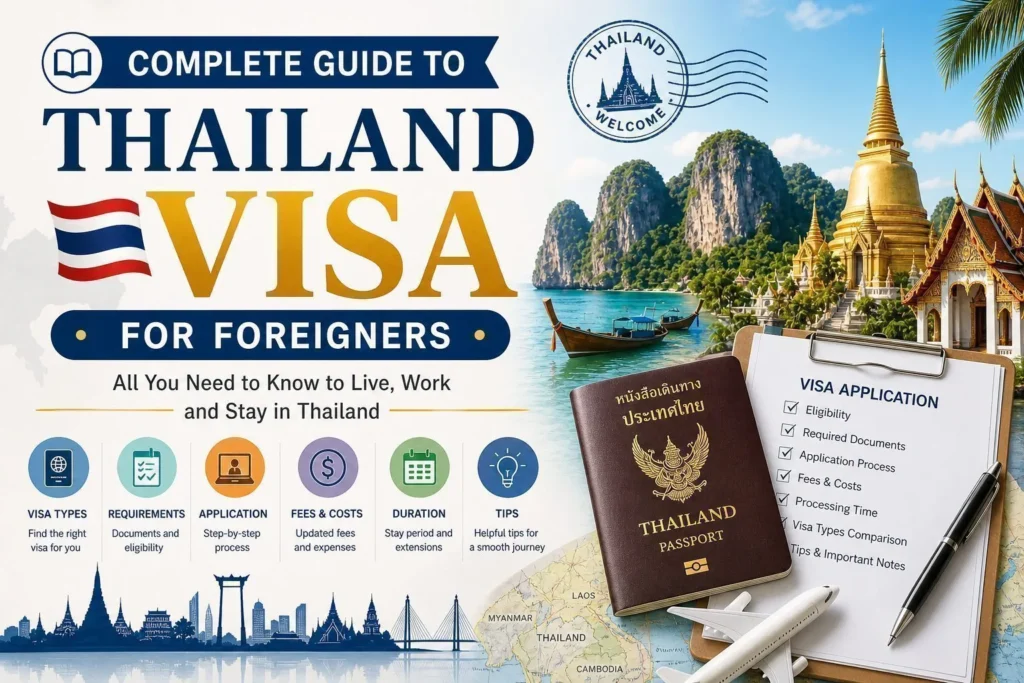
Complete Guide to Thailand Visa for Foreigners: Which Visa Should You Choose and How to Apply Correctly
Planning to stay in Thailand sounds simple at first: book a flight, find accommodation, and enjoy the country. But once you start checking visa rules, the questions come quickly. Do you need a visa before arrival? Is visa exemption enough? Can you work remotely from Thailand? Should you apply for a Tourist Visa, DTV Visa, Non-Immigrant Visa, Retirement Visa, or Education Visa?
The right Thailand visa depends on your nationality, purpose of stay, length of stay, and documents. A short holiday may only require visa exemption or a Tourist Visa, while remote workers may consider the Destination Thailand Visa, employees need the correct work-related visa and work permit, and retirees or family members may need a long-stay Non-Immigrant visa.
From our visa handling experience, the biggest mistake is usually not one missing document. It is choosing the wrong visa purpose from the beginning. When the visa category, documents, and real intention do not match, the application becomes weaker and may lead to delays, additional document requests, or rejection.
Overview of Thailand Visas for Foreigners
Thailand does not have one visa for every foreigner
Thailand uses different visa routes depending on why the foreigner is entering or staying in the country. A tourist, digital nomad, employee, retiree, student, patient, and spouse of a Thai national should not prepare the same visa file.
| Visa / Entry Route | Best For | Key Caution |
|---|---|---|
| Visa Exemption | Short visits by eligible nationalities | Not a long-term residence plan |
| Tourist Visa | Tourism, holidays, leisure travel | Not for employment or long-term work |
| DTV Visa | Digital nomads, remote workers, soft power activities, medical treatment, eligible family | Requires purpose-specific documents |
| Non-Immigrant “B” | Employment or business in Thailand | Work permit and employer documents may be required |
| Education Visa | Students or training participants | School documents must be genuine and consistent |
| Retirement Visa / O-A | Eligible retirees | Not a work visa |
Official sources to check before applying
Visa rules, fees, stay periods, document requirements, and immigration procedures may change. You can check the latest information on the official Thai e-Visa website, the Ministry of Foreign Affairs Thailand, or the Thai Immigration Bureau.
Visa Exemption vs Tourist Visa: Which One Is Right?
Visa exemption is convenient, but not a long-term plan
Visa exemption allows eligible passport holders to enter Thailand without applying for a visa in advance for a limited stay. It can be useful for short holidays, but it should not be treated as a long-term residence strategy.
Thailand’s revised visa exemption information states that nationals of 93 countries and territories are entitled to visa exemption for eligible purposes for up to 60 days from 15 July 2024. Because this policy may change, always check the latest information from the relevant Royal Thai Embassy, Consulate, or Thai e-Visa website before travel.
| Route | Good For | Common Mistake |
|---|---|---|
| Visa Exemption | Short visits, tourism, eligible short-term purposes | Using repeated entries to simulate long-term residence |
| Tourist Visa | Tourism, leisure, longer holiday stays | Using it for employment or business operations |
Can Foreigners Work in Thailand on a Tourist Visa?
Tourist status is for tourism, not employment
A Tourist Visa is meant for travel, leisure, and short-term tourism purposes. It should not be used as a substitute for employment, business operations, local consulting, teaching, or work that requires authorization in Thailand.
Why this matters in real cases
From real client cases, applications become risky when the stated purpose is tourism but the supporting documents suggest work. For example, a Thai company letter, local work address, or unclear long-stay plan can create inconsistency in the file.
| Strong Tourist File | Weak or Risky Tourist File |
|---|---|
| Clear itinerary, accommodation, funds, return or onward travel, and genuine tourism purpose | No clear travel plan, repeated long stays, Thai employer documents, or unclear source of funds |
DTV Visa for Digital Nomads and Long-Stay Visitors
DTV is not simply a longer Tourist Visa
The Destination Thailand Visa, often called DTV Visa, is relevant for digital nomads, remote workers, freelancers, workcation travelers, Thai soft power activities, medical treatment, and eligible family members. However, applicants should prepare documents that prove the specific purpose of stay.
| Applicant Type | Documents That Help | Mistake We Often See |
|---|---|---|
| Digital Nomad / Remote Worker | Employment contract, employment certificate, payslips, remote work explanation | Portfolio without proof of income |
| Freelancer | Portfolio, invoices, client contracts, payment records, bank statements | Income documents do not connect to bank deposits |
| Soft Power / Medical | Acceptance letter, course confirmation, hospital appointment, payment proof | Informal booking or chat message without official confirmation |
Working in Thailand: Non-Immigrant B and Work Permit
Working for a Thai company requires the correct route
If a foreigner wants to work for a Thai company, receive employment income from Thailand, or take a position in a Thai business, they usually need the correct work-related visa and work authorization process. The Ministry of Foreign Affairs’ Non-Immigrant “B” information refers to documents connected with employment and approval from the Ministry of Labour in employment cases.
| Situation | Visa Route to Review | Key Documents |
|---|---|---|
| Working for a Thai company | Non-Immigrant “B” + work permit process | Employer documents, company documents, employment letter, labour-related approval if required |
| Remote work for foreign employer | DTV Visa or another suitable route | Foreign employment evidence, income proof, portfolio, bank statements |
Long-Stay Thailand Visas: Retirement, Education, Family, and Medical
Long-stay visas are purpose-specific
Thailand has several long-stay visa routes, but each one has its own conditions. A retirement visa is not a work visa. A student visa is not a tourist visa. A family-based stay requires relationship documents, not only hotel bookings.
| Case Type | Documents to Prepare | Practical Caution |
|---|---|---|
| Retirement / O-A | Age proof, financial evidence, insurance if required, no-work intention | Retirement status should not look like employment |
| Education Visa | School documents, course details, study schedule, acceptance letter | School and course must be credible and consistent |
| Family / Marriage | Marriage certificate, birth certificate, relationship proof, financial documents | Relationship documents may need translation or legalization |
| Medical Stay | Hospital letter, appointment confirmation, treatment plan, cost estimate | Documents should clearly show the patient name, treatment period, and hospital details |
How to Choose the Right Thailand Visa
Step 1: Define your real purpose
Start with the honest reason for staying in Thailand. Are you visiting, working remotely, working for a Thai company, studying, retiring, receiving medical treatment, or joining family?
Step 2: Check nationality and place of application
Visa rules can differ by nationality and application location. Some applicants can use visa exemption, some need a visa before travel, and some may apply through Thai e-Visa.
Step 3: Match the visa to your length of stay
Length of stay matters, but it should not be the only factor. The better question is not only “How many days can I stay?” but also “Why am I staying?”
Step 4: Prepare documents that prove the purpose
A strong visa file tells one clear story. A bank statement, employment letter, hotel booking, school letter, or family document should all support the same purpose.
Step 5: Plan extensions and reporting before arrival
Some foreigners focus only on getting the visa and forget what happens after entry. Extension rules, overstay risks, and 90-day reporting should be checked early through the Thai Immigration Bureau.
Thailand Visa Documents Checklist for Foreigners
Your documents should prove identity, purpose, finances, and stay plan
From real client cases, the strongest applications are not always the thickest. They are the clearest. The officer should quickly understand who you are, why you are entering Thailand, how you will support yourself, and why your visa category matches your real purpose.
| Document Group | Examples | Common Mistake |
|---|---|---|
| Identity | Passport, photo, visa form, previous visa pages | Passport validity too short or photo not meeting requirements |
| Financial Evidence | Bank statement, bank certificate, payslip, sponsorship letter | Screenshot instead of official statement, or sudden deposit without explanation |
| Purpose Evidence | Itinerary, work contract, school letter, hospital appointment, family documents | Documents do not match the selected visa category |
| Stay Plan | Accommodation, address in Thailand, return or onward plan | Stay plan looks unrealistic for the visa type |
Approved Case vs Rejected Case: What Made the Difference?
From real client cases, consistency matters more than volume
| Topic | Weak / Risky Case | Stronger Case |
|---|---|---|
| Visa Purpose | Chooses visa based only on longest stay period | Chooses visa based on real purpose and proof |
| Financial Evidence | Unclear statement, sudden large deposit, no source of funds | Official statement, clear income flow, supporting explanation |
| Work Status | Says “tourism” but submits Thai employment-related documents | Work documents match the correct visa route |
| Document Organization | Many files, no structure, officer must guess the story | Documents organized by category with a short explanation |
Common Mistakes Foreigners Make With Thailand Visas
1. Choosing the visa based only on stay duration
Some applicants ask, “Which visa lets me stay the longest?” The better question is, “Which visa matches what I will actually do in Thailand?”
2. Using a Tourist Visa for work
Tourist status is for tourism. If you work for a Thai company or perform work that requires authorization, review the correct work visa and work permit route.
3. Not checking the latest embassy requirements
Different embassies may require different document formats, fees, translations, or residence proof. Do not rely only on old social media posts or someone else’s successful case.
4. Sending weak financial evidence
Bank statements should be clear, official, readable, and consistent with the applicant’s story. A screenshot of a bank app may not be enough.
5. Ignoring work permit rules
A visa gives permission to enter or stay under a category. It does not automatically give permission to work in every situation.
6. Assuming extension is automatic
Extension depends on visa type, documents, timing, and immigration discretion. Always check the permission-to-stay date and official extension rules.
7. Not planning for 90-day reporting
Some long-stay foreigners must complete 90-day reporting. Missing the reporting window can create unnecessary issues.
Summary: How to Choose the Right Thailand Visa
Key points to remember:
- Choose your Thailand visa based on your real purpose, not only the length of stay.
- Visa exemption is useful for short visits but not a long-term residence plan.
- Tourist Visa is for tourism and should not be used for work.
- DTV Visa may suit digital nomads, remote workers, freelancers, soft power activities, medical treatment, and eligible family members.
- Working for a Thai company usually requires a work-related visa and work authorization route.
- Retirement, education, family, and medical stays each require specific documents.
- Financial evidence should be official, readable, and connected to the applicant’s story.
- Extension and 90-day reporting rules should be planned before arrival.
- Always check the latest official requirements before applying.
Let Co Journey Visa help you choose the right Thailand visa
Choosing the right Thailand visa can be confusing because each route has different rules, documents, and practical risks. Starting with the correct visa strategy can help reduce delays, avoid unnecessary document requests, and make your application more convincing.
ทำไมควรให้ Co Journey Visa ช่วยดูแลวีซ่าของคุณ
การขอ Thailand Visa อาจมีขั้นตอนที่ซับซ้อนและต้องการความแม่นยำในการเตรียมเอกสาร หากคุณไม่ต้องการให้เกิดความผิดพลาดและต้องการความสะดวกสบายในการดำเนินการ Co Journey Visa พร้อมให้บริการช่วยเหลือคุณในทุกขั้นตอน:
Frequently Asked Questions About Thailand Visa for Foreigners
Do all foreigners need a visa to enter Thailand?
No. Some nationalities may enter Thailand under visa exemption, while others must apply for a visa before travel. The list of eligible countries, stay period, and conditions can change, so travelers should check the latest information from the Royal Thai Embassy, Thai Consulate, Thai e-Visa website, or Thai Immigration Bureau before making travel plans.
Which Thailand visa is best for tourists?
For short holidays, visa exemption or Tourist Visa is usually the first route to check. Tourist Visa is for travel, leisure, and tourism purposes. It should not be used for employment, business operations, or activities that require another visa category.
Can foreigners work in Thailand on a Tourist Visa?
No. A Tourist Visa is not meant for work. If a foreigner plans to work for a Thai company, receive income from Thailand, teach, consult locally, or perform work that requires authorization, the correct work-related visa and work permit route should be reviewed.
What visa should digital nomads consider for Thailand?
Digital nomads should review the Destination Thailand Visa if they have remote work, freelance work, or foreign-source income documents. The application should include clear evidence of remote work, income, financial capacity, and the reason for staying in Thailand.
What visa is needed to work for a Thai company?
Foreigners working for a Thai company usually need to review the Non-Immigrant “B” visa and work permit process. Employer documents, company documents, employment letters, and labour-related approvals may be required depending on the case.
Can retirees live in Thailand long term?
Yes, eligible retirees may consider retirement-related visa options such as Non-Immigrant “O-A” Long Stay. Applicants should review age, financial, insurance, and no-work conditions before applying because retirement status is not the same as work authorization.
Can a Thailand visa be extended?
Some visa types can be extended, but extension is not automatic. It depends on visa type, documents, timing, and immigration rules. Applicants should check extension requirements with the Thai Immigration Bureau before relying on a stay extension.
What happens if a foreigner stays in Thailand more than 90 days?
Some long-stay foreigners must complete 90-day reporting. The reporting requirement depends on the stay status and immigration rules. Foreigners planning to stay long term should check the latest reporting procedure with the Thai Immigration Bureau.
หากคุณต้องการคำแนะนำเพิ่มเติมหรือต้องการให้ Co Journey Visa ดูแลการยื่นวีซ่าของคุณ ติดต่อเราได้เลย 24 ชั่วโมง
บทความที่เกี่ยวข้อง
ติดตามข้อมูลวีซ่าอัปเดตจาก Co Journey Visa
เพิ่มเว็บไซต์นี้เป็นแหล่งข้อมูลที่ต้องการใน Google เพื่อให้ค้นพบบทความจากเราได้สะดวกขึ้น